Author Archives: logcabinslv

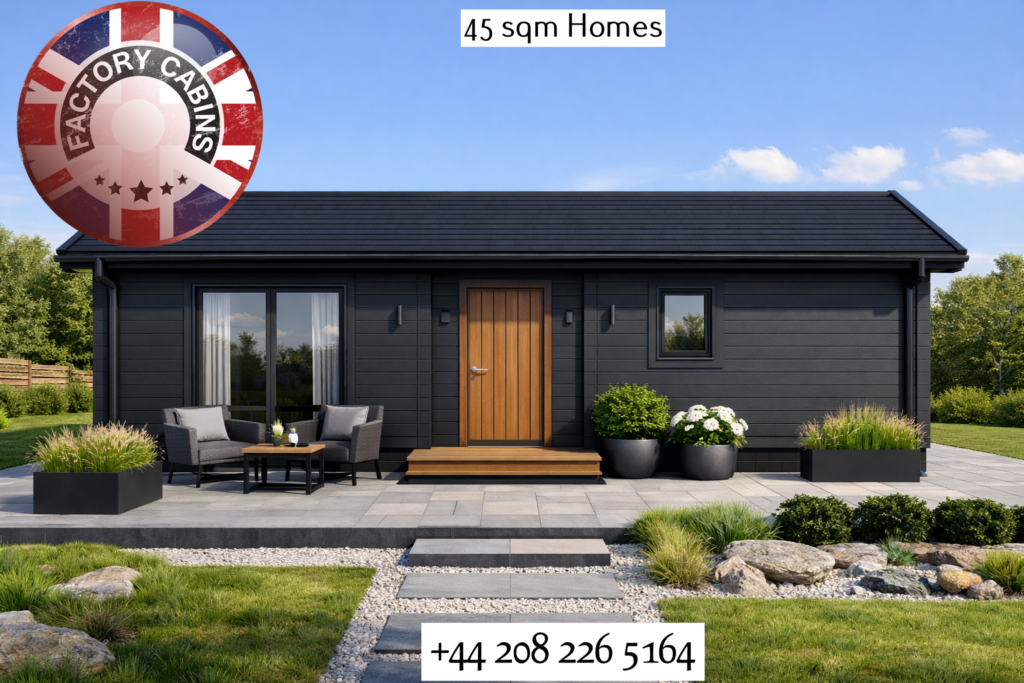
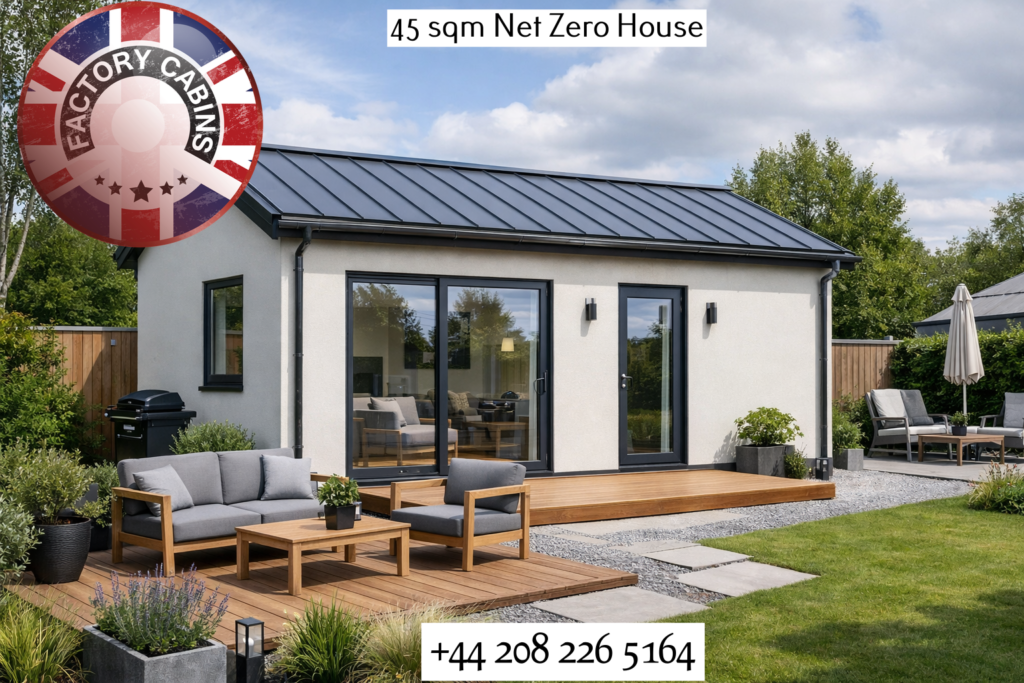
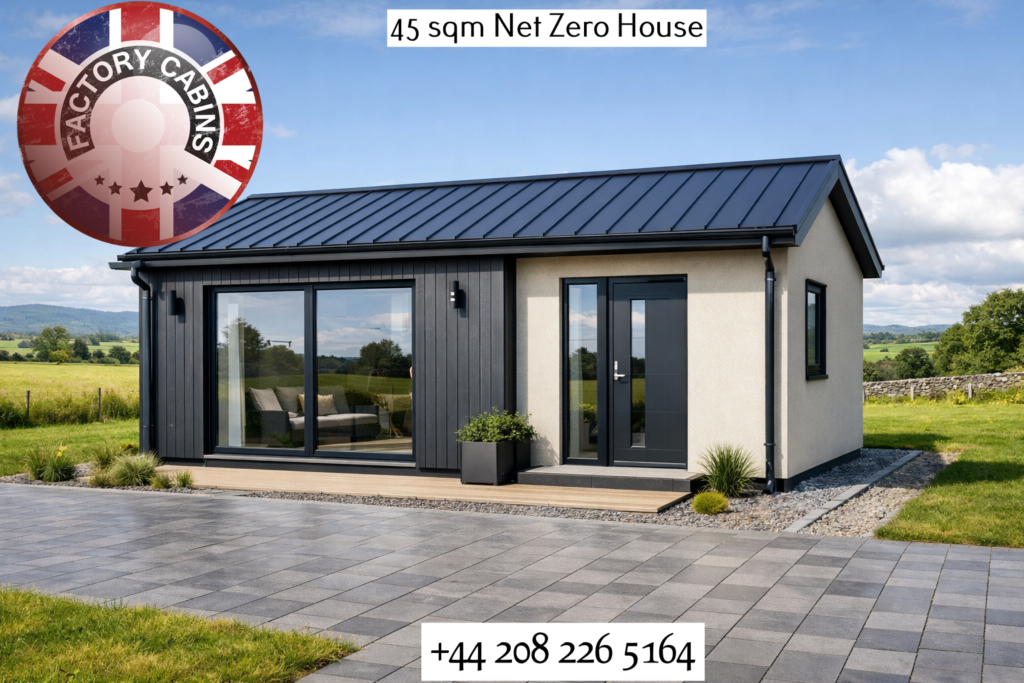
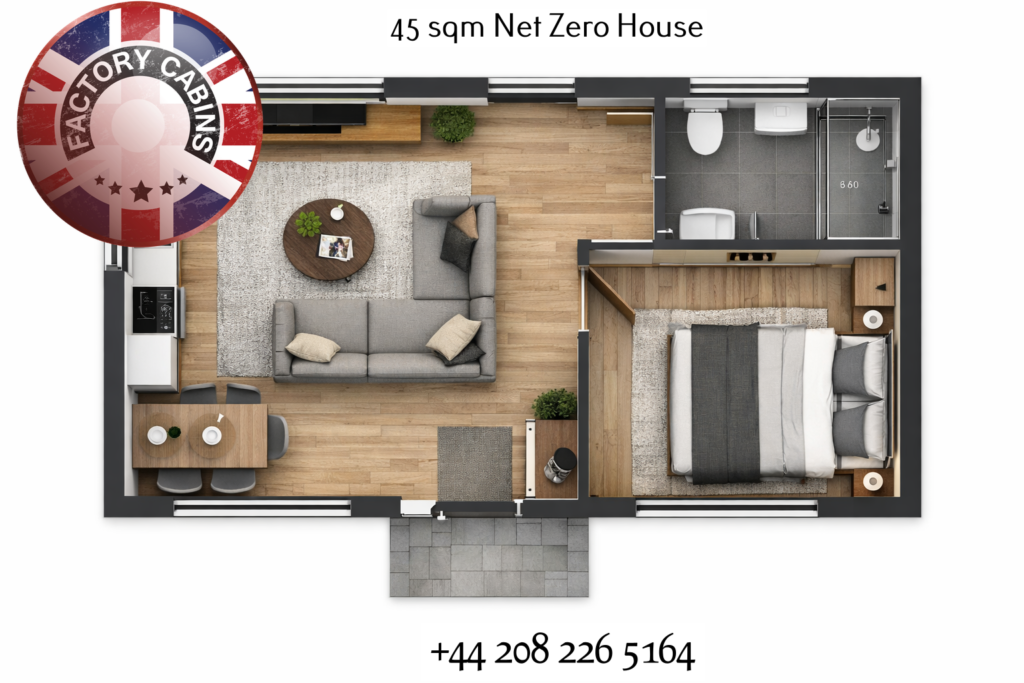
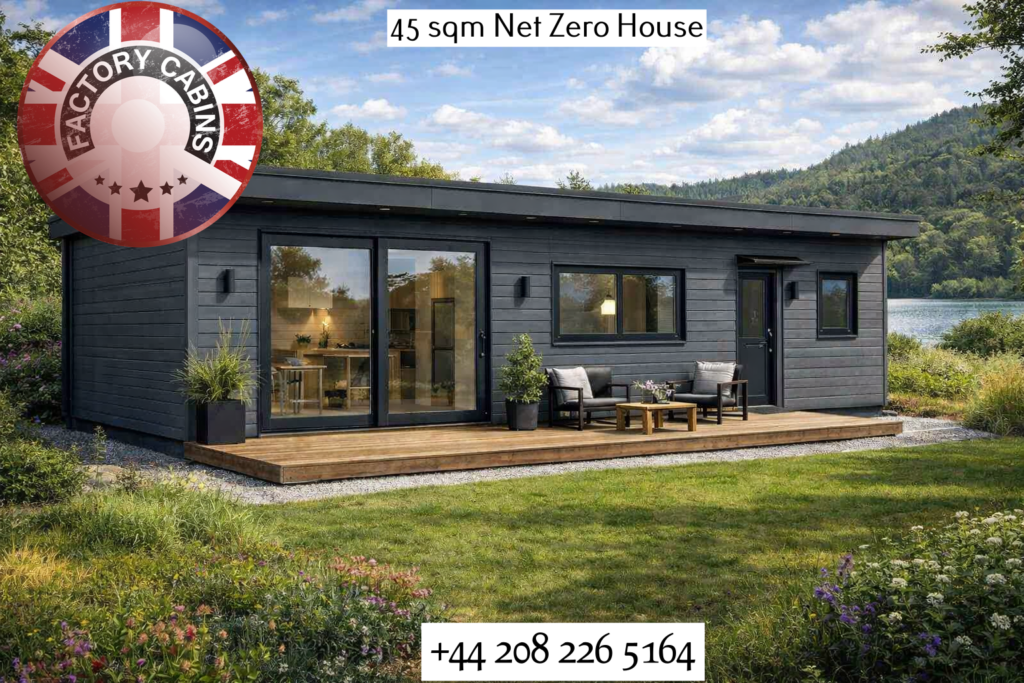
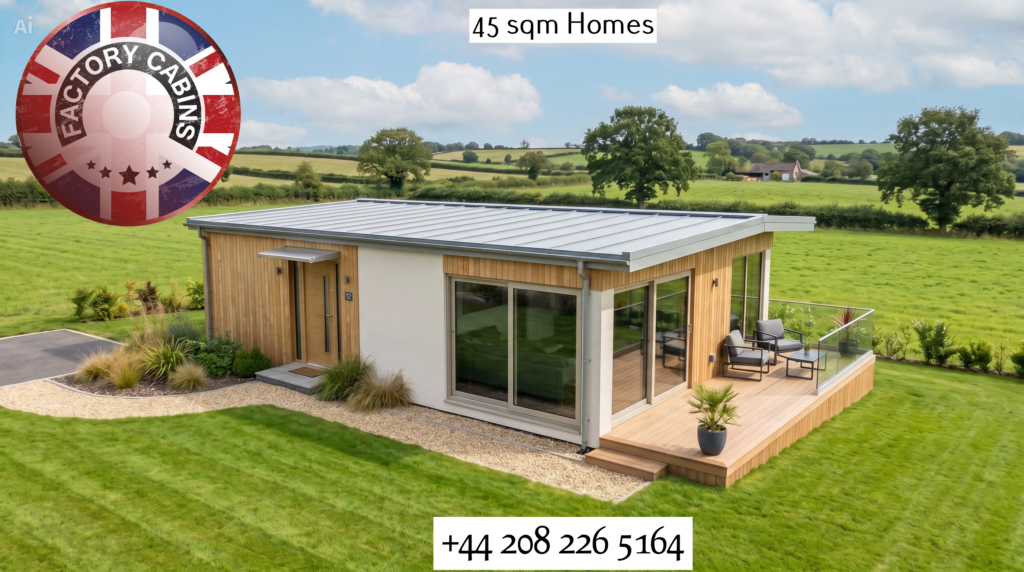
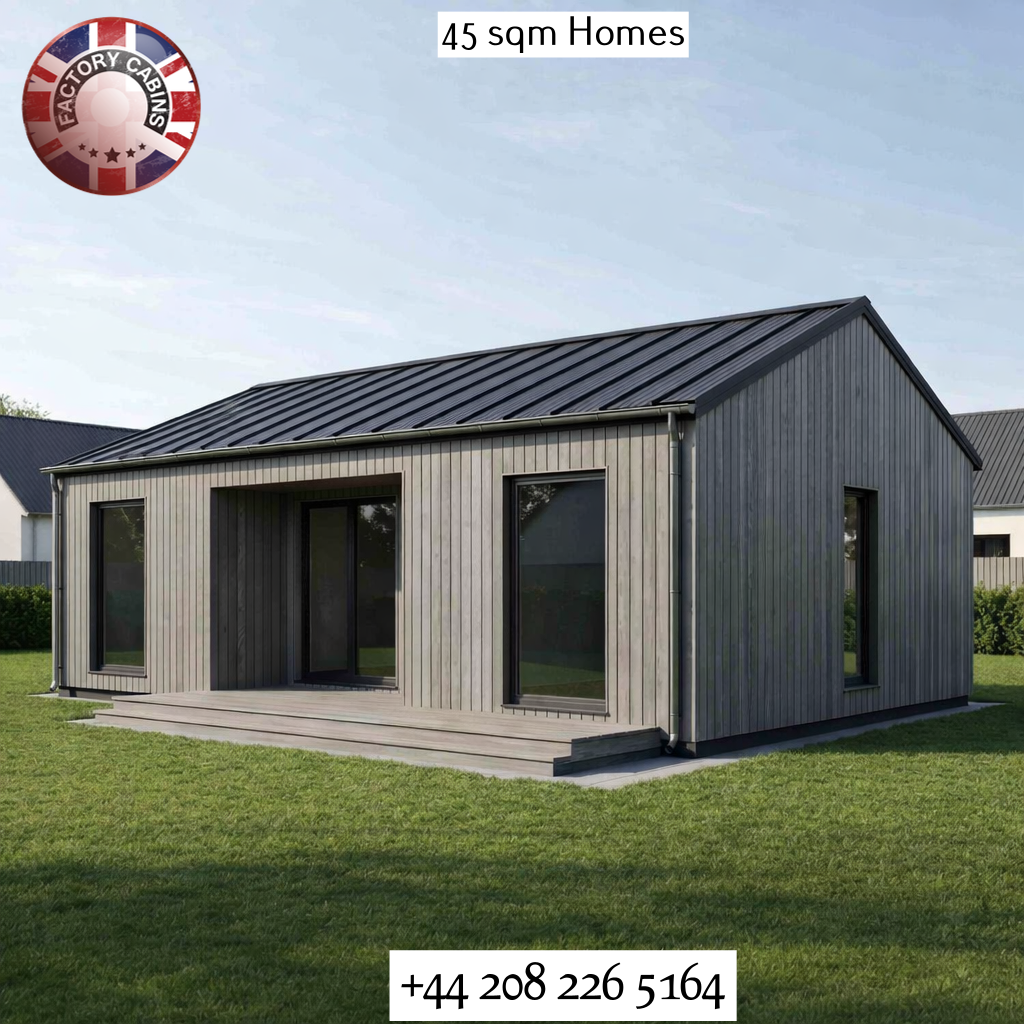
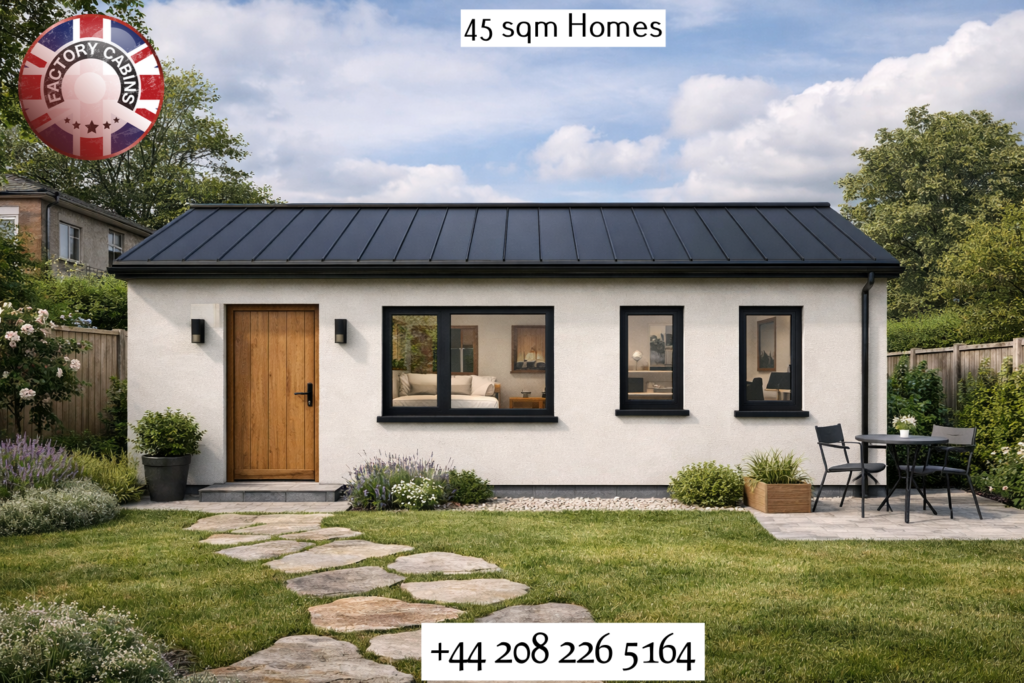
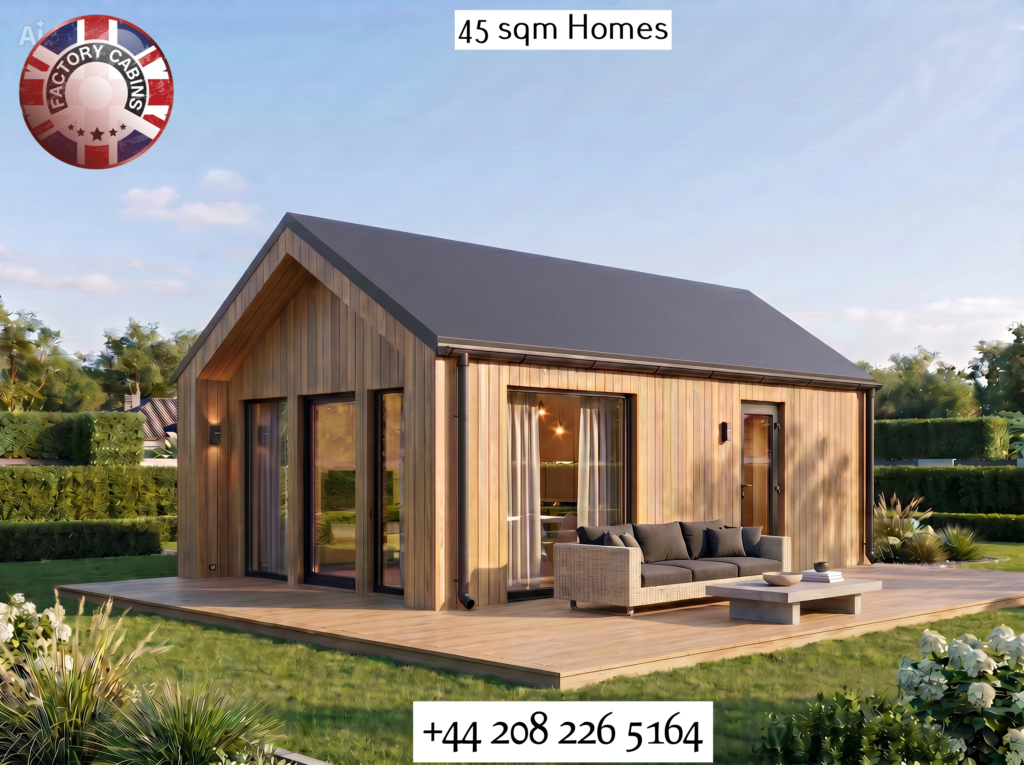
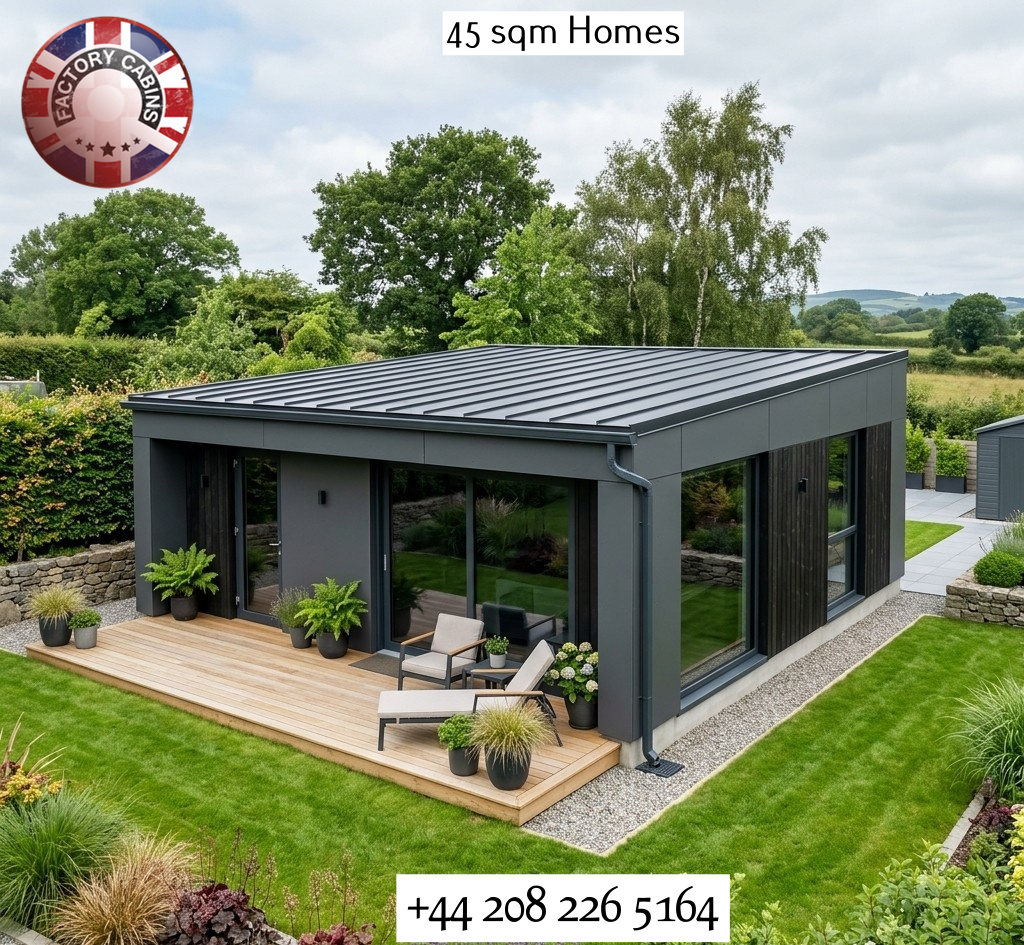
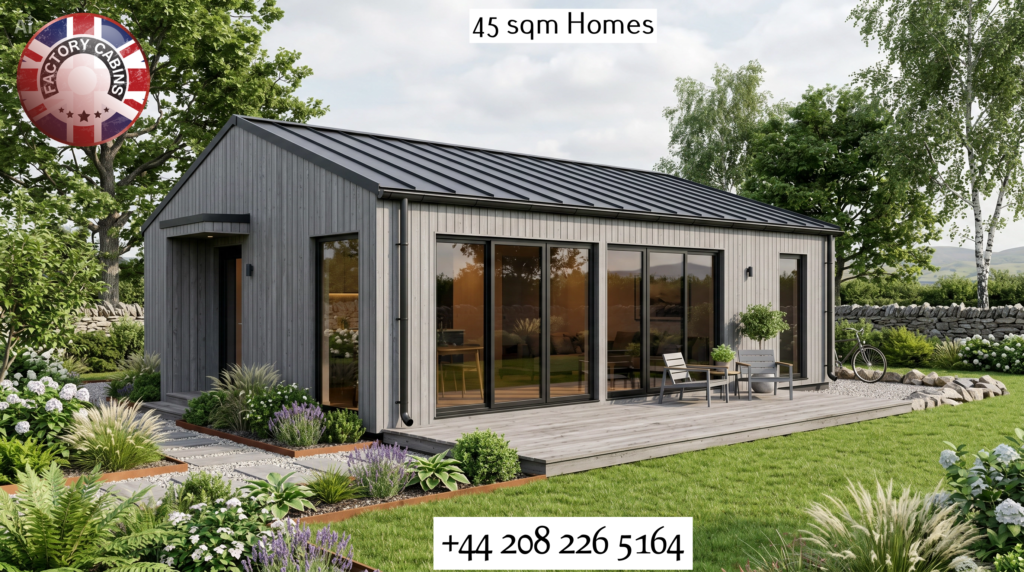
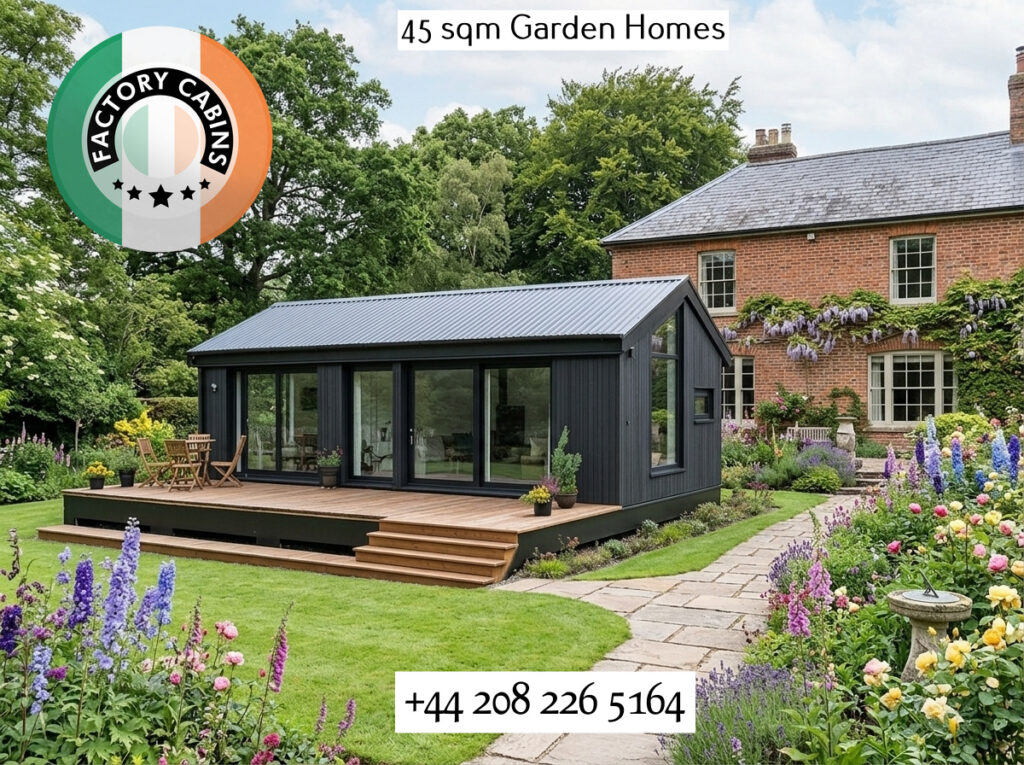
Beyond the 45 sqm Rule: Why Twin-Skin Cabins Are the Best Compliant Choice for Irish Gardens

BUY DIRECTLY FROM SOURCE.

Hi, my introduction to you all is this: you will hunt around the internet, and you will find many companies big and small that know very little about very little. They will say that their buildings are perfect, best price, best ratings, and you can’t find cheaper, and that maybe is the case, but with over 150 building companies in just Southern Ireland going under just last week and more coming, it’s time to think. Understand this new rule of a 45 sq. metre building in your garden is not so simple, but also the prices will rise as building companies will see a massive gap in the market, and now you will get overpricing and lies. If you are looking for a company that really understands you. +44 208 226 5164, so here goes a lot of information, not giving away too much, as I know from over 25 years of experience most dealers won’t know where to begin, and what they build won’t pass the new regulations, especially when it comes to pricing.

So, what’s really going on with the new 45 square metre rule for garden buildings in Ireland? Lately, this announcement has stirred up lively debate all over the country—people everywhere are dreaming about home offices, granny flats, or wellness spaces tucked away in their backyard. The appeal is obvious: more room to breathe, more flexibility, and a step towards greener living.

But hold on—before you run out with a tape measure or start picking from glossy cabin catalogues, it’s worth digging into what this change actually brings. The headline sounds like a free pass to build whatever you want. In reality, it’s not that simple, and there’s a lot more to it than meets the eye. If you ignore the details, you’re not just risking a slap on the wrist; you could end up with a costly headache.

One big misunderstanding right now is the idea that “exempt from planning” somehow means building standards don’t apply. That idea is completely off-base. In Ireland, planning laws and building regulations are two separate things; skipping planning permission doesn’t mean you’re dodging the rules that make a structure safe and sound. Every garden build—even the ones under 45 sqm—has to meet the Building Regulations 1997–2024, covering everything from insulation and ventilation to fire safety and energy use.

Why? Because Ireland’s weather isn’t gentle. It rains; it’s damp; winds batter exposed areas, and winter chills seep into anything not built right. If your new garden room ignores these realities, you won’t just feel a cold draught—you’ll be dealing with condensation, bad air, high heating bills, maybe even a knock from a regulator. The 45 sqm allowance isn’t a loophole for cutting corners; it’s recognition that properly designed garden builds deserve a spot in Irish life.

Now, you’ve probably seen ads for timber kits and prefab cabins promising easy installs and bargain prices. They look lovely—at least, until you realise most weren’t built for Irish standards. A basic log cabin, cute as it is, uses only timber as insulation. That’s fine if it’s just a summer shed, but nowhere near enough for a year-round living space. Without the right insulation, airtightness, proper ventilation, and moisture control, these builds don’t hold up. They’re hot in summer, cold in winter, and prone to condensation. Even worse, many aren’t structurally sound enough for compliance. Plenty of people only find out after pouring foundations and fitting out interiors that their cabin isn’t up to code. Retrofitting is expensive, frustrating, and usually doesn’t solve the problems fully.

That’s where experience matters. At Factory Cabins, we’ve spent years figuring out how timber buildings behave in Ireland. We’ve tested everything—thermal performance, moisture, joints, and compliance checks—to develop a twin-skin system made for Irish regulations from the ground up. ‘Twin-skin’ isn’t a buzzword: it’s a real design choice. We separate the inside and outside timber with a cavity that lets the building breathe, keeps moisture in check, and maintains warmth. The outer layer fends off the elements; the inner layer gives you comfortable interiors. In between, insulation and vapour management do their job. We don’t do flat-pack builds and hope for the best. Every piece is made for compliance, assembled with care, and delivered as a pre-engineered system.

Building for compliance is about focusing on it from the very start—not trying to fix mistakes later. We’ve poured time into matching our cabins with technical requirements: airtightness, insulation, ventilation, fire safety, you name it. We work closely with specialists to make sure our buildings actually meet the Irish standards—not just look good in the garden. That means you get thermal envelopes that keep you warm, ventilation strategies that keep the air fresh, moisture barriers, and systems that work together, not against each other. And we document everything, so you have proof when you need it.

If you choose our cabins, you’re not just buying four walls and a roof—you’re getting a complete system that’s engineered, tested, and ready for scrutiny. All the tricky bits? We handle them, so you get a garden room that’s comfortable, up to spec, and stress-free.

Ireland isn’t all the same, either. Building for sheltered Tipperary or windy Galway are two different beasts. That’s why our cabins aren’t generic. We tune them to suit all sorts of Irish climates, especially in the south, paying attention to local weather, soils, and exposure. We’ve talked with homeowners across Cork, Kerry, Limerick, Clare, Tipperary, and Waterford. Everyone just wants a reliable, good-looking garden room with no sneaky compliance or maintenance worries. They’re tired of risking it on quick-build kits that might crumble under Irish weather.

The 45 sqm rule is just a start. Building standards will only get tighter, and energy demands are rising. If you invest in a garden room that’s already up to code, you’re protecting your future. You won’t have to shell out for costly fixes years down the line. You’ll enjoy clean air, stable temperatures, and peace of mind that your investment will last.

Here’s what you need to know:

  • Just because you don’t need planning permission doesn’t mean building standards vanish. They still apply.
  • Standard log cabins look inviting, but they rarely pass muster for year-round living.
  • Twin-skin construction isn’t just thicker walls. It’s a real system built for Irish requirements.
  • You need paperwork: certified U-values, ventilation strategies, condensation risks, and commissioning certificates. We sort all of this out for you.
  • Experience counts. We’ve already navigated the messy parts, so you don’t have to.

You don’t need to become an expert in insulation or ventilation jargon. Just choose a cabin that’s already designed and documented for compliance. That’s exactly what we offer, and it’s what homeowners in southern Ireland are starting to demand.

In the end, garden buildings aren’t about speed or cheapness anymore—they’re about getting it right. People want homes that last, that perform, that they can trust. They want systems built by people who know their stuff, not just quick fixes. That’s what we’ve spent years preparing for. We’ve refined our designs, improved manufacturing, and created a twin-skin solution that fits Ireland’s building standards and weather challenges.

So, if you’re thinking of a 45 sqm garden room, don’t gamble. Go for a system built for compliance, made for the Irish climate, and crafted for decades of reliability. Your home and garden deserve that level of confidence.

Because honestly, building right the first time is the best investment you’ll ever make.

Please send us an email to sales@factorycabins.com

All bespoke designs are welcome. PLEASE call 020 8226 5164

Best Twin Skin Cabins Holiday Parks

The Twin-Skin Revolution: Why Holiday Parks Are Turning to Factory Cabins

Holiday parks aren’t what they used to be. Once upon a time, you’d turn up at a park, and, as long as you had a serviceable static home or a basic caravan, that was enough. But people expect more now. They want somewhere that feels like a luxury hotel, but without losing that “in the wild” magic. Comfort matters. So does sustainability. Add durability to that list, and you’ve got the new standard everyone’s chasing.

That’s pushed a lot of park owners to upgrade. Not just any upgrade, though—everyone’s after the twin-skin log cabin. And when it comes to these, Factory Cabins leads the way. Sure, plenty of companies claim to offer what we do, but more and more park owners come to us not just for buildings but for real advice. The reason’s pretty simple: we started this. We made the first twin-skin cabins, and we know them inside-out.

Why Twin-Skin Construction Works

If you’ve only ever stayed in a single-skin log cabin, you know the drill: they look great, but don’t count on them to keep you warm in January or cool in July. Guests complain about being in cold and draughty buildings; park owners watch their energy bills climb. It just doesn’t work for today’s market.

Twin-skin cabins flip that script. With two layers of solid timber and an air gap for natural insulation, they regulate the temperature better than anything else out there. Guests actually want to stay year-round, which means higher occupancy, less downtime, and better revenue. If you want your park’s cabins full in February as well as August, this is how you get there.

The Factory Cabins Difference

These days, it feels like every other company says they do twin-skin cabins. But do they have the history? We don’t just build them—we invented the category. That comes with real experience. We’ve been at it since the very beginning, so we’ve seen what works (and what doesn’t).

That’s why park owners lean on us. They’re not just buying cabins—they need information. How should they lay out the site? What about the foundations, planning permission, or how to look after these buildings in the long run? We’re not just here to sell you something and vanish. We’re in it for the long haul, guiding you through the whole process. That’s turned a lot of one-time buyers into long-term partners.

Why 70 mm x 70 mm Matters

Most cabin specs are just numbers on a page. But not all logs—or all twin skins—are the same. Factory Cabins uses 70 mm x 70 mm logs, inside and out. That means the whole wall is solid, through and through. Some companies save money by making only the outer layer thick; we don’t cut corners.

What does that mean for you? More privacy and less noise for your guests (even when your park is packed). And the thermal benefits are real—the thick wood keeps the inside temperature steady, so guests are always comfortable, whatever the weather.

Cabins That Stand Up to British Weather

Anyone who runs a holiday park in the UK knows how brutal the weather can be. Coastal wind. Driving rain. Snow one day, a heatwave the next. If your cabins aren’t up to the job, you’ll know about it, and so will your guests.

That’s why our builds are tested for wind speeds up to 140 mph. Our logs lock together tight, keeping water out and warmth in. We know that park owners worry about structural problems in a storm. When you choose Factory Cabins, that concern disappears. These cabins are built to last—year in, year out.

A Smart Investment

Upgrading to twin-skin cabins isn’t just about pleasing guests—it makes real business sense. Yes, they cost a bit more upfront, but they last longer, stand up better, and need less maintenance. Fewer repairs means fewer headaches.

Plus, the energy savings and sustainability factor help you stand out. Eco-friendly travel isn’t just a buzzword anymore. Guests will pay more for an eco-lodge that feels like a treat. Factory Cabins helps you deliver exactly that.

Ready to Partner?

Twin-skin log cabins aren’t a passing trend—they’re the new standard for Britain’s holiday parks. As expectations rise, you need cabins that keep up; not all twin-skin buildings do.

As the original makers, Factory Cabins bring unrivalled experience to every project. Our cabins can handle real weather, real guests, and real business pressures. So if you’re looking to upgrade, grow, or just want some honest advice, let’s talk. Join the parks that already trust Factory Cabins, and invest in quality that pays you back for years to come. Choose the team that started it all. Choose Factory Cabins.

Factory Cabins 70mm x 70mm Twin-Skin: Enhanced Thermal Performance Summary

Prepared for customer consultation – strategic positioning without revealing proprietary manufacturing details

Thermal Performance: Updated U-Values (Enhanced Specification)

Some details might be missing, this is to make other manufacturers do their work, not copy ours!

Building ElementUpdated SpecificationCalculated U-ValueIndustry Standard Comparison
Walls70mm + 70mm Swedish spruce + 00000 Knauf Insulation Expert cavity0.11–0.13 W/m²KSingle-skin 70mm log: ~1.41 W/m²K; Standard timber frame: ~0.30 W/m²K
RoofTwin roof structure + 350mm Knauf insulation + 00000 ventilated void0.08–0.10 W/m²KStandard insulated roof: 0.18–0.25 W/m²K
FloorInsulated base + 00000 Knauf Insulation Expert0.10–0.13 W/m²KTypical suspended timber floor: 0.25–0.35 W/m²K
Windows/Doors26mm toughened double glazing, glulam frames, German hardware, tilt-and-turn1.0–1.2 W/m²K (whole unit)Standard double glazing: 1.2–1.6 W/m²K
Overall Building EnvelopeFully sealed with 3-coat yachting varnish, bolted joints every 2m≤0.12 W/m²K averageBS 3632:2023 requirement: ≤0.26–0.30 W/m²K for walls

Structural Integrity: KN Load Capacity & Engineering Advantages

FeatureFactory Cabins SpecificationTypical Market AlternativePerformance Advantage
Wall Load CapacityTwin 70mm x 70mm interlocking Swedish spruce, bolted every 2m + apex screws (0000 x 0000)Single-skin logs, nailed or loosely interlocked≥15–18 kN/m vs. ~9.4 kN/m standard log wall
Wind ResistanceCNC-precision interlock + mechanical bolting + yachting varnish sealBasic interlock or screw-only assemblyRated for 140+ mph sustained winds; eliminates air infiltration
Settlement ControlKiln-dried winter-cut Swedish spruce (16–18% MC) + twin-skin redundancySummer-cut timber, higher moisture content, single-skinNear-zero post-installation movement; maintains thermal seal integrity
Joint IntegrityBolted connections every 2m Rods + apex screw reinforcementNails, staples, or minimal mechanical fixingPrevents “racking” under lateral loads; critical for 10m x 10m spans

🔒 Why This Matters: Structural strength isn’t just about standing up—it’s about staying sealed. A cabin that shifts loses its thermal performance. Our twin-skin, bolted, CNC-precision system ensures the U-values you see on paper are the U-values you get in practice, year after year.

Comparative Advantage: Why Factory Cabins Leads the Market

1. The Twin-Skin Difference (Engineered, Not Just “More Wood”)

  • Most competitors offer “twin-skin” as two thin logs with minimal cavity. Ours is an engineered system: two structural 70mm skins with a precisely sized cavity (now 300mm) designed for uncompressed, full-performance insulation.
  • Compression kills insulation performance. Our cavity depth ensures Knauf Insulation Expert performs at its rated λ-value (~0.033 W/mK), not a degraded value from being squeezed.

2. Material Science: Swedish Spruce vs. “Generic Softwood”

  • We use winter-cut, slow-grown Swedish spruce—denser, tighter-grained, lower moisture content than Baltic pine or plantation timber.
  • Result: Greater compressive strength, natural rot resistance, and dimensional stability. This isn’t marketing—it’s material physics.

3. The Seal That Makes the System Work

  • Three coats of yachting varnish aren’t cosmetic. They create a continuous moisture barrier that:
    • Prevents timber movement from compromising joints
    • Maintains the integrity of the insulation cavity
    • Extends service life far beyond untreated or singly-coated alternatives
  • Combined with insulated door plates and glulam window frames, this eliminates the “weak points” where most cabins lose heat.

4. BS 3632 Compliance—Exceeded, Not Just Met

  • Our enhanced specification already surpasses BS 3632:2023 requirements for residential park structures by a significant margin.
  • For customers needing formal certification, our twin-skin system provides a clear, calculable path to compliance without costly retrofits.

Quick Reference: U-Value Summary Table (Enhanced Spec)

ComponentFactory Cabins (70mm x 70mm Twin-Skin, Enhanced)Standard Single-Skin 70mm LogTypical Timber Frame
Wall0.11–0.13 W/m²K~1.41 W/m²K~0.30 W/m²K
Roof0.08–0.10 W/m²K~0.25–0.35 W/m²K~0.18–0.25 W/m²K
Floor0.10–0.13 W/m²K~0.30–0.40 W/m²K~0.25–0.35 W/m²K
Glazing (whole unit)1.0–1.2 W/m²K~1.6–2.8 W/m²K~1.2–1.6 W/m²K
Whole Building Avg.≤0.12 W/m²K~1.0+ W/m²K~0.25–0.30 W/m²K

Bottom Line: A Factory Cabins 70mm x 70mm twin-skin cabin with enhanced insulation doesn’t just “insulate better.” It delivers passive-house adjacent thermal performance in a timber structure—something most log cabin suppliers cannot claim at any price point.

Customer-Facing Talking Points (Concise)

  • “Our twin-skin system isn’t two walls—it’s one engineered thermal barrier. The 300mm cavity isn’t empty space; it’s where performance lives.”
  • “U-values below 0.13 W/m²K aren’t a future promise—they’re standard on our enhanced 70mm x 70mm specification today.”
  • “Strength isn’t just about thickness. It’s about how the pieces lock together. Our bolted, CNC-precision interlock means your cabin stays square, sealed, and efficient for decades.”
  • “We don’t just meet BS 3632—we design beyond it. If you ever need formal certification, you’re already ahead.”
  • “Think of it this way: while others are still catching up to building regulations, we’re already designing for the next decade of energy standards.”

Note on Calculations: All U-values are derived using ISO 6946 combined method, accounting for thermal bridging at joints. Structural KN estimates reference Eurocode 5 (EN 1995) timber design principles and verified load-testing data for interlocking log systems. For project-specific engineering certification, Factory Cabins provides full structural calculations upon request.

Lastly.

Factory Cabins Twin-Skin: Net-Zero Readiness Assessment

Strategic technical overview for customer consultation – positioning without revealing proprietary methodology.

What “Net-Zero” Actually Means for Buildings

TermDefinitionRelevance to Your Cabin
Operational Net-ZeroAnnual energy use for heating, cooling, lighting, and hot water is balanced by on-site renewable generationAchievable with our twin-skin + modest solar/MVHR
Whole-Life Net-ZeroIncludes embodied carbon in materials, construction, and end-of-lifeSwedish spruce is low-carbon, renewable, and stores carbon
Net-Zero ReadyBuilding fabric is so efficient that adding renewables easily achieves net-zeroThis is where Factory Cabins twin-skins sit today

💡 Key Positioning: We don’t just approach net-zero—we engineer the foundation that makes net-zero simple, affordable, and reliable.

Thermal Performance vs. Net-Zero Benchmarks

Standard / BenchmarkWall U-ValueRoof U-ValueFloor U-ValueAir TightnessWhole-Building Heat Demand
UK Building Regs (Part L)≤0.26 W/m²K≤0.16 W/m²K≤0.18 W/m²K≤5.0 m³/h·m² @50Pa~45–55 kWh/m²/yr
BS 3632:2023 (Park Homes)≤0.30 W/m²K≤0.20 W/m²K≤0.25 W/m²KNot specified~60–70 kWh/m²/yr
Passivhaus Classic≤0.15 W/m²K≤0.10 W/m²K≤0.15 W/m²K≤0.6 ACH @50Pa≤15 kWh/m²/yr
LETI Climate Emergency≤0.12 W/m²K≤0.10 W/m²K≤0.12 W/m²K≤1.0 ACH @50Pa≤20–35 kWh/m²/yr
Factory Cabins (Enhanced Twin-Skin)0.11–0.13 W/m²K0.08–0.10 W/m²K0.10–0.13 W/m²K~0.8–1.2 ACH @50Pa (estimated)~12–18 kWh/m²/yr (modelled)

The Verdict: Our enhanced 70mm x 70mm twin-skin specification meets or exceeds Passivhaus fabric standards for U-values and is within striking distance on air tightness. This isn’t “close to net-zero”—this is net-zero ready fabric.

Why Twin-Skin Design Is the Net-Zero Advantage

1. Thermal Bridging: Eliminated, Not Just Reduced

  • Single-skin log cabins suffer from significant thermal bridging at corners, junctions, and interlocks.
  • Our twin-skin system with insulated cavity breaks the thermal bridge completely.
  • Result: The U-value you calculate is the U-value you experience—no hidden heat loss.

2. Air Tightness: The Seal That Makes Efficiency Real

  • Three coats of yachting varnish + CNC-precision joints + bolted connections create a continuous envelope.
  • Estimated air permeability: 0.8–1.2 m³/h·m² @50Pa—comparable to certified Passivhaus builds.
  • Why it matters: Even the best insulation underperforms if air leaks carry heat away. We seal the system.

3. Material Carbon: Swedish Spruce Is a Carbon Store

  • Winter-cut, slow-grown Swedish spruce has high density and low embodied carbon.
  • Timber sequesters ~0.9 tonnes CO₂ per m³—your 10m x 10m cabin stores several tonnes.
  • Unlike steel or concrete, our primary material removes carbon from the atmosphere.

4. Future-Proof Flexibility

  • The 250mm roof void and twin-skin cavity allow easy retrofit of:
    • MVHR (Mechanical Ventilation with Heat Recovery) ducting
    • Additional insulation if standards tighten further
    • Solar-ready roof structure with integrated cable management

Pathway to Full Operational Net-Zero

Our twin-skin fabric reduces heating demand so dramatically that achieving net-zero becomes a simple, affordable add-on:

ComponentSpecificationImpact
Base FabricEnhanced twin-skin (as above)Heat demand: ~12–18 kWh/m²/yr
+ MVHR Unit90%+ heat recovery efficiencyEliminates ventilation heat loss; maintains air quality
+ Air Source Heat PumpSmall 3–6 kW unitProvides heating + hot water at 300–400% efficiency
+ Solar PV3–5 kWp roof arrayGenerates ~2,500–4,000 kWh/yr—typically exceeds annual energy use
= Operational Net-ZeroAnnual energy balance achievedNo grid dependence; potential income from export

💡 Customer Message: “With our twin-skin as your foundation, adding net-zero capability isn’t a major renovation—it’s a weekend upgrade.”

Comparative Heat Demand: What This Means in Practice

Building TypeAnnual Heating Demand (kWh/m²)Estimated Annual Heating Cost*CO₂ Emissions (kg/m²/yr)
Standard 70mm Single-Skin Log Cabin~85–120£800–£1,400~25–35
Typical Timber Frame (2020 Regs)~35–45£350–£500~10–14
BS 3632 Park Home~40–55£400–£600~12–17
Factory Cabins Enhanced Twin-Skin~12–18£120–£200~3–5
Passivhaus Certified≤15£100–£180≤4

*Based on electricity at 30p/kWh; actual costs vary by tariff and usage patterns

🔑 Takeaway: Our twin-skin reduces heating costs by ~80% compared to standard log cabins and ~60% compared to current-regulation timber frames. That’s not just efficiency—that’s financial resilience.

Customer-Facing Net-Zero Messaging (Concise)

  • “Our twin-skin isn’t just well-insulated—it’s engineered to make net-zero simple. Add solar and a heat pump, and you’re there.”
  • “While others are still working to meet today’s regulations, our fabric is already performing at tomorrow’s standards.”
  • “Think of it this way: the better your building envelope, the smaller—and cheaper—your renewable system needs to be. We’ve done the hard part.”
  • “Swedish spruce doesn’t just build your cabin—it stores carbon. Your Factory Cabin is a climate solution from day one.”
  • “Net-zero isn’t a distant goal with us. It’s a specification choice.”

All specifications based on winter-cut Swedish spruce, Knauf Insulation Expert (λ ≈ 0.033 W/mK), and Factory Cabins proprietary assembly methodology. Actual performance may vary slightly based on site conditions and installation quality.

Please send us an email to sales@factorycabins.com

All bespoke designs are welcome. PLEASE call 0208 226 5164

Becoming a Premium Log Cabin Dealer

Become a Premium Log Cabin Dealer: Why Swedish Spruce, Twin-Skin Engineering, and Deep Industry Knowledge Matter More Than Ever

Partnering for Excellence: The Truth About Timber, The Power of Knowledge, and Becoming a True Log Cabin Dealer

The first part of you wanting to join our team, is reading, and thats going through https://www.logcabinslv.co.uk/blog/, this is a must, this will prepare yourself for our questions, not us yours. We are extreamly serious about this, we want to understand you, as you are selling our product, not us yours, we need you to understand that to have a great business with Factory Cabins products, you are not just selling the best log cabins available on the market, you can even bespoke them up to a Net Zero build. Also our twin skin 70mm x 70mm can withstand a hurricane 3, which means from 111 to 129 mph. We are even able to up the strength, if needed.

So, we need to understand is, what you have to offer us, and what your customer needs are.,

Welcome! If you’re reading this, you’re probably at a turning point in the timber building world. Maybe you’ve seen those flashy ads, “too good to be true” deals, or companies bragging about being “fully booked” when, honestly, they’re just slashing prices to keep business moving. Perhaps you’re thinking about becoming a dealer, searching for a product you can genuinely stand behind—something with real value, durability, and a solid reputation.

First off, thank you for considering us. We appreciate the time, the energy, and the curiosity you’re bringing to this partnership. We’re Factory Cabins—a UK-based company with manufacturing roots in Lithuania, dedicated to log cabins, timber frame buildings, and camping pods that redefine quality in this industry. We don’t just sell buildings; we engineer homes, offices, and retreats meant to last generations. Our care extends to the product, the process, and the people we work with, so let’s be upfront about what becoming a dealer really involves. It’s more than a sales gig—it’s a pledge to craftsmanship, openness, and partnership that lasts.

https://www.logcabinslv.co.uk/blog

Before you pick up the phone, take a moment to read this guide. We wrote it with honesty and warmth, laying out a clear path so you can figure out if this journey makes sense for you—and if it does, how to prepare for a meaningful chat with us. Like we always say, “cheap is cheerful,” but in our world, “buy cheap twice.” We want partners who understand that difference.

Wall Thickness Reality: Why 28mm and 35mm Are Outdated

Let’s start with the basics: What makes a log cabin a real structure? At its core, it’s a precision-made timber building that blends with nature but stays strong, comfortable, and thermally stable. But not all timber buildings are the same. One of the biggest myths in our industry? Wall thickness.

You’ll still spot companies pushing 28mm or 35mm log walls as “standard,” “budget-friendly,” or “just right for garden rooms.” Let’s be clear—today, with energy costs rising and stricter standards, selling thin walls like 28mm or 35mm just won’t cut it anymore.

Yes, a 28mm or 35mm wall might look like a real cabin in a glossy brochure, but it doesn’t have the mass, stability, or insulation needed for year-round use. Timber breathes, expands with moisture, contracts in dry weather, and shifts as seasons change. Thin walls amplify these movements, creating gaps, drafts, moisture problems, and eventually, structural fatigue. More importantly, they’re poor insulators. That sends heating bills through the roof, causes condensation in wall cavities, and turns the cabin into a cold, uncomfortable space. This isn’t a glorified shed—it’s a place where people live, work, relax, and sometimes sleep. If the walls can’t keep things warm, dry, and sturdy, you’re selling headaches—not homes.

Our Standard: Swedish Spruce and Superior Dimensions

We’ve taken a different approach. We don’t compromise on materials or on what defines a quality building. Partnering with us means you stand behind a product line built only from winter-cut, slow-grown Swedish spruce.

https://www.logcabinslv.co.uk/blog

Why Swedish spruce? Because it’s dense, stable, and has great insulation—better than other softwoods. And just so you know: We don’t use Baltic pine. While Baltic pine works for some things, Swedish spruce is the gold standard for year-round comfort and performance. It resists warping and stays square, sealed, and secure for decades.

We’ve left flimsy standards behind. Here’s what we actually manufacture:
44mm solid log cabins ( for garden sheds, or a summer garden office).
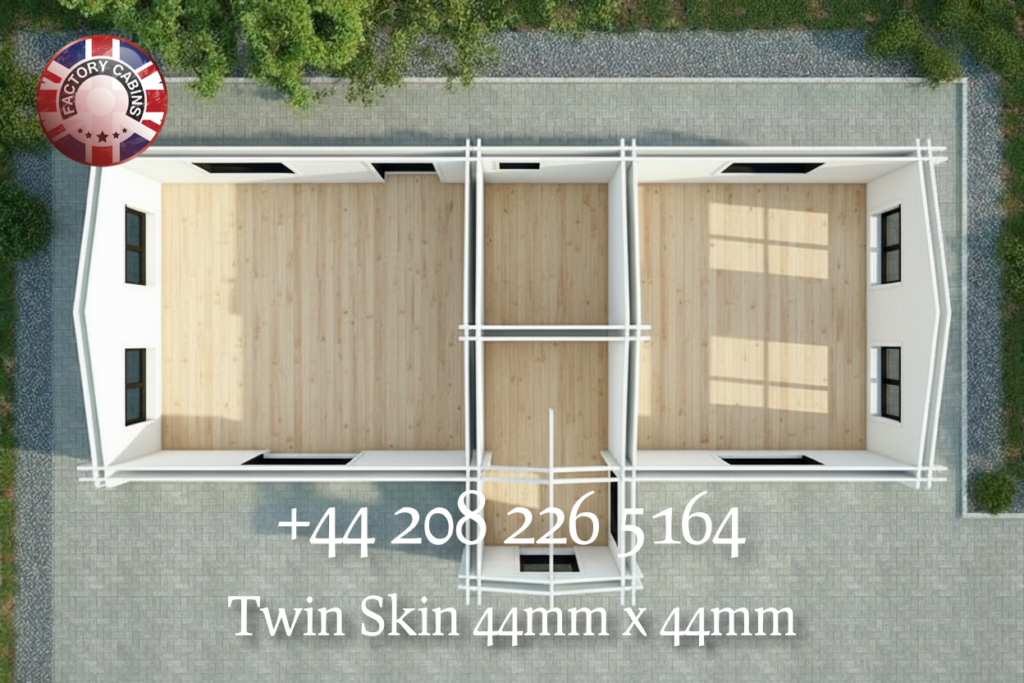
44mm x 44mm twin-skin log cabins, for all year round.
70mm solid log cabins the same as a 44mm, but slightly more robust.
70mm x 70mm twin-skin log cabins, this is more than a cabin, its the future in so many ways.

These aren’t just numbers—they’re a promise of performance. Whether it’s 44mm or 70mm single skin, or our advanced twin-skin systems with an insulating air gap, our cabins are built for the rugged British climate.

The Twin-Skin Advantage: Designed for Extreme Weather

If you’ve done your research, you know our twin-skin system isn’t a minor tweak—it’s a total rethink on how timber cabins should perform. Traditional log cabins rely on solid timber, which sounds charming until reality hits: logs settle, gaps show up, insulation is botched, and weatherproofing is a constant struggle.

Our twin-skin cabins fix all that from the beginning. They feature precision outer and inner layers of Swedish spruce, locking into a tight, thermally superior shell. The timber gives the building its strength and beauty, while the layered skins provide consistent insulation, manage moisture, and resist wind. At the same time, this doesn’t block breathability.

https://www.logcabinslv.co.uk/blog

We don’t just design cabins to look pretty in summer. We make them handle winter, survive spring storms, manage autumn humidity, and stand strong for decades. Our cabins are engineered and tested to withstand hurricane-force winds. That’s not sales talk—that’s real engineering. So, if a customer asks, “Will this survive severe weather?” you’ll have the answer, with confidence, proof, and clear documentation.

Bespoke Excellence: Windows, Doors, and Total Customization

Another mistake lots of dealers make? They only sell what’s sitting in the warehouse, whether or not it matches what the customer wants. At Factory Cabins, we believe in full customization.

We make all our own windows and doors, never outsourcing these critical parts. That means total control over quality, fit, and finish—German hardware, full tilt-and-turn action, toughened double glazing (usually 28mm) for both security and insulation.

Even better, we can make any window shape or size you want. Arched windows? Circular portholes? Floor-to-ceiling glass walls? Triangular gables? If you can sketch it, we can make it. That means you can offer a true bespoke service—no limits to boxy catalog designs. You get to work with architects, homeowners, and businesses, crafting unique buildings that fit their needs. From net-zero energy buildings to luxury camping pods and complex timber frames, our CNC machines make even the wildest visions accurate and real.

Reading the Market: Slowdowns and Why Cutting Corners Is Dangerous

Right now, the timber building market is cooling off a bit. Orders are slowing, and that’s industry-wide. Still, visit company websites and you’ll see claims like, “Fully booked!” “Limited slots!” “Huge summer sale!” Sound familiar?

https://www.logcabinslv.co.uk/blog

Let’s be honest: When a big company with fleets of trucks suddenly slashes prices by 30%, 40%, or even 50%, it’s rarely because they’re more efficient. It’s usually because orders are drying up and they still need to cover fixed costs. Where do they cut? Unfortunately, it’s often in places customers won’t notice right away: substituting lower-grade timber (like Baltic pine for Swedish spruce), using thinner walls, simplifying joinery, skipping treatments, and rushing production.

As a dealer, your reputation depends on the product you sell. When a company cuts corners to protect profits during slow times, you’re left handling unhappy customers—dealing with warped walls, leaky roofs, or dodgy warranties. We believe pricing should be honest, not desperate. And transparency builds trust.

Knowledge Matters: Why Fundamentals Are Key

Now, let’s get serious, respectfully: You can’t successfully sell structural timber buildings without understanding the fundamentals.

Most people who reach out know nothing about the industry. They haven’t learned how timber behaves, how foundations bear weight, how moisture moves, or why ventilation is vital. That’s never a good start. You’re not selling flat-pack furniture or garden ornaments; you’re selling a structure that, if put together wrong, could hurt someone. Wind uplift, snow build-up, foundation settling, thermal bridges—these are real, not abstract. They’re physics. They matter.

That’s why we require you to have at least some knowledge before seriously discussing becoming a dealer.

So how do you get this knowledge? By reading our blog. It’s massive—probably the world’s biggest resource on timber buildings. It covers everything: the story of Swedish spruce, how twin-skin cabins go together, dangers of thin walls, advantages of German hardware—you name it. We spent years building up this information because educated dealers succeed.

When you contact us, we’ll ask questions. Can you explain the difference between our 44mm twin-skin and a standard 28mm cabin? Why is Swedish spruce better than Baltic pine? How does our custom window manufacturing work? If you can’t handle these basics, please don’t waste your time calling us. It’s a sign you’re not prepared and don’t respect the seriousness involved.

But if you’ve read our blog and understand things like grain orientation, moisture control, flashing, and roof pitch, you’re ready. You get that we’re not just selling wood—we’re selling safety, comfort, and lasting value.

How We Support You: Help Line, Not Build Line

One thing dealers hate? Getting abandoned after the timber leaves the yard. You sell a cabin, it arrives, the customer builds, something doesn’t fit, and suddenly you’re the engineer, project manager, and customer service rep. That’s not real partnership.

That’s why our support model is different. We run a help line, not a build line.

Here’s the difference: A build line throws you a phone number and says, “Good luck!” A help line connects you with experienced timber builders, structural advisors, and technical experts who know every step of the build. If a customer runs into trouble mid-build, we don’t send a generic email—we walk you through the plan, go step-by-step, clarify how to seal, distribute weight, and finish safely.

Our plans are detailed. They walk you from the first foundation plate to the final roof ridge, calling out torque specs, moisture checks, safety tips, and more. You’ll never be left in the dark. You’ll be supported, trained, and confident to deliver results every time.

What You Should Know Before Calling Us

We’re friendly and approachable, and we love meeting people who share our passion. But to make the conversation worthwhile, make sure you can clearly answer these questions:

https://www.logcabinslv.co.uk/blog

Can you explain to a buyer why 28mm or 35mm walls aren’t good enough, compared to our 44mm or 70mm Swedish spruce?
Do you understand how our twin-skin cabins provide storm resistance and top-notch insulation?
Have you read our blog, and can you reference at least three technical concepts to prove you understand timber building science?
Do you know we make all our windows and doors in-house and can create custom shapes and sizes?
Do you value long-term partnerships and reputation over fast commission or quick sales?
If you’re saying “yes,” we’d love to talk to you. If you’re still learning, that’s fine—take the time to read, watch, and understand the reasoning behind every design decision. This business rewards patience, preparation, and integrity. And when you’re ready, we’ll be here, excited to welcome you.

A Partnership That Means Something

The timber building market might be slowing down, but the need for genuine quality gets stronger. People are tired of thin walls, misleading deals, and companies who disappear after payment. They want honesty, transparency, and a building that works, keeps them safe, and looks great for decades.

That’s what we build. That’s what we stand for. When you join us as a dealer, you’re representing a standard—not just moving boxes. You’re guiding customers to make smart, safe investments.

https://www.logcabinslv.co.uk/blog

So take a breath, dive into our blog, learn why Swedish spruce beats Baltic pine, see the power of 70mm twin-skin walls, and come prepared. We’re ready to support you with custom services, in-house manufacturing, and unwavering quality.

Thanks for your time, your curiosity, and your commitment to doing things the right way. We’re grateful you’re considering us, and eager to welcome partners who share our vision for timber buildings—done right, done safely, and done with pride.

Please send us an email to sales@factorycabins.com

All bespoke designs are welcome. PLEASE call 0208 226 5164

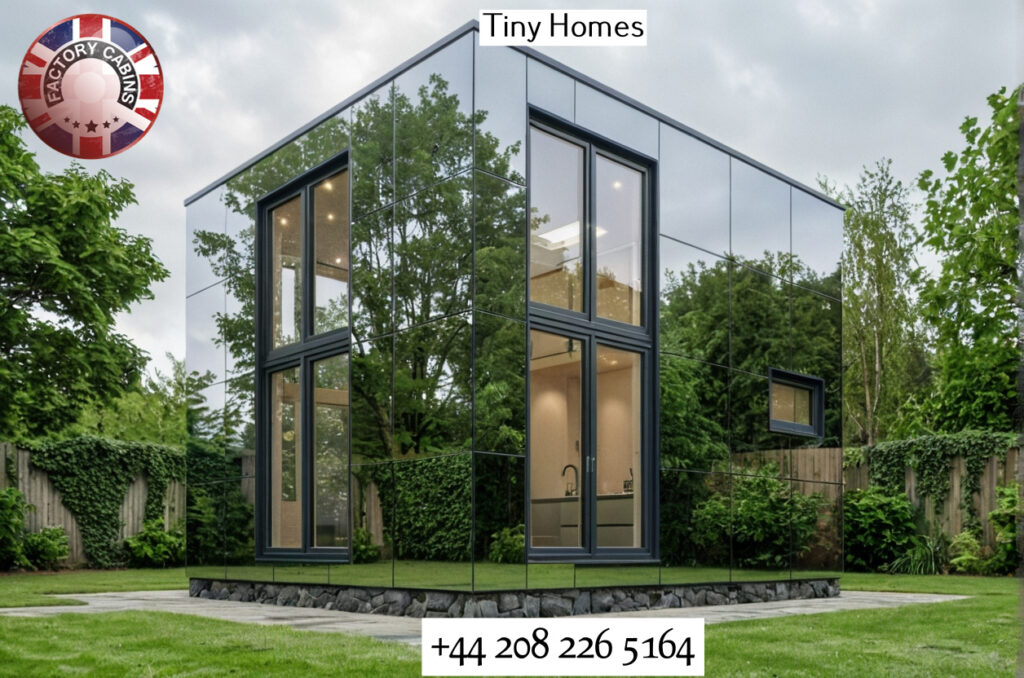
The Micro House Mirage: Why Timber-Frame Is the Real Small Home Solution

Micro Houses, and the Truth.

The idea of living small is everywhere now. Scroll through Instagram, flip through a magazine, or listen to a podcast, and you’ll see these dreamy promises: step into a tiny, perfectly designed cube, sphere, or pod—embrace radical simplicity, toss out the mortgage, and forget about endless maintenance chores and wasted space. The “micro house” movement, as it’s sold today, is all about looks. It’s more about the aesthetic than the actual lifestyle. Once you get past those cinematic drone shots and minimalist setups, there’s a problem buyers are starting to notice: a lot of what claims to be “micro housing” isn’t anything of the sort. It’s expensive, overdesigned, and crammed into a small box, but it falls apart when real life moves in.

Highly Insulated Tiny Houses cost pennies to heat!

Strip away the marketing, and what you get is this: How should we really build small? Should we chase flashy shapes and custom everything, or stick to proven construction methods and simply size them down? More and more, the answer is timber-frame. When you do timber-frame right, a micro house isn’t a sacrifice. It feels like precision—it’s just a smaller, legitimate home that meets standards and keeps you comfy year after year. Unlike those geometric pods that only look good online, timber-frame micro homes survive daily life, time and time again.

The Illusion of “Micro” Housing

“Micro” used to mean something practical—a scaled-down home to lower costs, cut environmental impact, and make maintenance easier. Early pioneers figured out that downsizing meant rethinking storage, flow, and how the space could multitask. Then the movement went mainstream. Now “micro” is more about branding than actual design.

Tons of companies push structures between 200 and 400 square feet as “affordable micro homes,” but price them at $80,000, $150,000, or even higher. Add in prepping the land, utility hookups, permits, and delivery, and your total is often just as high—or higher—than an ordinary starter home. Many of these so-called micro homes come loaded with fancy appliances, custom woodwork, and designer fixtures, which totally contradict the whole “affordable” angle. They’re built for photos, not for real people.

And if you look closer, you’ll notice these designs ignore how folks actually live in a tiny space. Open layouts, perfect for an 800-square-foot apartment, turn chaotic in 250 square feet. Sleeping lofts with ladders aren’t ideal as you age. Thin walls and bad insulation make these places miserable in harsh weather. So what looks innovative on paper turns into a headache in day-to-day life. Buyers soon realize that living in a space designed only for looks means sacrificing comfort, storage, and functionality—constantly.

The Problem with Novelty Shapes

Maybe the biggest mistake in the micro-house scene is this obsession with weird footprints. Cubes, hexagons, cylinders, domes—these geometric pods are everywhere. Designers call these shapes “cutting edge,” “green,” or “space-saving.” But honestly, they create a bunch of issues nobody talks about until after you buy.

Furniture is the first big headache. The entire world of furniture, appliances, and building materials runs on rectangles and squares. Beds, cabinets, fridges, sofas, desks—even dry wall—all are sized for normal walls. Stick a standard bed next to a curved wall or a cube’s weird corner, and boom, you lose usable floor space. Corners die. You need custom furniture, which costs more and takes longer. What was sold as super-efficient ends up being anything but.

Thermal performance tanks, too. Curved or angled walls make insulation hard to install, create gaps, and make air sealing a nightmare. With rectangles, you get straightforward vapor barriers, continuous insulation, and HVAC that makes sense. Odd shapes need special climate controls—expensive, inefficient, and full of headaches. Cold areas? Condensation collects in curved walls. Hot climates? Weird roofs cook the interior. Building science rewards simplicity, not novelty.

Maintenance and construction just make things worse. Materials for those funky shapes mean long waits, more waste, and extra labor. Roofing, siding, windows, doors—they’re all custom, not off the shelf. If something breaks, you’re not popping over to the hardware store—you’re contacting the manufacturer, waiting weeks for a part, and paying more for the fix. Micro houses are supposed to simplify life—not pile on complexity.

Timber-Frame: Timeless Engineering, Scaled Down

Timber-frame stands out as the quiet solution, ignoring trends. It’s an old-school method, refined over centuries. Heavy wood beams connect with precise mortise-and-tenon joints, pegged together to make a self-supporting skeleton. The spaces between the beams get filled with insulated panels, SIPs, straw bale, or modern walls—but the wood does all the real work.

Timber-frame is perfect for micro housing because it’s honest. There’s nothing hidden behind drywall—the structure is the design. Shrink a timber-frame house to 200–400 square feet, and you don’t make it “cute” by removing features. You keep the proportional logic of real homebuilding and just reduce the excess. It’s a grounded, intentional, and highly functional space.

Timber-frame micro houses crush novelty pods in several key ways:

Structural Integrity: Heavy timber beams are great at handling wind, snow, earthquakes. You don’t need interior load-bearing walls, so layouts are flexible—even when the footprint’s small.

Thermal Efficiency: Because wood is doing the heavy lifting, exterior walls become thick insulation and weather shields. Modern timber-frame micro homes use SIPs or advanced infill that beat code requirements. You’re left with a tight envelope—comfortable all year, minimal energy needed.

Natural Material Benefits: Wood keeps indoor humidity steady, absorbs noise, and ages well. Steel pods sweat in humidity; concrete shells feel cold. Timber interiors are warm and breathable, making tiny spaces feel brighter and more welcoming.

Adaptability and Longevity: Timber-frame lasts forever. Tons of old timber buildings survive centuries with little maintenance. Build a micro house with solid joinery, moisture management, and good finishes, and you’ve got a long-term asset—not a short-lived trend.

Shrink a timber-frame house and you don’t lose what makes it feel like home—you concentrate it. Ceiling height stays right. Windows line up with your vision and sunlight. Roof sheds rain and snow well. The layout flows from entrance to living to sleep, no weird corners or dead spaces.

Building to Code vs. Building for Instagram

Here’s something people miss: codes. A lot of designer micro homes are pitched as “portable,” “temporary,” or “accessory units,” hoping to dodge residential building codes. But once you connect to water, sewer, electricity, or put the house on a foundation, the codes matter. For a reason.

Building codes aren’t just red tape—they’re the collected wisdom about fire safety, structure, electrical, plumbing, ventilation, and emergency exits. Ignoring these standards isn’t clever—it’s dangerous. Bad window placement can kill in a fire. Low ceilings or steep stairs cause daily hazards. Undersized electric panels trip with normal use. These aren’t abstract—they’re what owners of “almost legal” pods deal with every day.

Timber-frame micro homes, properly designed and built to code, sidestep these issues. They have safe windows for escape, correctly sized electrical, vented roofs, moisture-proof foundations, and insulation that beats local energy standards. They can be permitted, financed, insured, and appraised just like any regular home. That’s not just about legality—it’s about making life safe, livable, and secure.

Look at resale and financing. Banks and appraisers have a hard time with funky micro houses. Lenders often say no—forcing buyers into cash or high-interest loans. Insurance companies call them “alternative structures” or “park models”—leaving owners underinsured. A timber-frame micro home to code fits into standard lending and appraisal. It holds value because it meets quality, safety, and durability standards.

The Real Investment: Practicality Over Novelty

Buying a home isn’t just about the sticker price—it’s about the total cost over time, how well it works, and whether you can sell it later. Novelty micro homes fail on all three points. Custom parts bump up maintenance. Inefficient layouts mean furniture break down faster. If it doesn’t meet code, it’s tough to resell. Owners often find themselves spending more energy wrestling with the space than living in it—usually within two or three years.

A well-built timber-frame micro house plays a different game. Construction might cost more than a prefab pod, but over its lifetime you save. Standard windows, doors, fixtures—easy to replace. Good insulation and sealing keep energy bills steady. Strong joinery and finishes age nicely—not fast decay. The rectangular, code-compliant layout means furniture fits, storage works, and daily life flows without constant fixes.

Most important, timber-frame micro houses understand the psychology of living small. People don’t do well in experimental spaces—they do well in ones that feel reliable, comfortable, and organized. A proper 300-square-foot timber-frame design has an entry, kitchen with counter space, a well-ventilated bathroom, a living area big enough for everyday seating, and a restful sleeping zone. It makes smart use of vertical space—no daily circus tricks required. Windows are placed for daylight and breeze. There’s room for real life—laundry, groceries, books, shoes, seasonal stuff, and visitors.

That’s not giving up anything. That’s exactly what matters.

How to Choose or Build a Real Micro House

Thinking about a micro home? Slow down and be picky. Look past pretty pictures and marketing buzzwords—ask the tough questions:

  1. Is it rectangular or close to it? Right angles aren’t dull—they’re practical. They fit furniture and maximize living space.
  2. Does it follow residential building codes? Check for compliance—structure, electrical, plumbing, egress. If someone says “codes don’t matter,” just walk away.
  3. Can you fit normal furniture? Get the floor plan with actual sizes. Try placing a real bed, sofa, table, wardrobe—if it doesn’t work, the design is broken.
  4. What’s the insulation and sealing plan? Ask for R-values, vapor barrier details, HVAC specs. Tiny spaces make bad thermal planning obvious—and miserable fast.
  5. Who designed it, and are they experienced? Look for licensed architects or engineers with a track record in small residential projects—not just exhibition booths or art installations.
  6. Is it financeable and insurable? If lenders and insurers treat it like a novelty, you’re in for trouble later on.

When you look at timber-frame micro houses this way, the perks pile up. You’re not just buying a talking point—you’re buying a real home. Tiny, sure—but legitimate.

So!

The micro house movement doesn’t need more weird shapes or luxury finishes squeezed into 250 square feet. It needs honesty, practicality, and respect for real life. Timber-frame construction delivers all that: a method tested by time, scaled down, built to perform, and aging gracefully. It shows that small doesn’t mean fantasy—it means improvement.

As housing costs explode and we all care more about the environment, people will want sensible small homes. The winners won’t be the ones selling Instagram-worthy pods with hidden flaws. They’ll be the ones making timber-frame micro houses to code, ready to live in from day one, decade one, and beyond. Because a home isn’t just decoration. It’s shelter, sanctuary, and the foundation for life. Build it right, keep it small, and let the design work for you—not the other way around.

Please send us an email to sales@factorycabins.com

All bespoke designs are welcome. PLEASE call 0208 226 5164

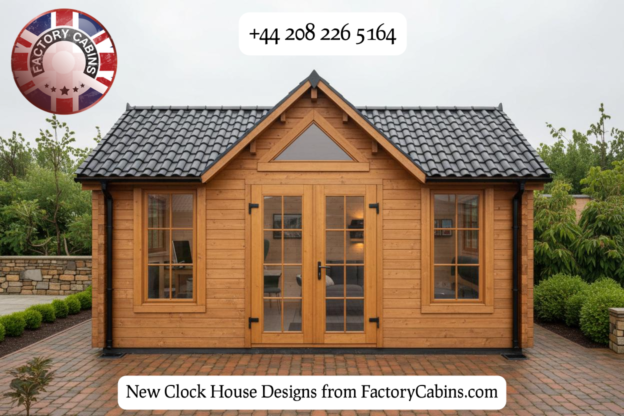
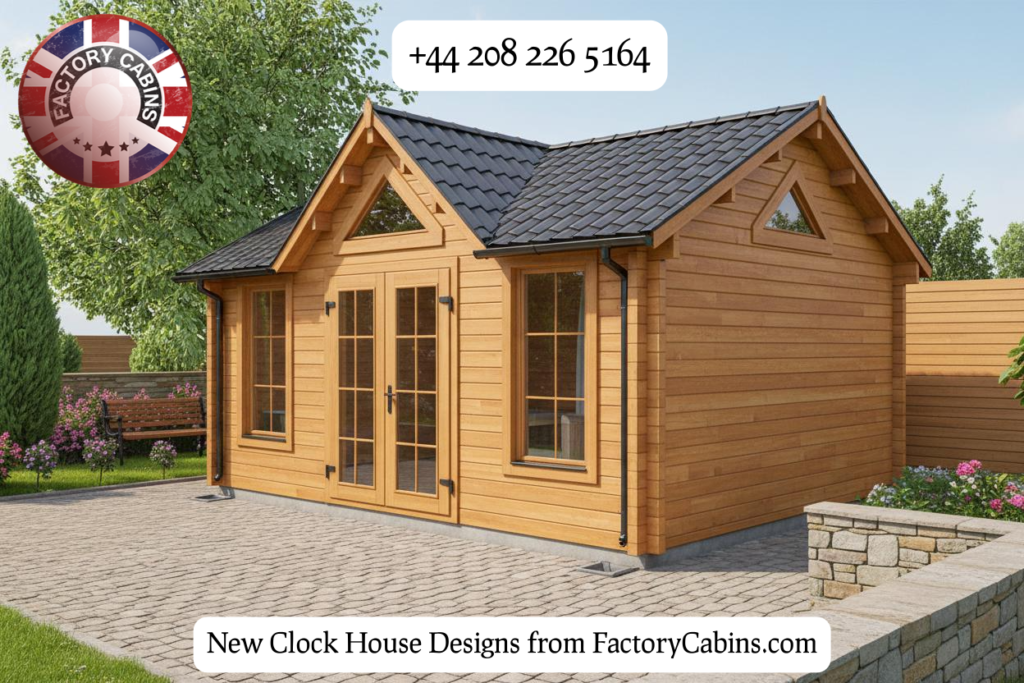
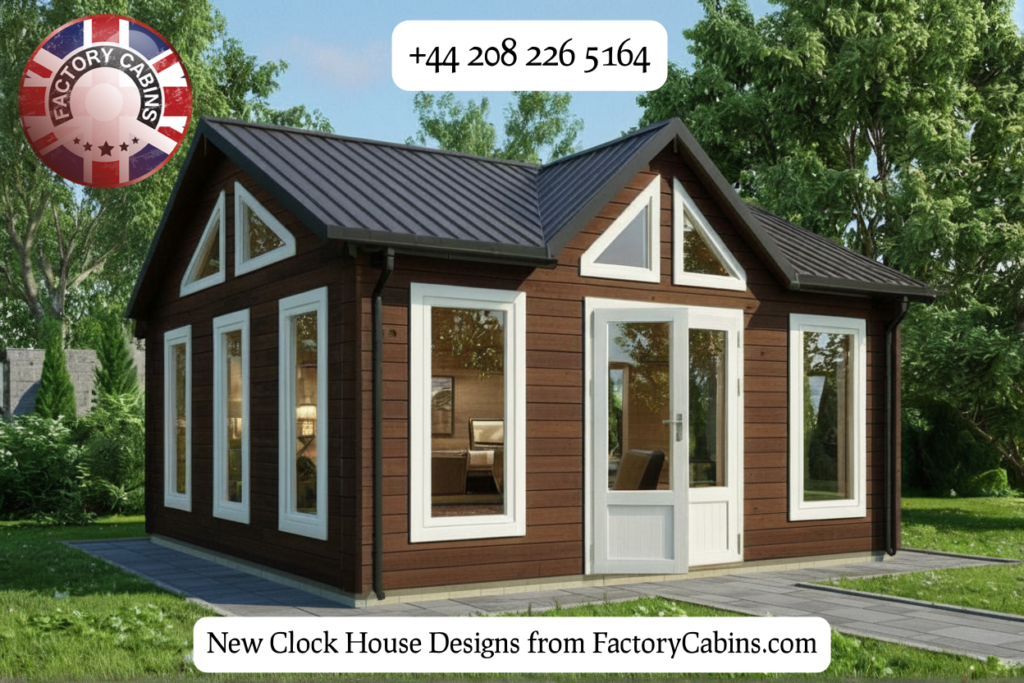
Clock House Log Cabins – Twin-Skin Log Cabins

Why Our Clock Houses Are the Best—No Debate

These days, it’s easy to get lost in a sea of flimsy, factory-made garden buildings. You’ve probably seen the usual suspects: sheds with thin walls that promise everything but end up leaking and rotting after a bit of British rain. At Factory Cabins, that’s not our style. We’re not here to chase fads. We set the pace, and we build clock houses to last. So, why do we claim ours are the best? It’s not about flashy ads or empty guarantees. It comes down to solid engineering, top-notch materials, and a stubborn dedication to quality that just won’t quit.

We’ve all heard, “You get what you pay for.” With cheap garden rooms, you realize what you’ve paid for the first time a proper storm rolls through. That’s when the “bargain” turns into an expensive mistake. Let’s break down what sets our clock houses apart.

Twin-Skin Construction: Not Your Average Shed
The heart of our clockhouse is the twin-skin construction. Here’s the truth—most sheds you find are made from single, thin timber walls, maybe 19mm or 28mm thick. They’re hopeless at keeping out the cold in winter or trapping in heat over summer. Our design is different. We use two layers of timber, separated by a cavity where we fit high-quality insulation. This creates a real barrier, keeping it warm when it’s freezing and cool when the sun finally decides to show up. You’re not just getting comfort—you’re getting a space you can actually use all year round, whether it’s an office, a gym, or an annexe. And, because the structure is solid, you don’t get annoying gaps that let in rain.

The Right Timber: Winter-Cut Swedish Spruce
Not all timber is the same. We only use slow-grown spruce, cut in winter from Swedish forests. Why? Less moisture, tighter growth rings, and denser wood that shrugs off warping, twisting, and pests. It ages well, so it’ll look good for years without turning ugly and brittle. The forests are FSC-certified, too. Our timber doesn’t just meet the standard—it is the standard.

Smart Openings: Glulam Frames and Real German Hardware
Let’s talk about windows and doors. On most garden rooms, these are weak spots. Ours, though, use glulam frames—laminated wood that stays stronger and truer than regular timber. No fighting with jammed windows, and no saggy doors. Hardware matters too, so we use proper German components with secure, multi-point locks. The result? A clock house that stays locked tight, looks sharp, and keeps the heat (or cool) exactly where you want it.

Glazing That Does Its Job: 28mm Toughened Double Glass
Bringing in light shouldn’t mean losing heat or feeling exposed. Every Clock House comes with 28mm toughened double glazing. It’s not just stronger and safer; it keeps noise out, warmth in, and lets in plenty of daylight. Even better, the glass breaks safely and the windows tilt and turn for easy ventilation. Whether you’re working, relaxing, or creating, you’ll notice the difference.

CNC Precision: Every Piece Fits
Old-school sheds rely on a carpenter’s eye and a tape measure—sometimes that works; sometimes you end up with “almost straight” walls and gaps you could slide your hand through. Our process is fully CNC-based. Computers handle the cuts, so everything lines up perfectly. That means less wasted material, quicker build times, and the flexibility to make custom sizes for awkward gardens or planning rules.

Built for the Future: Fully Compliant and Ready for Net-Zero
We don’t just meet basic rules—we’re up to BS3632 standards for mobile homes and park structures. If you want to live in your Clock House or use it as a proper annexe, you won’t run into legal headaches later. With top-grade insulation and options for solar panels, heat pumps, and turnkey connections, these buildings are ready for the future and kinder to your energy bills.

Designed for Real Life
Our Clock Houses aren’t one-size-fits-all. Want a garden office with built-in power and data? Sorted. Need a luxury annexe with a kitchen and wet room? We do that too. Fancy a soundproof studio or a creative space with north-facing skylights? It’s all possible. Even commercial pop-ups for markets or events—our clock houses adapt, but the top-end spec stays the same.

Beauty That Lasts
Looks do matter. Swedish spruce is not just tough; it’s good-looking and just works—whether your home’s a modern setup in Brighton or a classic place near Tunbridge Wells. Pick your finish or cladding, and it will blend in naturally, not stick out like a sore thumb.

One Last Word: Quality Isn’t a Gimmick
Buying a clock house is more than ticking a box on a shopping list. It’s about putting your money into something that lasts, not just for now, but for years ahead. We focus on materials and methods that pass the test—weather, time, and use.

The truth? If you buy cheap, you buy twice. Our Clock Houses are a one-time investment.

We build them right, and they’re built to last—simple as that. Whether you’re after a peaceful garden retreat, a home office, or an annexe—and whether you’re based in Sussex or Kent—a bespoke Clock House from Factory Cabins upgrades your lifestyle and becomes something you can be proud of for years to come.

Please send us an email to sales@factorycabins.com

All bespoke designs are welcome. PLEASE call 0208 226 5164

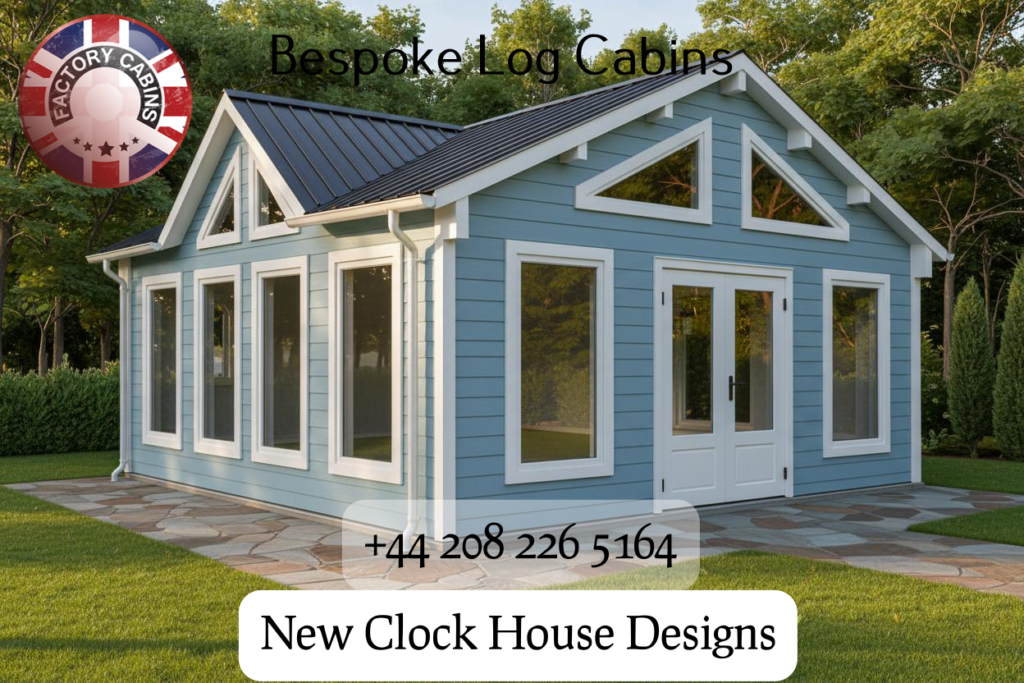
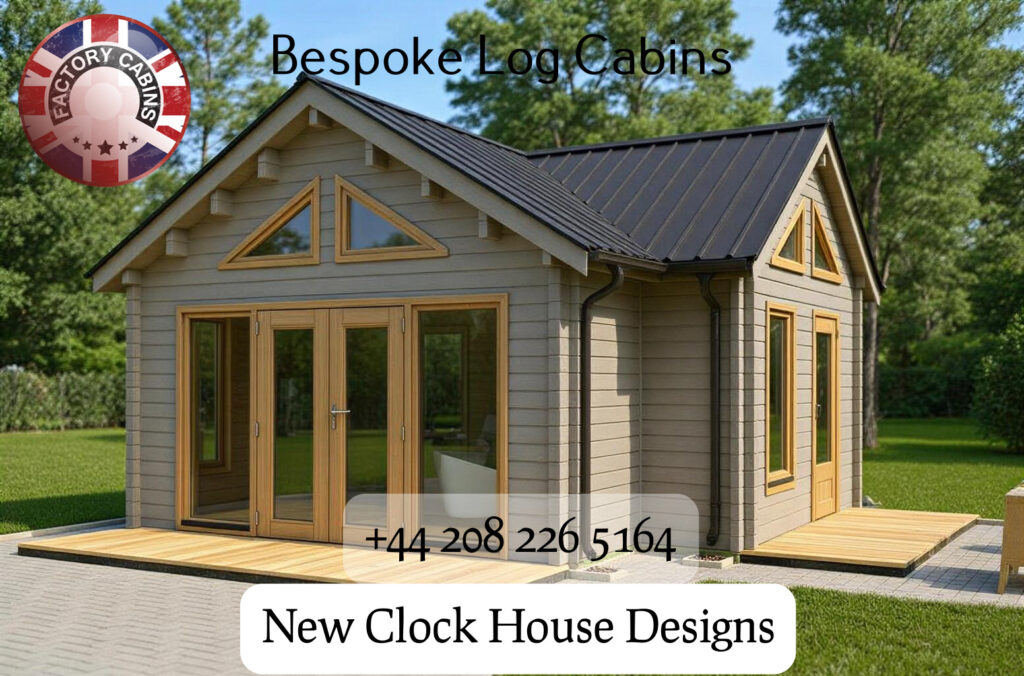
Bespoke Log Cabins 2026

Beyond the Garden Shed: Discovering What Bespoke Log Cabins Can Really Do!

Say “log cabin”, and most people picture a cosy holiday getaway tucked into the woods, or maybe just a garden shed crammed with old tools and bikes. Those are the obvious uses, sure, but honestly, that’s just the tip of the iceberg. Modern, custom-built timber cabins can do so much more. In a world where space costs a premium and everyone’s juggling work, family, and downtime, a bespoke log cabin isn’t just another building out back. It’s a game-changer. It can totally reshape how you live, work, and relax.

At Factory Cabins, we’ve learned that “cheap and cheerful” only works until the weather turns nasty or the insulation gives up. Real value comes from building something that lasts — something precise, adaptable, and tough. That’s why we use winter-cut, slow-grown Swedish spruce, glulam windows, German hardware, and twin-skin construction. These cabins stand up to the elements like proper brick houses but still feel warm and natural. And when you throw out the design rulebook? Honestly, you can build almost anything you can imagine.

Home Offices and Creative Studios, Your Way

With remote work now the norm, garden offices have exploded in Kent, Sussex, and everywhere else. But those generic prefab pods? They often fall short. They usually miss the details that matter — like proper soundproofing, good airflow, or enough power for all your gear. A made-to-measure log cabin gives you total control.

Picture a music studio where you can actually play drums and record vocals without bothering the neighbours, thanks to thick insulation and high ceilings. Or maybe you want a light-filled art studio with big windows bringing in that perfect north light and climate control to keep your paints and canvases safe. Tech professionals can have a cabin wired from the ground up for servers, fibre optics, and ergonomic lighting—a real workspace that’s separate from home but just a few steps away. We build with CNC precision, so every socket, data port, and shelf fits right into the timber walls. No messy cables, no wasted space.

Your Own Private Spa or Leisure Retreat

Why drive hours to a spa when you can build your own sanctuary right outside? More people are turning bespoke cabins into private wellness centres. With our focus on net-zero design and top-notch insulation, these spaces stay comfortable all year, which makes them perfect for saunas, yoga, or meditation rooms.

Imagine a pool house with showers, a changing area, and a comfy lounge that looks out over the water — all built with timber that shrugs off humidity. Or maybe you want a gym at home, with rubber floors, mirrored walls, and heavy-duty ventilation, ready for serious workouts. Because it’s all custom, we can add full plumbing and electrics from the start, so your retreat works as good as it looks. Whether you’re dreaming of a cinema room with perfect sound or a games room for the kids, your cabin becomes the place everyone wants to be—right in your own backyard.

Sustainable Living and Ancillary Accommodation

Bespoke timber framing isn’t just about beautiful buildings—it’s a real answer to the housing crisis and the needs of families living together across generations. If you’ve ever tried to build something new, you know how planning rules can tie you up in knots. But here’s the thing: granny flats and annexe often get the green light under different, more flexible rules—especially if they meet standards like BS 3632 for park homes.

Picture this: a log cabin designed just for you, tucked in your garden. Maybe it’s a one- or two-bedroom place for your parents, giving them independence but keeping them close when they need you. These homes come with proper kitchens, easy-access bathrooms, underfloor heating, and insulation that actually keeps energy bills in check. They’re not just for parents, either. Young adults who want their own space while they save up for a home love them, too. Or maybe you’re eyeing Airbnb income—these cabins make perfect holiday lets. In places like the South Downs or the Kent countryside, a stylish eco-lodge can pull in serious nightly rates. Suddenly, a forgotten patch of your garden becomes a steady income stream.

Specialized Commercial and Community Uses

Timber structures aren’t just for homes. All over the UK, businesses are getting creative—using these buildings for pop-up shops, rural coffee stops, and reception areas that actually look like they belong in the landscape. Because we handle everything—from the groundworks to electrics and plumbing—you’re looking at a finished, ready-to-use space in weeks, not months.

Schools and nurseries are catching on, too. Outdoor classrooms made from timber give kids a real connection to nature, plus they’re weatherproof, so rain doesn’t cancel class. These buildings grow with you: need more space? Just add on. Equestrian centres love them for tack rooms, grooming stations, or even workshops for the farrier. They’re tough enough for farm life but comfortable enough to spend your day in.

The Importance of “Bespoke” vs. “Off-the-Shelf”

The real magic is in “bespoke.” Off-the-shelf cabins force you to compromise—with fixed sizes, awkward window placements, and flimsy walls that just don’t handle British weather. Buy cheap, buy twice, as they say.

But when you go bespoke with Factory Cabins, the building fits your life—not the other way around. Need a 10-meter open span for a dance studio? We engineer glulam beams for it. Want triple glazing and airtight, passive-house standards for year-round living? We build that right in. Looking to match a historic home or make a bold, modern statement? We tweak the cladding, roof shape, and finish until it’s perfect.

We use toughened glass, high-spec windows, and insulated doors, so whether you want a secure site office or a sun-drenched art studio, your cabin just works. And because we manufacture directly, there’s no middleman, so your money goes into better timber, hardware, and finishing—not someone else’s pocket.

Future-Proofing Your Investment

A bespoke log cabin is about flexibility. Maybe today it’s your home office. Down the line, it could be a teenager’s hangout or a guest suite. Swedish spruce and CNC precision mean it’ll stand up to decades of weather, resisting rot and warping. It’s a building that grows with you.

From This 44mm box

To This bespoke design

And let’s talk about sustainability. Timber is one of the greenest building options out there—especially when it’s sourced properly, like ours from slow-grown Scandinavian forests. It locks up carbon, and when you add solar panels or heat pumps (which our designs make easy), you’re not just building for yourself. You’re building for the planet.

When it comes to bespoke log cabins, your only real limit is your imagination—and the size of your plot. Need a high-spec office, a luxury retreat, a guest house, or a commercial cabin? You can have it, fast and without breaking the bank. These buildings do more than traditional extensions ever could—they solve real problems in modern life.

Why settle for a bland, off-the-shelf box that barely gets the job done? You deserve a space crafted for your needs, built from the best materials, and designed to last.

Please send us an email to sales@factorycabins.com

All bespoke designs are welcome. PLEASE call 0208 226 5164

Bespoke Log Cabins

BESPOKE LOG CABINS: THE ULTIMATE GUIDE TO CREATING YOUR PERFECT GARDEN RETREAT

OUR NEW EMAIL IS SALES@FACTORYCABINS.COM

Introduction: Why Bespoke Matters

Here’s the thing—at Factory Cabins, we’ve spent years bringing together some of the best carpenters, architects, joiners, and machinists out there.

All with one goal in mind: building truly bespoke log cabins. We don’t just churn out the same old cabins you’ll find everywhere else. Instead, we focus on three things, in this order: quality, design, and then price. If we cared only about cutting costs, we’d be letting our customers down.

Safety always comes first in every project. We sweat the details on quality, then we think about price.

Picking out a bespoke log cabin can feel overwhelming. There’s a lot to consider, but honestly, safety should always top your list. Factory Cabins really does stand out—we’re known across the industry for being the best at what we do. Don’t settle for something average.

Call us up, tell us what you need, and let’s build something just for you. With Factory Cabins, you get the only log cabin that’s truly built for your peace of mind.

Chapter 1: Understanding Twin Skin Construction

What Makes Twin Skin Superior?

Every one of our cabins comes with a twin skin option—either 44mm x 44mm or 70mm x 70mm. This isn’t just fancy talk. Twin skin construction is a genuine step forward in how log cabins are built.

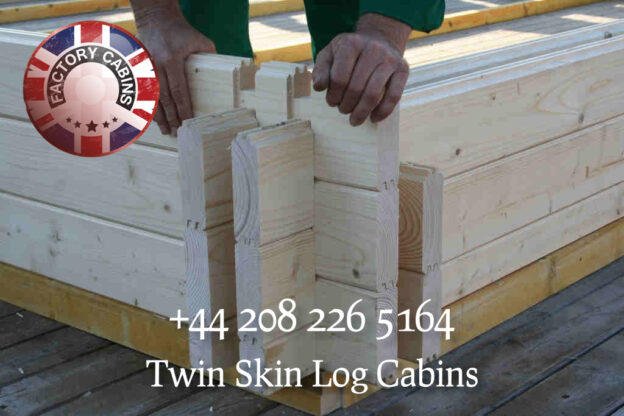
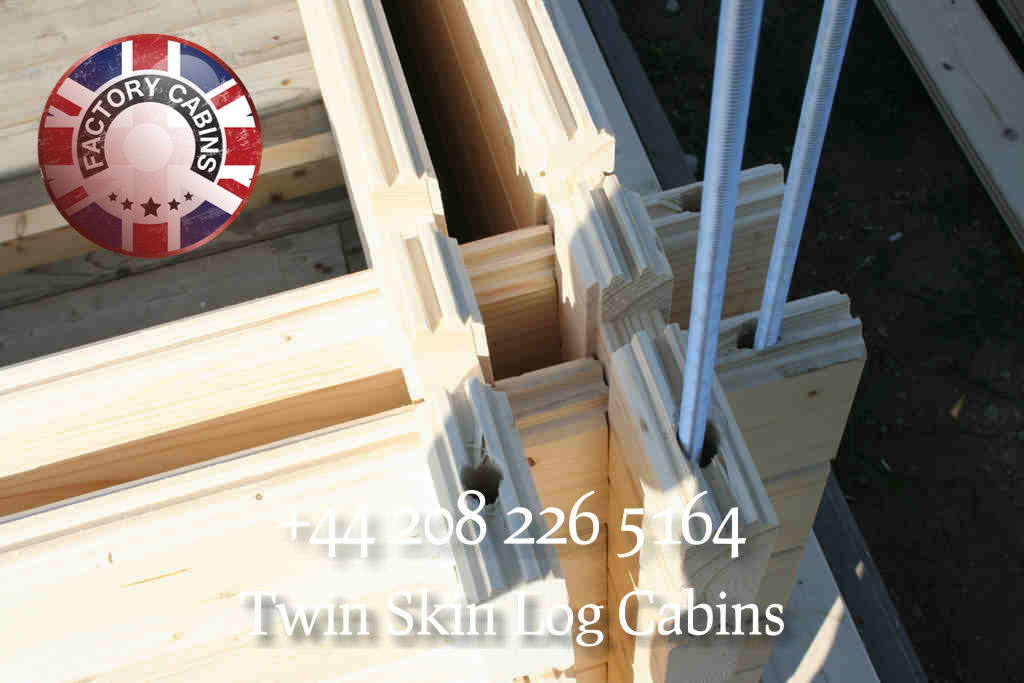
A twin skin cabin uses two separate layers of timber—one inside, one outside—with a gap in between for top-notch insulation. That’s the secret. This setup gets rid of cold spots, stops condensation, and keeps things nice and quiet inside.

The insulated walls? They work just as well as a solid wall that’s five times thicker. So you save space, use fewer materials, and—most importantly—cut down on costs.

44mm x 44mm Twin Skin: The Smart Choice

Durability, energy efficiency, style, and value all come together here. Using slow-grown Swedish spruce for both the inner and outer walls, this design works great for all kinds of spaces—year-round holiday rentals, glamping pods, garden offices that actually keep you warm, or family getaways where comfort really matters. It’s also a solid choice if you want a passive income property without high running costs.

Between the two 44mm spruce walls, there’s a cavity that fits 50mm to 100mm of insulation. With standard Celotex, you can get U-values down to 0.35 W/m²K. If you go with UK Building Regulations-compliant insulation kits, you can drop that even further, all the way to 0.19 W/m²K.

70mm x 70mm Twin Skin: Premium Performance

For those seeking maximum thermal performance, our 70mm x 70mm twin skin option delivers exceptional results. With a 110mm insulation cavity, this configuration achieves U-values of 0.19 W/m²K—significantly better than current UK building regulations require (0.21 W/m²K for 2022 standards)

The substantial 70mm logs provide excellent thermal mass, meaning they hold heat far better than thinner alternatives This makes them ideal for:

  • Residential park homes requiring BS3632 compliance
  • Year-round living spaces in challenging climates
  • Luxury holiday accommodations demanding premium comfort
  • Locations requiring enhanced insulation (lakeside, coastal, or exposed sites)

Why Swedish Spruce?

Swedish spruce stands out for its strength and durability, which is why people keep coming back to it for building solid, long-lasting log cabins.

Unlike faster-growing woods, Swedish spruce trees take their time—about 80 years before harvest. That slow growth gives the wood a density and quality you just don’t get elsewhere.

So what do you actually get with Swedish spruce? For starters, it’s got great thermal insulation. Spruce’s low density means log homes built from it keep the warmth in, even through those endless northern winters.

It’s also known for its dimensional stability. All those tight growth rings from slow growth help the wood resist warping and twisting. If you treat it right, Swedish spruce will stick around for decades with hardly any fuss. You don’t need to baby it.

The wood comes from FSC-certified forests, which means it’s harvested responsibly. That matters when you care about the planet.

And you can’t ignore the look. The natural grain and color of Swedish spruce give cabins a warm, timeless feel that just works, year after year.

One more thing—winter-cut seasoned spruce is even better. When they cut the trees in winter, the sap’s low, so the wood stays stable and resists weird warping or cracks as it ages. That’s the kind of detail that really makes a difference.

Chapter 2: Complete Window and Door Freedom

Our Vision, Your Placement

When you go bespoke, you get total freedom with your windows and doors. Seriously—put them wherever you want, as many or as few as you like. Want a cabin with no windows at all? Or maybe you want a wall full of glass? We’ve done both. Just tell us what you’re imagining, and we’ll make it happen.

With off-the-shelf cabins, you’re stuck with whatever layout’s already set. Our custom service flips that. You can:

Pick the perfect spot for a window to catch your favorite view or soak up the sunlight
Put doors exactly where they make sense for how you move through the space
Decide how many windows or vents you need—maybe you want loads for fresh air, or just one for a cozy vibe
Play around with different sizes to make things interesting and useful

Standard Door Sizes

We have three standard door sizes to choose from. Beyond that, everything else is made to fit what you want.

Door TypeDimensionsBest For
Single Door1930mm x 830mmGarden offices, storage access, secondary entrances
Double Door1930mm x 1410mmMain entrances, moving furniture, creating open feel
Double Door with Outer Glass Panes1930mm x 2310mmPremium entrances, maximizing light, statement features

Every door is made from joinery glulam—basically, that’s laminated timber that stays straight and true, even as time goes by. Unlike regular solid wood, it doesn’t twist or warp, so your door always fits snug and works smoothly all year round.

And when it comes to windows, we offer five standard sizes. Each one’s crafted from the same joinery glulam and fitted with reliable German hardware.

Window TypeDimensionsFeatures
Small Square500mm x 500mmSecondary lighting, ventilation, aesthetic balance
Standard Portrait880mm x 650mmGeneral purpose, good light-to-wall ratio
Wide Landscape1520mm x 710mmMaximizing views, main wall features
Medium Landscape1130mm x 710mmVersatile sizing for most applications
Double Opening Tilt and Turn1130mm x 1310mmPremium ventilation, easy cleaning, security

Every window comes double glazed as standard, with options for fixed panes or handy tilt-and-turn openings.

The tilt-and-turn system is pretty clever. You can tilt the window inwards for a bit of fresh air—totally safe, especially if you’ve got kids or pets. Or, swing the whole thing open for a proper breeze and easy cleaning.

We use German hardware on all our windows and doors. It’s not hype—this stuff really is top quality. The tilt-and-turn mechanisms aren’t just smooth and easy to use; they’re built tough to last for decades.

You get solid, heavy-duty components that keep working year after year. Opening and closing feels effortless, thanks to precise engineering. Security’s covered too, with multi-point locks and anti-lift features, so you can actually relax. The seals hold up in all kinds of weather—rain, wind, even salt air near the coast, thanks to stainless steel parts that fight off corrosion.

All the hinges and hardware are residential quality, the best you’ll find in the industry. And here’s the thing—this isn’t an extra you pay more for. Every Factory Cabins bespoke project gets these features as standard.

Custom Sizes, No Limits

Sure, our standard sizes work for most people, but sometimes you need something different. Maybe you want huge windows to take in that lake view. Maybe you have a unique design in mind, or you need taller doors for better accessibility. We can handle it. Whatever shape or size you’re picturing, we’ll build it to fit your space.

We use the same high-quality glulam joinery and German hardware for every window and door, no matter the size. So your whole cabin feels solid and consistent, even if you mix standard and custom pieces.

Georgian Bar Choices

Want Georgian bars on your windows or doors? We’ve got you covered. We factory-fit these bars for a clean, lasting finish—they’re not the removable kind you’ll find in our Country and Planning Compliant ranges. If you want everything to match, just let us know.

Chapter 3: Creating Your Bespoke Log Cabin – Step by Step

Step 1: Pick Your Log Cabin

Start by choosing the log cabin body you want. There’s a massive range—different sizes, layouts, verandas, roof heights, and setups. You’ll find over 180 bespoke log cabin bodies here. Still not seeing one that works for you? Shoot us an email or just give us a call. We’re always happy to talk through your ideas.

Step 2: Measure Your Space

Grab a tape measure and check how much room you’ve got in your garden. Leave some space between your new cabin and any fences or buildings—around 600mm is a good rule of thumb. That way, you’ll have enough room to actually build the cabin and keep it in good shape down the line.

A few planning rules to keep in mind:

  • Log cabins need to be under 2.5m tall if they’re close (within 2m) to your property boundary.
  • The cabin shouldn’t take up more than half your garden.
  • There are height limits: 4 metres for gable roofs, 3 metres for other roof types.
  • If you plan to sleep in the cabin, live in it, or rent it out for holidays, you’ll need full planning permission.

Getting this sorted is the first step to building your own luxury log cabin.


OUR NEW EMAIL IS SALES@FACTORYCABINS.COM

Step 3: Choose Your Wall Thickness

Once you’ve picked the cabin that fits, it’s time to choose the wall thickness. Go for 44mm or 70mm walls—or try the twin skin options (44mm x 44mm or 70mm x 70mm). Then just add it to your cart and you’re set for the next step.

ThicknessBest UseThermal Performance
44mm SingleSummer offices, seasonal useModerate
70mm SingleExtended season useGood
44mm x 44mm TwinYear-round comfortExcellent
70mm x 70mm TwinPremium year-roundSuperior

44mm logs are seriously thick — 57% thicker than the usual 28mm ones you see out there. But you know what? Twin skin construction takes thermal performance to a whole new level, no matter how thick your logs are.

Step 4: Choose Windows and Doors

There’s a ton of options. You can go for single or double doors, pick from fully glazed, three-quarter, or half-glazed styles, and even add Georgian bars if that’s your thing. All our glazing? Double glazed, sealed units as standard.

When it comes to windows, you’ve got just as much choice. Single or double, pick any size you want. Again, everything’s double glazed. Some windows are fixed, others tilt and turn — it’s up to you. And the hardware on the windows matches the doors, so everything feels solid and looks good.

Step 5: Position Windows and Doors

Now, decide where you want each window and door. The visuals for each cabin wall actually show you the possible spots. Just make sure you’re not placing anything closer than 300mm to a corner or a main structural section.

Here’s something that sets us apart: we always double-check your plans to make sure your cabin stays rock solid. Not every bespoke manufacturer does this, but we do. It’s that attention to detail that keeps your cabin performing the way it should, year after year.

Chapter 5: Why Factory Cabins Stands Apart

Quality Over Quantity

Our structural timbers outshine, outsize, and outprice 99.9% of the bargain basement happy-go-lucky log cabin dealers/agents in the UK. We only use premium winter-cut, slow-grown Swedish spruce—no cheap shortcuts

No Middlemen

You buy straight from us, so there’s no unnecessary markup or compromise. You get a custom, high-spec cabin for a fair price, and we’re with you every step—from your first question to the final installation

Engineering Heritage

We invented the interlocking twin skin system. We designed it, we built it, we brought it to market first, and we know it inside out. When you create something yourself, you know every detail, every strength, and every opportunity to make it even better

Complete Bespoke Service

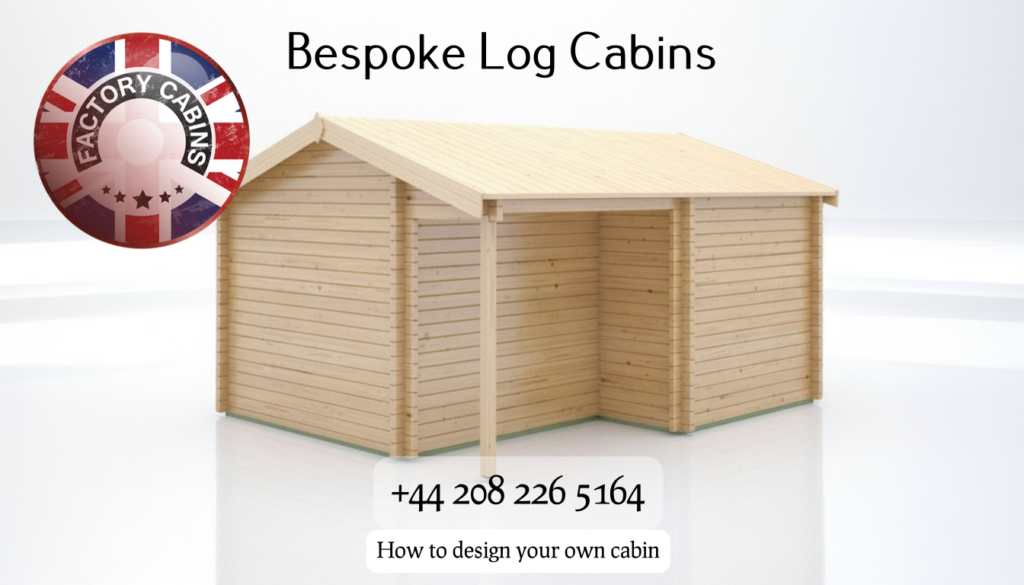
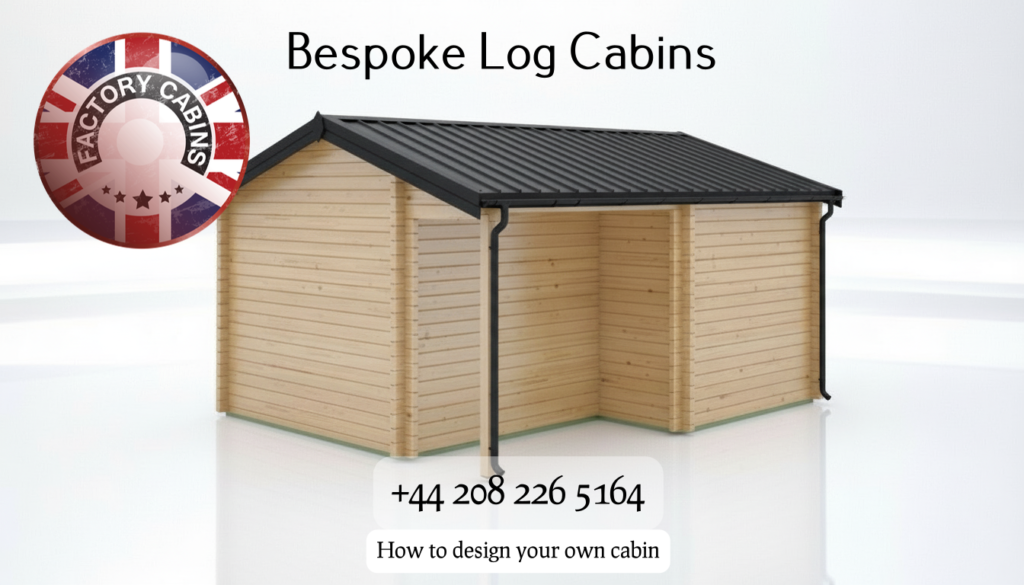
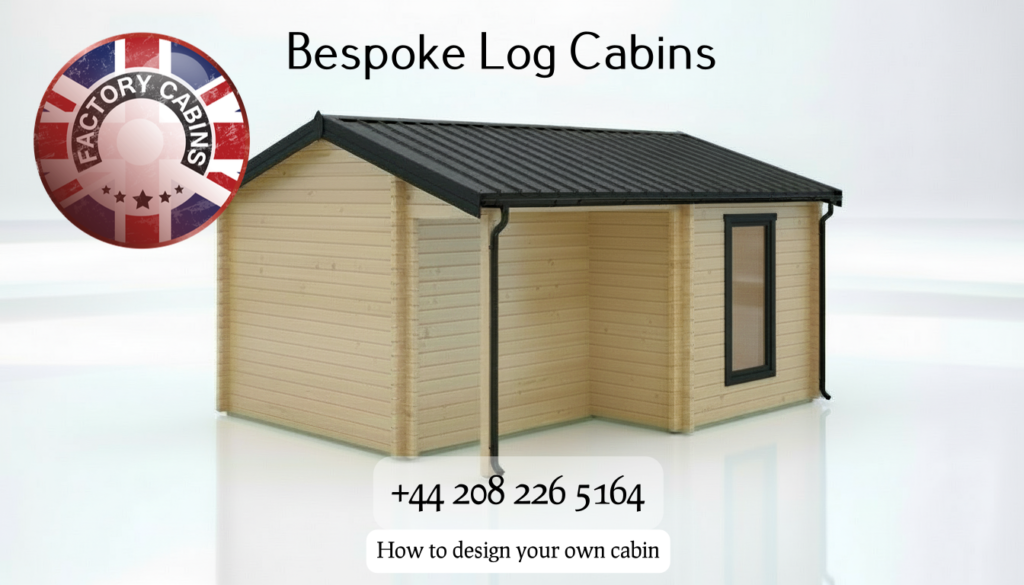
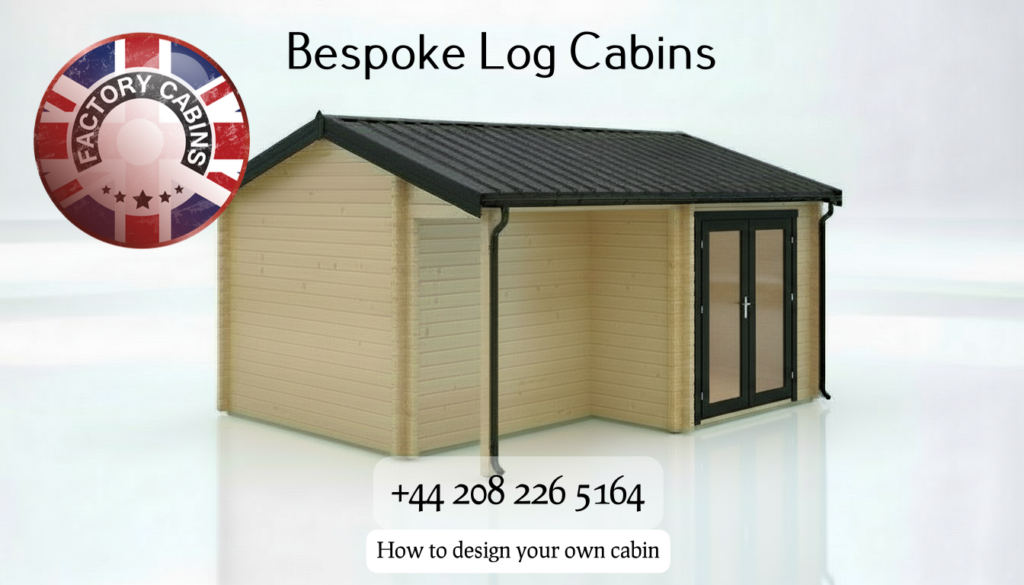
As you can see this started of as a shell 44mm winter cut spruce logs., floor 28mm, roof 19mm, no windows and doors, all you do is tell us what you really want and it will be delivered in 8 weeks!

Single skin, Twin Skin, any kind of size, double glazed, tilt and turn windows and doors!
Bespoke Log Cabins…

BESPOKE LOG CABINS

PLEASE..Click Here

Every cabin is truly bespoke. You decide where everything goes—furniture, walls, doors, windows, it’s all your call. Our design team works closely with you to create a solution that exceeds expectations while working within your constraints.

Chapter 6: Applications and Uses

Garden Offices

Walk into a twin skin cabin, and it just feels right—a quiet, cozy spot where you can actually get things done. Thanks to the insulated walls, you’ll use it in January just as much as July. It’s more than an office; it’s your own personal hideaway, no matter what the weather’s up to.

Holiday Lets

Self-catering cabins never lose their charm. Put a well-built log cabin in a beautiful spot—think Kent, Sussex, the Lake District, or the Highlands—and you’ll see steady bookings. Our clients pull in £800 to £1,500 a month, year-round, all because these cabins really hold the heat.

Multi-Generational Spaces

Life changes, families grow. Maybe your teenager needs space, or an elderly parent can’t handle the stairs anymore. We design cabins that fit real lives: proper insulation between rooms, wet rooms with underfloor heating, kitchenettes—all the details sorted, so everyone feels at home.

Glamping and Tourism

The UK’s holiday scene is booming. More people are staying local, looking for eco-friendly options, and want something a bit special. A 44mm twin skin log cabin blends that classic timber look with up-to-date comforts guests actually notice.

Chapter 7: Technical Specifications Summary

Wall Options

Single Skin: 44mm or 70mm Swedish spruce.
Twin Skin: 44mm x 44mm or 70mm x 70mm, with 50-110mm of insulation in between.
U-Values: As low as 0.18 W/m²K (twin skin with building regs insulation).

Door Specifications

Single: 1930mm x 830mm
Double: 1930mm x 1410mm
Double with Glass: 1930mm x 2310mm
Material: Joinery-grade glulam, top-quality German hardware.
Glazing: 28mm toughened double glazing, standard.

Window Specifications

500mm x 500mm – Small square
880mm x 650mm – Standard portrait
1520mm x 710mm – Wide landscape
1130mm x 710mm – Medium landscape
1130mm x 1310mm – Double opening, tilt and turn
Material: Joinery glulam, German hardware.
Glazing: Double glazed, sealed units.

Lead Time & Delivery

Production: Up to 6 weeks from confirmed plans.
Delivery: HIAB lorry to your kerbside (included in price).
Installation: Full turnkey service available if you want it.

Your Bespoke Journey Starts Here

Honestly, we could write for days and never run out of reasons why Factory Cabins stands out. But here’s what matters: we’re the best in the business, and everyone knows it.

Don’t settle for anything less. Call us and tell us what you need. Garden office? Luxury holiday let? A cabin for the whole family? We’ll make it happen, just how you want it.

Contact Information:

Email: sales@factorycabins.com
Phone: 0208 226 5164
Website: factorycabins.com

Every custom design is welcome. Whether you’re in Brighton, Margate, the Lake District, or the Highlands—we deliver quality and performance that change how you think about garden buildings.

Bespoke Cabins from Factory Cabins—the only choice that makes sense.

This guide is built on over twenty years of hard-earned expertise, thousands of successful projects, and a real commitment to quality. Your dream space is just a phone call away.

Chapter 6: Applications and Uses

Garden Offices

Step into a twin skin cabin, and you’ve got a peaceful, warm, proper workspace. The insulated walls mean you’ll actually use it all year, not just when the sun’s out. It quickly becomes your personal retreat, whatever the weather’s doing outside

Holiday Lets

Quality self-catering properties are always in demand. Place a well-located log cabin in beautiful areas like Kent, Sussex, the Lake District, or the Scottish Highlands, and you’ll enjoy steady rental income

Our clients report earning £800–£1,500 monthly from cabins let year-round thanks to genuine thermal performance.

Multi-Generational Spaces

Families evolve. Teenagers seek independence. Elderly parents require ground-floor accommodation. Our bespoke service creates cabins tailored to human needs: internal partitions with proper insulation, wet rooms with underfloor heating provisions, kitchenette integrations

Glamping and Tourism

The UK holiday market is thriving. More people are choosing staycations, eco-tourism is growing, and travelers want something unique. A 44mm twin skin log cabin combines classic timber aesthetics with modern features that guests appreciate.


Chapter 7: Technical Specifications Summary

Wall Options

  • Single Skin: 44mm or 70mm Swedish spruce.
  • Twin Skin: 44mm x 44mm or 70mm x 70mm with 50-110mm insulation cavity.
  • U-Values: As low as 0.18 W/m²K (twin skin with building regs insulation).

Door Specifications

  • Single: 1930mm x 830mm.
  • Double: 1930mm x 1410mm.
  • Double with Glass: 1930mm x 2310mm.
  • Material: Joinery glulam with German hardware.
  • Glazing: 28mm toughened double glazed as standard.

Window Specifications

  • 500mm x 500mm – Small square.
  • 880mm x 650mm – Standard portrait.
  • 1520mm x 710mm – Wide landscape.
  • 1130mm x 710mm – Medium landscape.
  • 1130mm x 1310mm – Double opening tilt and turn.
  • Material: Joinery glulam with German hardware.
  • Glazing: Double glazed sealed units.

Lead Time & Delivery

  • Production: Maximum 6 weeks from confirmed plans
  • Delivery: HIAB lorry to kerbside (included in price)
  • Installation: Optional turnkey service available

Your Bespoke Journey Starts Here

There are so many points we could focus on in this article—we would need 300 web pages! But we will say just this: Factory Cabins is without doubt the Best of the Best and everyone in the Industry Knows it!

Do not settle for less. Give us a call and tell us what you are looking for. Whether you need a compact garden office, a luxury holiday let, or a multi-functional family space, our bespoke service ensures you get exactly what you need.

The last thing to remember, this prosess, gives you totally dominance over the size, height, lenght, and what windows where, and also doors position. Total BESPOKE!

Contact Information:

All bespoke designs are welcome. From Brighton to Margate, from the Lake District to the Scottish Highlands, we deliver quality, accessibility, and performance that redefine what’s possible in garden building.

Bespoke Cabins From Factory Cabins – the only safe choice.


This comprehensive guide represents over two decades of engineering excellence, thousands of successful installations, and an unwavering commitment to quality. Your dream space is just a conversation away.

Please send us an email to sales@factorycabins.com

All bespoke designs are welcome. PLEASE call 0208 226 5164

www.cladco.co.uk the best roofing we believe for our Bespoke Log Cabins.

OUR NEW EMAIL IS SALES@FACTORYCABINS.COM

44mm Twin Skin Log Cabins-UK Holiday Lets

Why 44mm x 44mm Twin Skin Log Cabins Are the Smartest Choice for UK Holiday Lets & Passive Income

Right now, the UK holiday market is thriving. More people are choosing staycations, eco-tourism is growing, and travelers want something unique. If you own land, manage a park, or dream of running a hospitality business, investing in a 44mm x 44mm twin skin log cabin is a logical choice. These cabins strike the perfect balance between durability, energy efficiency, style, and the potential for passive income. And when it comes to top quality, Factory Cabins stands out. They get it right.

Built for British Weather—Strong and Comfortable

Let’s be honest: British weather can be unpredictable. One moment it’s sunny, the next it’s raining, and the wind is always present. Guests need somewhere that keeps them warm and dry, whatever the weather. That’s where the twin skin design excels. Instead of a single layer of timber, you get two thick walls of slow-grown Swedish spruce with a ventilated gap between them. This design eliminates cold spots, prevents condensation, and ensures peace and quiet inside. It’s ideal for year-round holiday lets, glamping pods, or even a luxury countryside retreat.

Travelers expect more than just a place to sleep now. They want an experience—and an attractive one. A 44mm twin skin log cabin from Factory Cabins combines classic timber aesthetics with modern features: double glazing, solid insulated doors with German hardware, smooth tilt-and-turn windows, and even the option for thermally-modified exteriors. Guests appreciate these touches, leave better reviews, and often return. This leads to more bookings on Airbnb, Booking.com, and glamping platforms.

Earn Passive Income with High Returns and Minimal Effort

If you’re seeking a way to earn without being tied to a desk, holiday accommodation is a great option in the UK. Quality self-catering properties are always in demand, especially in beautiful areas like Kent, Sussex, the Lake District, or the Scottish Highlands. Place a well-located log cabin there, and you’ll enjoy steady rental income.

Here’s why these 44mm x 44mm cabins are so effective for investors:
They require minimal maintenance thanks to superior materials and craftsmanship.
In many cases, planning permission isn’t needed (always check your local regulations).
They’re versatile—use them as holiday lets, glamping pods, wellness retreats, or even tiny net-zero homes.
They add instant value to your land or holiday park.
They’re energy efficient, keeping running costs low and guests comfortable. This results in longer stays and higher rates. Combine this with professional photography, smart marketing, and dynamic pricing, and you’ll have a consistent income stream with little daily effort.

Easy and Fast to Build—No Hassle

Many assume log cabins are difficult to assemble. Factory Cabins proves otherwise—at least with their 44mm x 44mm twin skin range. Their original interlocking system, which they pioneered, makes construction straightforward.

Each log is precision-cut at their Lithuanian factory, ensuring everything fits together seamlessly. It’s almost like assembling a satisfying puzzle. This reduces time and costs on site, whether you’re an experienced builder or a beginner. And if you prefer everything managed for you, Factory Cabins offers a complete turnkey service, handling groundwork, assembly, electrics, plumbing, and finishing touches—so you can relax and watch your investment take shape.

Why Factory Cabins Outsells Everyone Else: We Built the System from Scratch

Let’s get straight to it—nobody in the UK sells more 44mm x 44mm twin skin log cabins than Factory Cabins. The reason’s simple. We invented this interlocking twin skin system. We designed it, we built it, we brought it to market first, and we know it inside out. That’s not just marketing talk; it’s the truth. When you create something yourself, you know every detail, every strength, and every opportunity to make it even better.

Sure, you’ll see plenty of companies offering cabins that look similar. But when it comes to real expertise, material quality, and pushing for better performance, nobody comes close. We only use premium winter-cut, slow-grown Swedish spruce—no cheap shortcuts. Our cabins have laminated timber for extra strength, thick 28mm toughened glass, and top-notch German ironmongery. We don’t believe in cutting corners. In the holiday business, buying cheap means buying twice. We’d rather get it right the first time.

And here’s another big reason people choose us: no middlemen. You buy straight from us, so there’s no unnecessary markup or compromise. You get a custom, high-spec cabin for a fair price, and we’re with you every step—from your first question to the final installation. Need one camping pod for a cozy farm stay? Or twenty bespoke lodges for a luxury park? Doesn’t matter. We deliver.

Keywords for Success: Make Your Holiday Let Stand Out

Want your holiday cabin to show up when people go searching? It starts with the right features and the right words. Our 44mm twin skin cabins check every box for high-value keywords, like:

UK holiday lets
Glamping pods for sale
Eco-friendly holiday cabins
Self-catering accommodation in Kent and Sussex
Luxury log cabins for holiday parks
Year-round insulated cabins
Passive income property investment
BS3632-compliant structures (for park homes)
Sustainable tourism accommodation
Quick-install holiday homes

Let’s look at one of our standard buildings from a different angle. You bespoke your space thats a must if you want what you want, or need, so we let you decide where everything goes—furniture, walls, doors, windows, it’s all your call.

This unit comes with a 44mm x 44mm 100mm void twin-skin shell. Inside, it’s a blank canvas, just waiting for whatever you dream up. Any changes, no problem.

Choose a cabin that really fits what people want, and market it well. Suddenly, you’re right in the middle of the UK’s booming experience economy.

Final Thoughts: Quality You Can Count On

The UK holiday market is packed with potential, but you need to offer something special to stand out. A 44mm x 44mm twin skin log cabin from Factory Cabins is more than just a building—it’s a quality guest experience, a long-lasting asset, and a smart way to grow your income.

We started this system, we build every cabin with care, and we back our quality all the way. If you’re growing a holiday park, adding new income streams to a farm, or building up a property portfolio, you’re in safe hands with the original experts.

Ready to turn your holiday let dreams into real income? Check out our 44mm twin skin log cabins for sale in Kent, Sussex, and across the UK at factorycabins.com. Let’s build something great together.

Please send us an email to sales@factorycabins.com

All bespoke designs are welcome. PLEASE call 0208 226 5164

Buy Quality Log Cabin Once

The KI Range: Where Modern Design Meets Real Quality

Let’s be honest—when it comes to garden buildings, you’ve got your flimsy, cheap sheds on one end, and then you’ve got the kind of spaces you actually want to spend time in.

At Factory Cabins, we’ve never bought into the whole “stack ’em high, sell ’em cheap” game. We care about building cabins that last, look incredible, and feel like a real upgrade to your home—no matter the season.

That’s exactly what you get with our KI Range of insulated log cabins. Whether you want a proper garden office, a luxury studio, or just a retreat you can use all year, the KI Range isn’t just another option—it’s the one you really want to check out. Here’s what sets it apart. Aesthetic Mastery: Curves That Make You Look Twice The first thing you’ll notice? The silhouette.

Most garden buildings out there are just boxes—practical, maybe, but not exactly inspiring. The KI Range breaks the mold with its sweeping, curved roof. It’s not just for show, either.

This design gives you more space inside, while still sticking to the strict height rules that apply in a lot of UK gardens. We use cutting-edge CNC machinery to get every detail just right. The front wall reaches up to 2.47m, then slopes down to 2.08m at the back, so most models fit under the key 2.5m height limit.

That means you can often install one without planning permission (though you should always double-check locally). Step inside, and you’ll see what that curve does—it feels open, light, and way bigger than it looks from outside. It’s the kind of building that adds to your garden, not just takes up space.

Built to Handle Anything: Winter-Cut Swedish Spruce Looks are great, but they don’t mean much if the building can’t handle the weather. That’s where we really pull away from the competition.

We don’t mess around with cheap, fast-grown timber. Every KI cabin starts with winter-cut, slow-grown Swedish spruce. Why is that important? Wood cut in the winter has less moisture and tighter grain, so it’s stronger, denser, and holds up better through years of British rain, wind, and snow. It’s just more stable—less likely to twist, warp, or rot.

Pair that with the strict standards in our Lithuanian factory, and you get a cabin that stays solid year after year. We also use thick 28mm floorboards and sturdy 19mm roof boards, all supported by the biggest purlins you’ll find in a log cabin.

The result? Every step inside feels secure, and you won’t hear those annoying creaks or feel the floor give like you do in cheaper models. This is a cabin built to last, inside and out.

The Twin-Skin Revolution: Real Comfort, All Year Round Here’s the thing—nothing beats the comfort you get from our modern KI Range and its twin-skin construction.

If you’ve ever tried using a single-skin cabin, you know they’re fine for tossing your stuff in during the summer. But in winter? Or the middle of a heatwave? Not so much, unless you’re ready to pay up for a retrofit.

Our twin-skin KI cabins are built with thermal efficiency in mind. Two layers, with air trapped right between them, create a natural barrier that keeps the cold out in winter and the heat out in summer. You actually feel the difference. Energy bills drop, and your space stays comfortable—whether you’re working from home, sweating through a workout, or hosting guests.

The temperature inside holds steady no matter what’s happening outside. Plus, the double layers do a great job blocking out noise. You get a quiet, peaceful spot to focus or kick back. And let’s not forget strength and durability—these cabins hold up over the years, and they’re even designed with fire resistance in mind. It’s the kind of building that fits right into a future where net-zero living isn’t just a buzzword.

Premium Joinery: German Hardware and Glulam Craft Windows and doors make or break a cabin. We take that seriously, so we use glulam for all our frames. It’s a laminated timber that doesn’t twist or warp over time, unlike regular solid wood.

That means every window and door seals tightly and keeps working perfectly, year after year. Each cabin comes with tilt-and-turn windows—German hardware, 28mm toughened double glazing.

You get great ventilation, cleaning’s a breeze, and you don’t have to worry about safety. The doors? Just as solid. They use high-quality German fittings and thermally-modified timber for the outside, so they’re smooth to operate and keep the weather out for good. We pay attention to every detail.

Every joint, every fitting, is carefully crafted, not just slapped together. Our precision CNC machining makes sure everything fits perfectly, giving you a weatherproof, tight seal you just can’t get from mass-produced kits.

Bespoke Customization: Your Ideas, Our Expertise People think you have to sacrifice choice for quality. Not here. Because we build everything ourselves, right in our factory, you get way more options than you’d expect.

The KI Range isn’t one-size-fits-all. Need a cozy 2.5m studio? Or maybe a big 10m commercial space? We’ll make it fit your space, no problem. Want an extra window? Need to move a door? Extra insulation, special interior finishes? We’ve got you.

Other companies either charge a fortune for changes or just say no—we do it without slowing things down. And if you want a roof that’s hassle-free, we can finish it with EPDM rubber. It goes on fast, lasts forever, and you won’t have to think about leaks or repairs.

The Factory Cabins Promise: Real Value, No Middlemen

When you buy a KI cabin from us, you’re coming straight to the source. No fancy showrooms, no salespeople taking commissions, no middlemen jacking up the price.

You get a better deal, and the quality stays high. We don’t just sell you a shell and leave you hanging. If you want, we’ll handle everything—base prep, assembly, electrics, plumbing.

We’re all about long-term value. Cheap cabins look like a bargain upfront, but in a few years, you’re stuck with repairs or even replacement. The KI Range? It’s an investment that lasts. It adds real value to your property and keeps performing, year after year.

The Obvious Choice for People Who Want More There’s no shortage of flat-pack cabins and cheap imports out there.

But the KI Range stands out. With its curved design, winter-cut Swedish spruce, twin-skin insulation, and top-notch German joinery, you get a cabin that actually feels like a home—not just a box in your garden. Don’t settle for something that just keeps the rain off. Pick a KI cabin and get a space that inspires you, keeps you comfortable, and lasts. Cheap comes and goes, but quality sticks around.

Check out the full KI Range at Factory Cabins and find the perfect mix of style, strength, and sustainability for your garden.

Please send us an email to sales@factorycabins.com

All bespoke designs are welcome. PLEASE call 0208 226 5164

Twin Skin Log Cabin Windows and Doors

If you’re thinking about buying a log cabin in Kent, Sussex, or anywhere else in the UK, here’s something that really matters: your cabin is only as strong as its weakest part.

For years, mass-produced cabins have skimped on the important stuff—windows and doors are often flimsy, and if you want anything better, you have to pay extra.

At Factory Cabins, we just don’t buy into the whole “cheap is cheerful” thing. When you cut corners, you end up paying more in the long run for repairs and wasted energy.

That’s why, with us, you get premium glulam windows and doors with full tilt and turn features as standard.

So! No hidden costs. No “optional” upgrades. It doesn’t matter if you’re after a neat little 12-square-metre garden office with 44mm walls or a huge twin-skin cabin with solid 70mm x 70mm walls—our windows and doors never drop in quality.

We use top-grade thermally-modified timber, so you don’t have to worry about rot, warping, or the classic British downpour ruining your investment.

And forget the usual outward-opening casement windows. Ours are German-engineered tilt and turn hardware are incluged in ever Factory Cabins Models.

You can tilt them inwards for a bit of safe, fresh air or swing them fully internally open for a proper clean and real airflow. Honestly, it makes a huge difference—keeps you comfortable all year and lets you control your insulation and ventilation with ease.

Every unit comes with 28mm toughened double glazing, no exceptions. It’s not just about keeping things safe—it’s about keeping your space warm and energy bills down. In our twin-skin cabins, this glazing teams up with the thick walls to make a net-zero ready space that’s built for the future.

We only use the best German hardware, so every handle and hinge feels smooth and solid, year after year. Some companies might try to charge you more for “better” locks or “improved” windows, but we think that stuff should be the baseline, not a pricey extra.

Whether you’re looking for a handmade camping pod or a custom-built net-zero cabin, our approach never changes. We manufacture everything ourselves, which means you get a top-spec build without the middleman bumping up the price.

When you buy a Factory Cabin, you’re not just picking up a garden shed—you’re investing in something built to last, with real value baked right in. Don’t settle for flimsy, single-glazed windows. Go for the standard that actually raises the bar: glulam strength, tilt and turn versatility, and real peace of mind.

Please send us an email to sales@factorycabins.com

All bespoke designs are welcome. PLEASE call 0208 226 5164

Please click here to see more of windows and Doors photos.

Buying a Log Cabin

The Log Cabin Conundrum:

Why Buying Your First One Feels Like a Gamble (And How to Stop It)

So, you’ve decided to go for it. You’re finally getting a log cabin.

Maybe you want a garden office to escape the never-ending noise in the kitchen.

Or you’re dreaming of a cosy studio for painting, a gym to burn off your Sunday roast, or somewhere for your mum to stay when she visits. Doesn’t matter why—it’s a great idea.

Who doesn’t love the thought of a wooden hideaway at the end of the garden? But here’s the problem: actually choosing the right cabin is tough. For a first-timer, it’s almost impossible to tell what’s what.

You’re bombarded with confusing choices. If you’re staring at words like wall thickness, U-values, and interlocking profiles and feeling totally lost, take a breath. You’re not the only one.

Most people have no clue where to begin, and let’s be real, the cabin industry doesn’t exactly help clear things up.

The Knowledge Gap Buying a log cabin isn’t like picking out a TV or a sofa. You can’t just go by the price and the colour. This thing’s a building. It has to put up with British weather (which, let’s face it, isn’t exactly gentle). It needs to keep you warm and dry, and it should last for years.

But as soon as you start looking, you get hit with a wall of jargon. 45mm interlocking logs. Double glazing with argon gas. Pressure-treated timber. It’s enough to make your head spin.

If you’re like almost everyone, you don’t really know what any of that means for your garden cabin dreams. Is 44mm thick enough for winter use? (Spoiler: usually not.) Does pressure-treated wood mean it’ll never rot? (Only if it’s done right.) You’re about to spend a lot of money, and you’re basically guessing.

That’s not a great feeling. The Problem with the Phone Call So, you do the obvious thing. You pick up the phone and call a supplier, hoping to get some real answers. But that’s not always what happens. You get a sales team. They’re friendly enough, but their goal is to sell, not to turn you into a construction expert.

They have a script; they have targets. You ask, “Will this keep me warm in January?” They say, “Yes, it has double glazing.” What they don’t mention? If your walls are too thin, it doesn’t matter how fancy the glazing is—the cold gets in anyway. They’re not trying to mislead you; they just might not know all the technical details themselves. They know the brochure, but not always the building.

Evading the truth.

A 44mm twin-skin cabin really ups your game. It’s got proper insulation, so you stay warm in winter and cool in summer. But here’s the thing: it all comes down to how many windows you put in and what you do with the roof. Go overboard with glass and skip the right specs, and you’ll lose all that precious heat. Now, if you want to go big, look at a 70mm x 70mm twin-skin setup. That’s two thick layers of 70mm timber with a 200mm gap in between, plus 300mm of roof insulation.

You’re getting close to net-zero standards at this point. And no, we’re not even talking about solar panels or batteries. This is all about the building itself. Quality vs. Subpar.

A twin-skin 70 mm x 70 mm structure, done right—sealed tight, with the right roof, windows, and doors—is seriously efficient. See what I mean? One approach is just a sales pitch. The other actually gives you comfort. This isn’t an ad. It’s about giving you the facts.

We get it: if you actually understand what you’re buying, you’ll make a choice you won’t regret. If that’s a factory cabin build, fantastic. If you end up going with someone else but choose the right cabin, we’re happy with that too. A log cabin isn’t a short fling—it’s something you’ll live with for years. It should add to your home, not turn into a drafty shed you avoid.

So before you grab your wallet, dig into our guides. Get the info the salespeople might gloss over. Ask tough questions.

Learn about the timber, the gaps, and the insulation. At the end of the day, it’s your garden, your cash, your peace of mind.

Welcome to Factory Cabins. Let’s make sure you know what you’re getting. If this helped, pass it on to a friend who’s thinking about building. And if there’s something you want to know that we haven’t covered yet, just ask—we’re always up for a challenge.

Lots of bespoke cabins ready to go!

Please send us an email to sales@factorycabins.com

All bespoke designs are welcome. PLEASE call 0208 226 5164

Twin-Skin vs. Single-Skin: Why Factory Cabins Lead the Market.

1. Superior Strength and Weather Protection Let’s face it—the British weather isn’t easy on buildings. Single-skin cabins just can’t cope, but your twin-skin design stands up to the elements year after year. While bargain cabins might look good on day one, they end up warping, leaking, or losing heat as soon as winter hits. Your twin-skin construction puts those worries to bed. It keeps the structure solid and dry, no matter the season. And the timber? You only use slow-grown, winter-cut Swedish spruce. It’s dense, low in moisture, and shrinks less, so it stands up to rot and insects in ways cheaper wood just can’t.

2. Real Insulation, Real Comfort You’ve designed these cabins for true net-zero performance—they’re built to handle all four seasons. The twin-skin cavity lets you add serious insulation, something single-skin logs just can’t match. With top-notch ventilation and proper weatherproofing, your cabins feel comfortable inside, whatever’s going on outside. And with 28mm toughened double-glazed units, you’re not just adding windows—you’re sealing in warmth and blocking out noise. That’s crucial, whether someone’s using the cabin as a home or a high-end garden office.

3. Premium Hardware and Finishing Touches The difference between a shed and a luxury cabin? It’s all in the details. You go for German hardware—hinges and locks that work smoothly for decades, not just a year or two. Your windows and doors are built from glulam—glued laminated timber that resists warping and twisting, unlike the cheap stuff. Plus, you use thermally modified timber on all external doors and windows, so they don’t swell or shrink every time the weather turns. And with full tilt-and-turn windows, people get better ventilation and security than with basic sliders or fixed glass.

4. Precision, Made to Order Since you own the factory in Lithuania and use advanced CNC machines, every part fits perfectly. There’s no fiddling around on-site and no sneaky gaps letting in drafts. Forget cookie-cutter designs—your customers get bespoke cabins suited to their needs, whether it’s a camping pod, a family home, or something for business.

5. Value from the Source—No Middlemen You control the whole process, from raw timber to finished cabin, and you sell directly. That means no middlemen taking a cut, and no compromises on quality. Customers get tough, well-built cabins at a fair price. And you don’t just drop off a pile of wood. You handle the whole project—bases, assembly, electrics, and plumbing. The buyer gets a turnkey solution that’s ready to use – no headaches.

6. Built to Last, Built Right Your cabins meet BS3632 standards, so they’re officially recognised as high-quality homes. That protects your customers’ investment and boosts resale value. And honestly, you get what you pay for. Sure, cheap cabins might seem like a bargain, but they don’t last. Yours are built to stand the test of time, delivering real value for generations. In the end, Factory Cabins delivers the best because you control every step—from the forests of Sweden to the last screw. No shortcuts, no compromises. Just solid craftsmanship and materials that last.

It’s very easy for most of you to crawl through websites and decide that’s the best cabin for me. You then call the company and you order it. I then get a call and get asked to manufacture it. By purchasing directly, who is going to make the savings?

Please send us an email to sales@factorycabins.com

All bespoke designs are welcome. PLEASE call 0208 226 516

Twin-Skin Log Cabins: Residential Gold Standard

Why Our Residential Twin-Skin Log Cabins Set the Standard

These days, the way people use their homes has changed a lot. Remote work is everywhere, and more families are living together across generations. So, folks are turning to their gardens for extra space. But the old garden shed or flimsy summerhouse just doesn’t cut it anymore.

People want something real—a space that’s comfortable all year, looks great, and doesn’t cost a fortune to heat. That’s where our residential twin-skin log cabins really shine. If you’re putting money into a new building—maybe for a home office, a guest room, or even a full-time living space—quality matters.

There are plenty of timber buildings out there, but almost none match the engineering, insulation, and style you get with a high-spec twin-skin cabin. Here’s what makes ours stand out from the rest. Twin-Skin Construction:

What’s the Big Deal? First, let’s be honest about single-skin log cabins. They look nice, sure, but you’re really just getting one thick wall of wood. That’s it. And wood moves with the weather. It expands, contracts, lets in drafts, and loses heat fast. If you want to actually live in one through the winter, you’d have to spend a lot more to upgrade it. Our cabins work differently.

We use two solid layers of timber, with a special cavity in between. And that cavity isn’t just air—it’s packed with high-density insulation. Think of it like the modern cavity walls you see in new brick homes: the natural look of wood on the outside, but real warmth and energy efficiency on the inside.

With this setup, there’s no direct path for heat to escape or for the cold to creep in. You stay warm in winter and cool in summer, and the whole building just feels better to be in. Stay warm and save money. Let’s talk about energy bills.

Heating a poorly insulated space is a nightmare—and expensive. Our twin-skin log cabins are designed to lock in warmth. The insulation goes right into the walls, not just in the roof or the floor, so the whole building works together to keep you comfortable. You won’t need to blast the heater just to take the edge off in January, and you won’t sweat through the summer, either.

Picture working in your garden office in the middle of winter, no coat needed. Or having friends stay over during a snowstorm and not worrying about the heating bill. Standard garden rooms just can’t compete.

Plus, the insulated design means no condensation issues—no dampness, no mould. It’s simply a healthier place for you and your family. Built to Last When you invest in a home, you want it to stick around. Single-skin cabins tend to warp and twist over time, thanks to moisture and sunlight. Our twin-skin cabins? They’re built to handle it.

The inside layer gives you a smooth, stable surface—you can plaster, paint, or wallpaper it like any other room in your house. The outer layer shields everything from rain, wind, and sun. That means less maintenance for you and a much longer lifespan for the building.

You get that classic log cabin look on the outside, but inside, it’s all comfort and clean lines. Quiet, Private, Yours Here’s something people don’t always think about: sound. If you’re working from home, making music, or just want a quiet retreat, noise matters.

Our cabins use two layers of timber and a thick layer of insulation, which blocks out sound way better than single-skin versions. It works both ways.

Your household noise stays out, and whatever you’re doing inside doesn’t bother the neighbours. You end up with a private, peaceful spot—perfect for focusing, relaxing, or just getting away from the chaos for a while. Step into one of our cabins, and you’ll feel the difference.

There’s real comfort, real privacy, and real quality—built to last for years, not just for a single season.

Built to Residential Standards When we say “residential”, we actually mean it. This isn’t some marketing gimmick—it’s a promise to build at a higher standard. Most garden buildings out there are really just temporary structures.

They’re not meant for real, everyday living. But our residential twin-skin log cabins? We design them for frequent or even full-time use.

That means we pick better timber, we use stronger joinery, and the floors stand up to heavy furniture and all the comings and goings of daily life. The windows and doors aren’t just basic—they’re double or even triple-glazed, with thermally broken frames to keep the cabin warm and energy bills low. We plan the electrical and plumbing with proper residential safety in mind.

So when you go for a residential-grade cabin, you’re getting real peace of mind—safe, built to last, and up to the mark. Aesthetic Versatility One of the best things about our twin-skin system is how flexible it is. Some people love that classic log cabin vibe; others want something more modern and clean.

Because the interior “skin” is separate from the exterior, you’ve got real freedom to make the inside your own without messing with the outside look. Keep the natural logs on the outside so the cabin fits right in with your garden, but inside, you can go as modern as you want—bright white walls, sleek finishes, and the works.

This kind of flexibility means your cabin isn’t just a nice extra; it actually adds value and style to your home. Conclusion There are loads of timber buildings out there, but not many are built to actually work as a real home extension.

When you look at thermal performance, solid construction, quiet interiors, and energy savings, the choice pretty much speaks for itself. Our residential twin-skin log cabins set the standard for garden buildings.

They’re not just fancy sheds—they’re comfortable, high-performance spaces built for real life. Whether you need a home office, a cosy annexe for family, or just somewhere special for your hobbies, a twin-skin cabin delivers the comfort and reliability you need. Why settle for something you can only use part of the year when you could have a real, year-round sanctuary? Go for the gold standard and see how much better garden living can be.

Please send us an email to sales@factorycabins.com

All bespoke designs are welcome. PLEASE call 0208 226 516

Log Cabins in Hastings & St Leonards: The Twin Skin & Direct Manufacturer Advantage

Log Cabins for Sale in Hastings & St Leonards:

The Twin Skin & Direct Manufacturer Advantage When people in Hastings & St Leonards start thinking about adding extra space to their homes, they usually type in something basic, like “log cabins”.

It’s a catch-all term, but once you start looking, you realise there’s a lot more to it. Honestly, just searching for “log cabins” barely scratches the surface. If you really want to know what you’re getting, you have to dig into the details — what separates a solid investment from something that won’t last. Some keywords matter more than you think.

They aren’t just there to please search engines; they tell you exactly what you can expect to see in your garden. In this guide, you’ll see why it pays to focus on things like twin skin log cabins, granny annexe specs, and—most importantly—why buying straight from the manufacturer changes everything.

We’re also going to take a real look at how the supply chain works and why going direct isn’t risky at all. In fact, it’s a smart way to save money and get more for it. Why Location Matters: Log Cabins in Hastings & St Leonards Searching for log cabins is vague.

When you look for log cabins in Hastings & St Leonards, you’re finally getting specific—and that matters. The South Coast isn’t like the rest of the UK. Hastings and St Leonards sit right on the coast, so your cabin has to handle salty air, more moisture, and winds that hit harder than what you’d get inland.

If you buy a generic cabin from a national supplier, there’s a good chance the wood hasn’t been treated for salty environments, or the roof isn’t built for those coastal gusts.

When you narrow your search to your own backyard, you’re saying, “I need something that’s built for my weather.” Local manufacturers get it. We know mornings in St Leonards can be full of sea mist, while a spot closer to the Hastings countryside often wakes up with a heavy frost. And don’t forget—Hastings has loads of conservation areas. If you buy a generic shed, you could end up breaking planning rules.

But if you go for a custom Clock House log cabin, designed with local style in mind, it can blend right in with the Victorian and Edwardian homes around here. When you stick to Hastings & St Leonards, you make sure your new cabin fits the look, follows the rules, and stands up to the weather. It just makes sense.

The Technical Divide: Why Twin Skin Log Cabins Matter Once you’ve picked your spot, the next thing you really want to focus on is twin-skin log cabins. Seriously, don’t just settle for a standard log cabin—there’s a big difference. Here’s the thing: single-skin cabins are just one layer of timber, maybe 28 mm to 44 mm thick.

They look solid, sure, but wood alone isn’t great at keeping heat in. If you’ve ever tried to use one of these in a UK winter, you know the drill—cold air seeps in, heat slips right out, and suddenly your energy bills spike. Plus, you get condensation, and that’s just asking for damp and mold. Twin-skin cabins solve all that.

You’ve got two layers of timber with insulation sandwiched in between. That extra layer makes a world of difference. It traps heat, so you’re not constantly cranking up the heater just to stay comfortable in January.

And because the inside wall stays warm, condensation doesn’t stand a chance—no more damp patches or mold creeping in. So when you search for twin-skin log cabins, you’re really weeding out all those flimsy, short-term options. You’re after something that works as a real room, not just a summer hideaway or a glorified shed. Especially if you live somewhere like Hastings, where the air is always a bit damp, twin skin isn’t a fancy upgrade—it’s the smart move if you want your cabin to last and stay healthy.

Let’s talk about the term “granny annexe”. It’s more than just a fancy way to say “garden room”. When you use this phrase, you shift the conversation from a simple outbuilding to a genuine living space. That difference matters, especially around the Southeast.

The housing market’s tough. In places like Hastings and St Leonards, lots of families want to keep their older relatives close but still give them their own space.

A granny annexe makes that possible — it’s a safe, accessible home right in the garden. But here’s the thing: calling it a granny annexe sets the bar higher. Now you’re talking about real building standards, like BS3632 compliance.

That means solid insulation, proper ventilation, fire safety, and decent windows and doors. If you just search for a “garden shed”, you’ll probably get something you can’t legally sleep in.

But when you ask for a granny annexe, you’re telling builders you need a proper place to live — plumbing, electrical safety, and energy efficiency all included. Suddenly, this isn’t just a weekend DIY project. It’s a real housing solution, and it adds serious value to your property.

Now, here’s an insider tip: always buy directly from the manufacturer. Forget the middlemen, the glossy showrooms, and the national brokers. People get nervous about going straight to the source—they worry about service or warranties, or maybe they think it’s complicated. But honestly, buying direct isn’t risky. It’s how you get the real price for a top-quality cabin. That’s the secret the industry doesn’t want you to know.

The Hidden Supply Chain Let’s be honest about the log cabin industry: not many companies actually make these buildings in the UK and Europe. What you mostly see are thousands of brokers, resellers, and showroom brands.

Scroll through ads online, and you’ll find plenty of companies shouting about their cabins—but most of them don’t build a thing. They’re just marketing agencies selling cabins made by someone else. And here’s the kicker: they guard the identity of the real manufacturer like it’s a state secret. Why? Simple. They don’t want you to find us. If you knew who actually built your cabin, you’d probably get in touch directly. You’d see that the price you’re being charged is way above what comes out of the factory. Sometimes, it’s double. That’s how the middlemen make their money—they count on you not knowing how the supply chain works.

The Direct Advantage Buy straight from the manufacturer, and you cut out the middleman entirely. You pay for the building and the work, not for flashy showrooms, national ad campaigns, or broker commissions.

If you’ve got a question about the timber, the insulation, or the roof, you talk to the actual people who work with the wood. No endless back-and-forth between a salesperson and the factory floor. Need something custom? Brokers will hand you a catalogue and stick to the script. Manufacturers, on the other hand, can actually solve problems.

Maybe you need a twin-skin log cabin squeezed onto a tricky site in Hastings. A broker might just say, “It’s not in our package.” We can make it happen—because we run the production line. Debunking the Risk People worry that buying direct means less protection. In reality, it’s the opposite. If a broker shuts down, your warranty disappears. When you buy from a proper manufacturer, your guarantee comes straight from the source—the same factory that cut the timber and built your cabin. We back our work, our timber, and our installation.

In Hastings & St Leonards, we’ve installed loads of buildings directly for people who were stunned to discover they could have saved 30% by skipping the re-seller. That extra money? It just paid for the reseller secret. When you buy direct, you break that cycle.

You still get Swedish spruce, German hardware, and a proper twin skin build—just at a price that reflects what it actually cost to make. Making an Informed Choice So, what’s the point of all these keywords? They’re not just buzzwords—they’re the real decision-makers in your buying journey.

Pick “log cabins in Hastings & St Leonards”, and you get a building that can handle coastal weather and fits in with the local style. Choose “twin skin log cabins” and you get a cabin that’s warm, dry, and cheap to run year-round.

Go for “granny annexe”, and you’ll know your building meets all the legal and safety standards for family living. And if you “buy from the manufacturer”, you’re getting a fair price—no hidden markups, no secret middlemen. Don’t let vague search terms land you with a vague product.

Be clear about what you want. Be bold about who you buy from. The difference between a costly mistake and a solid investment often comes down to understanding what’s really behind the words you type into that search bar. Ready to skip the re-seller and talk straight to the factorycabins.com Get in touch. We’re proud to bring Hastings & St Leonards top-quality, twin-skin log cabins at honest, direct prices.

Let’s build something real together.

Please send us an email to sales@factorycabins.com

All bespoke designs are welcome. PLEASE call 0208 226 516

Twin Skin Cabins Access Roofing

Twin Skin Log Cabins for Tough Access & The Roofing Face-Off: Felt Shingles or Steel Standing Seam Most people imagine their new garden building as a finished dream:

maybe a cozy Clock House log cabin tucked among the flowers, a quiet garden office, or a fancy granny annexe. What almost nobody thinks about?

Actually getting it into the garden. For so many homes in Kent and Sussex, just getting from the factory to your backyard can turn into a real headache. Old-school builds need big machines, wide paths, and often a crane.

But what do you do when your side passage is only 0.8 meters wide? Or there are power lines overhead? Or your garden’s hidden behind a row of terraced houses with no rear access at all? That’s exactly where twin skin log cabins save the day.

They don’t just keep you warm all year and look great—they’re built in a way that lets us squeeze them into places where other buildings just can’t go.

Once you’ve figured out how to get your cabin in, the next big question is the roof. We offer both classic felt shingles and sleek steel standing seam roof sheets.

Both work, but picking the right one matters for your wallet, your cabin’s style, and how long it’ll last. Let’s dig into why twin skin cabins are unbeatable for tricky access and help you decide which roof actually fits your needs.

Part 1:

The Access Headache—Why Regular Builds Don’t Work If you live in an older house in Canterbury, a terraced spot in Brighton, or a cottage with a driveway barely wider than a bike in Tunbridge Wells, you already know the pain.

You want more space, but your house seems to fight you at every turn. Why Modular and Brick Just Don’t Cut It Brick extensions need mortar, scaffolding, and huge deliveries of blocks and sand. Even “modular” garden rooms, which come in big sections, usually need a crane. And cranes?

They need space to set up, open sky above, and gates wide enough to drive a small truck through. If you’ve got: – Side passages under a meter wide – Trees, cables, or neighbors’ roofs hanging overhead – Slopes too steep for trucks – Protected land where no heavy machines are allowed …regular construction just isn’t going to happen. Most big companies will come out, take a look, and politely walk away.

They don’t have the people or the know-how for this kind of job. How Twin Skin Cabins Solve the Problem This is where we step in. Our twin skin log cabins, made from Swedish spruce, break down into smaller, easy-to-carry parts.

No crane. No concrete mixer. Just skilled hands and some muscle. We carry every piece—logs, insulation, wall panels, windows, roof tiles—through the tightest gaps. Sometimes, we’ve brought luxury cabins through front doors, down steep banks, or along alleys so narrow we had to turn sideways.

For folks in Kent and Sussex with tricky gardens, this isn’t just helpful—it’s the only real option. Part 2: Why Twin Skin Beats the Rest for Awkward Sites

You might be thinking, “With all these access issues, shouldn’t I just go for a cheap, single-skin shed?” Not a chance. Tough access actually calls for better quality, and here’s why twin skin is the top pick for cramped spaces.

1. Built to Last,

Even When Built by Hand Single-skin cabins need big, heavy logs to stay stable. Twin skin cabins use a frame-and-panel system (or a fancy interlocking one) that stays strong, even when we build it piece by piece. That way, we can put everything together in tight quarters without needing a huge open space to lay out big wall sections.

2. Year-Round Usability,

No Matter Where Your Garden Sits Let’s be honest—some gardens just aren’t easy to reach, and those spots usually get hit hardest by the weather. If your garden’s tucked away at the bottom of a steep hill, you’re probably dealing with constant damp. If you’ve got a courtyard boxed in by high walls, it’s likely cold and shady for most of the year. Now, if you put up a simple single-skin cabin in these conditions, you’ll regret it come winter.

The cold timber will quickly collect condensation and that garden room will basically be off-limits for months. But when you go for a twin-skin insulated cabin, you get a proper thermal barrier. It blocks out the damp, holds onto the heat, and suddenly you’ve got a garden room you can actually use all year—even if the microclimate in that part of your garden is less than ideal.

3. Boosting Property Value,

Even in Tight Spaces In places like South East England, where every square meter of garden is precious, you want any new building to actually add value. If your garden room is only comfortable during the summer, it won’t do much for your property price. But a BS3632-compliant twin-skin annexe? That’s a different story. You can use it as a home office or guest space, any time of year. Even if access is tricky, the end result is a high-spec space that genuinely adds equity.

4. Less Mess,

Less Disruption Old-school building methods in narrow plots are a headache—think muddy trenches and the noise from digging foundations. Log cabins are a lot easier on both you and your neighbors. They need lighter foundations—usually just screw piles or concrete pads you can carry in by hand. That means way less mud, less noise, and much less disruption, which is key if you live in a row of terraced houses in places like Hastings or Maidstone.

Part 3: The Roofing Showdown –

Felt Shingles vs. Steel Standing Seam Once you’ve put up the walls, the roof is the big deal for keeping out the weather. We offer two main options: Felt Shingles and Steel Standing Seam Roof Sheets.

Both get the job done, but they look and cost pretty differently. Here’s what you need to know.

Option A: Felt Shingles (The Classic Look) Felt shingles are those small, overlapping tiles made from bitumen-soaked fiberglass or organic mat. They’re the go-to for traditional Clock House log cabins and old-school garden buildings.

The Look: Felt shingles have a rustic, textured style that fits right in with classic British gardens. You can get them in black, green, red, or brown, and they look a lot like slate or clay tiles, just much lighter. If you’re after a granny annexe or a garden office with a traditional vibe, this is usually what people pick.

The Cost: Felt shingles are easier on the wallet. Materials cost less, and they’re simple to install. If you need to keep the budget tight, this helps keep the whole project affordable.

The Lifespan & Maintenance: Here’s the catch—felt shingles last around 10 to 15 years before you’ll need to repair or replace them. They can get mossy in damp, shady gardens, and if they’re not nailed down well, strong winds can lift them right off. Best For: Traditional looks Tight budgets Places where getting onto the roof for repairs won’t be a pain

Option B: Steel Standing Seam (The Modern Choice) Steel standing seam roofs are made from long metal panels with raised seams that lock together. You’ll see them on modern buildings and high-end garden cabins. The Look: If you want sleek and contemporary, this is it.

The clean lines and smooth finish make any garden room look sharp. Plus, you can pick from loads of RAL colours, so it’s easy to match your windows or really make a statement.

The Cost: Steel standing seam costs more up front. The materials are pricier, and you need a specialist to install it so everything stays watertight. But it’s a solid investment in the long run.

The Lifespan & Maintenance: This is where steel really shines. Get it done right, and you’ll have a roof that lasts 40 to 50 years. It barely needs any upkeep—no moss, no leaks, and it shrugs off coastal winds. If your cabin is hard to get to or you never want to climb up there for repairs, this is a huge win.

Best For: Modern styles Long-term owners who want to do it once and be done Hard-to-reach roofs Windy locations (think Sussex by the sea)

FeatureFelt ShinglesSteel Standing Seam
Initial Cost££ (Lower)£££ (Higher)
Lifespan10–15 Years40–50+ Years
MaintenanceModerate (Moss/RepairsLow (Occasional Clean)
AestheticTraditional / RusticModern / Sleek
Wind ResistanceGoodExcellent
InstallationStandardSpecialist
Best UseTraditional CabinsPremium/Modern Builds

Part 4: Making the Right Choice for Your Project So, what’s the best move for your cabin? When you’re dealing with tricky access and have to pick a roof, here’s what we recommend.

1. Think About Future Maintenance Picture this: your cabin sits tucked away, maybe down a narrow path or squeezed in a corner of the garden. Ask yourself, “Will I be able to get a ladder here in ten years if I need to fix the roof?” If the answer is no, or if getting up there sounds like a nightmare, go with Steel Standing Seam. Sure, it costs more up front, but it gives you peace of mind. The last thing you want is a leak you can’t reach. Steel lasts for decades without fuss. But if you know you’ll have access and don’t mind occasional upkeep, Felt Shingles are a great pick. They’re easy on your wallet and really suit the traditional Clock House look.

2. Match Your Home’s Style Take a good look at your main house. If you live in a Victorian home with slate tiles, felt shingles in grey or black will blend right in. But if your house is more modern, maybe with metal or zinc details, steel standing seam just looks right—it feels like it belongs.

3. Budget vs. Long-Term Value You know the saying, “buy cheap, buy twice.” Felt costs less now, but steel outlasts it by decades. If you’re planning to keep your building for 20 years or more, steel actually works out cheaper over time. But if you just need a quick solution or want to keep your initial spend low, felt gets the job done.

4. Don’t Forget the Kent & Sussex Weather Coastal spots like Folkestone or Eastbourne get hit with salty air, which eats away at cheap metals. So, if you’re near the sea, make sure your steel roof is high-grade and built for marine weather. Inland, in places like Sevenoaks, you’ll see more moss on felt roofs because of the humidity.

Steel doesn’t give moss a chance—it sheds water too fast. Conclusion: Build Smart Where Space Is Tight Going for a twin skin log cabin is already a smart way to get around access headaches.

You get a warm, high-quality living space in places most builders wouldn’t even try. Even in the trickiest corners of Kent and Sussex, you don’t have to settle for second best. But don’t stop at the walls.

The roof you pick—felt shingles or steel standing seam—really decides how long your cabin lasts and how much work it’ll need down the road. Pick felt for classic looks and a lower price tag.

Choose steel for modern style, serious durability, and barely any maintenance, especially if getting to your roof will be a challenge. At Factory Cabins, we do more than just sell buildings.

We solve problems. Whether you need a bespoke Clock House log cabin squeezed through a tight alley or a garden office with a sleek steel roof, we know how to make it happen. Ready to get started? Reach out for a free site survey.

We’ll check your site, talk through your roofing options, and give you a clear, direct quote straight from the manufacturer. Let’s build something beautiful, accessible, and made to last.

All bespoke designs are welcome. PLEASE call 0208 226 516

Are Twin Skin Log Cabins Worth the Extra Cost?

A Guide to Log Cabin Energy Bills

Is Twin Skin Worth the Extra Cost? (Energy Bills)

In the current economic climate, every homeowner in the UK is watching their energy bills closely. When investing in a garden building—whether it’s a clockhouse log cabin, a garden office, or a granny annexe—the initial price tag is often the first thing people look at. Naturally, single-skin log cabins appear cheaper upfront. But for anyone planning to use their garden building beyond the sunny months of July and August, the question arises: Is twin skin worth the extra cost?

The short answer is yes. But the long answer involves understanding thermal efficiency, long-term durability, and the hidden costs of trying to heat a poorly insulated structure. As a direct manufacturer serving Kent and Sussex, we’ve seen firsthand how the choice between single and twin skin impacts our customers’ wallets and comfort levels year after year.

Here is a comprehensive breakdown of why twin-skin construction is not just an upgrade but a necessity for serious garden living.

What Exactly Is Twin Skin Construction?

To understand the value, you first need to understand the build. A single-skin log cabin consists of one layer of timber, typically between 28 mm and 44 mm thick. While this looks sturdy, timber alone is not a highly efficient insulator. Heat escapes through the wood relatively quickly, and cold penetrates just as fast.

Twin-skin log cabins, however, are built like a thermos flask. They feature:

  1. An Outer Wall: Usually made from premium Swedish spruce, providing structural strength and weather resistance.
  2. An Inner Wall: A second layer of timber or cladding inside the cabin.
  3. The Insulation Gap: Between these two walls lies a cavity filled with high-grade insulation material (often rock wool or rigid foam boards).

This creates a thermal break. The heat generated inside your cabin stays inside, and the cold British weather stays outside. This construction method is standard in residential homes for a reason—it works.

The Energy Bill Breakdown: Heating Costs Compared

Let’s talk numbers. While every building is unique, the difference in thermal efficiency between single and twin skin is drastic. A single-skin cabin has a high U-value (a measure of heat loss), meaning it loses heat rapidly. To keep a single-skin garden office warm in January, your heater must work constantly, cycling on and off every few minutes to combat the cold timber walls.

In contrast, a twin skin insulated cabin retains heat for hours. Once warmed up, the insulation prevents that heat from escaping.

  • Single Skin: You might run a heater for 8 hours to feel comfortable for 2 hours.
  • Twin Skin: You might run a heater for 2 hours to feel comfortable for 8 hours.

Over a year, especially if you use the building as a year-round garden room or home office, this adds up. With energy prices in the UK remaining volatile, the extra upfront cost of twin skin construction can often be recouped within 3 to 5 years purely through energy savings. After that point, every pound saved on heating is pure profit in your pocket.

Twin skin log cabins where standard building access is impractical !

Beyond Energy: The Hidden Costs of Single Skin

Energy bills are only part of the equation. Single-skin cabins come with hidden maintenance costs that twin skin avoids.

1. Condensation and Mold

When warm, moist air (from breathing, coffee machines, or computers) hits cold, single-skin timber, it condenses into water. This leads to damp patches, mould growth, and eventually timber rot. Treating mould and replacing rotted wood costs money and ruins the aesthetic of your clock house log cabin. Twin-skin construction keeps the internal wall warm, preventing condensation from forming in the first place.

2. Usability Limits

A single-skin cabin is essentially a summer house. In Kent and Sussex, where winters can be damp and windy, a single-skin building is often unusable from November to March. If you paid £10,000 for a building but can only use it 6 months of the year, your cost per use is high. A twin skin cabin is usable 365 days a year. Halving the cost per use instantly makes it the better value option.

3. Soundproofing

If you’re using the space as a home studio, music room, or office, sound matters. Single-skin timber transmits noise easily. Twin skin cabins, with their insulation layer, offer significant soundproofing benefits. This keeps your music practice from disturbing the household and keeps traffic noise out of your workspace.

The Kent & Sussex Weather Factor

Location matters. Here in the Southeast, we experience a specific type of weather pattern. Coastal areas in Sussex deal with salty air and strong winds, while inland Kent can suffer from heavy frost and damp winters. Twin-skin log cabin interior are warm and very energy efficient

Standard sheds or single-skin cabins struggle in this environment. The wind chill factor can make a single-skin cabin feel freezing even if the air temperature is above zero. Our twin skin log cabins are designed to withstand these local conditions. The dense Swedish spruce outer layer resists the wind, while the insulation layer ensures that the damp cold doesn’t seep into your workspace.

We’ve installed cabins in exposed locations in Hastings and Canterbury where customers reported staying warm and comfortable even during the coldest snaps, simply because the building envelope was secure.

Long-Term Value and Property ROI

Investing in a bespoke log cabin is an investment in your property. A well-insulated, twin-skin garden building adds more value to your home than a basic shed. Potential buyers look for “extra living space”, not “extra storage”.

A twin-skin cabin that is BS3632 compliant (residential standard) can function as a granny annexe or a rental unit. This opens income-generating possibilities. A single-skin cabin cannot legally or practically be used for residential accommodation due to insulation standards. Therefore, the twin-skin option offers a higher Return on Investment (ROI) should you decide to sell your home or rent out the space.

Twin skin log cabins navigating what conventional builders avoid !

Getting Twin Skin at Direct Manufacturer Prices

One misconception is that twin skin is prohibitively expensive. This is often true when buying through brokers or national retailers who add significant markups. However, as a direct manufacturer, we cut out the middleman.

We supply Clockhouse log cabins for sale directly from our factory to your garden in Kent and Sussex. This means you get premium twin skin construction with German hardware and double glazing at a price point that competes with single-skin offerings from larger national brands. You don’t have to sacrifice quality for affordability when you buy direct.

Conclusion: Is It Worth It?

If you only plan to store lawnmowers and sit in the sun once a week in July, a single skin cheap log cabin might suffice. But if you want a luxury garden room, a productive home office, or a comfortable guest cabin, twin skin is not just worth it—it is essential.

The combination of lower energy bills, zero condensation issues, year-round usability, and increased property value makes twin skin the smarter financial choice in the long run. Don’t let the initial price tag fool you; the true cost of a garden building is measured over decades, not days.

Ready to upgrade your garden living? Contact us today for a free quote on our twin skin clock house log cabins. We serve all of Kent and Sussex, offering site surveys to assess your space and access needs. Let’s build you a space that stays warm, stays dry, and stays valuable.

Please send us an email to sales@factorycabins.com

All bespoke designs are welcome. PLEASE call 0208 226 516

Clock House Log Cabins for Sale Kent & Sussex | Factory Cabins

Transform Your Garden: Discover the Magic of Premium Clock House Log Cabins Across East & West Sussex and Kent

A New Era of Garden Living Awaits You in the Southeast

Imagine stepping into your garden and being greeted by a charming clock house log cabin that perfectly complements your Sussex or Kent property. Whether you’re in the coastal charm of Brighton, the historic streets of Canterbury, or the rolling hills of the Weald, there’s something truly magical about adding a clock house to your outdoor space. It’s not just a building—it’s an experience, a statement, and a transformation of your entire property.

At Factory Cabins, we’ve dedicated ourselves to bringing this magic to homeowners across East Sussex, West Sussex, and Kent. From the vibrant seafront of Hastings to the tranquil countryside of Tunbridge Wells, our premium clock house log cabins are enhancing gardens and creating new possibilities for outdoor living. And the best part? Each one is crafted with the same care and precision that has made us the industry leader in clock house design.

The Clock House Difference: More Than Just a Pretty Face

When you choose a clock house log cabin for your Sussex or Kent property, you’re not just selecting a garden building—you’re choosing a piece of living history with modern functionality. Our clock houses blend traditional craftsmanship with contemporary engineering to create structures that are as practical as they are beautiful.

What makes our clock house log cabins truly special? It’s the attention to detail that transforms a simple garden building into a destination. The distinctive clock tower design creates visual interest that draws the eye and becomes an instant focal point in your garden. But beyond aesthetics, our clock houses offer genuine year-round usability thanks to our superior construction methods.

Unlike standard garden sheds that sit empty for half the year, our clock house log cabins are designed for genuine four-season enjoyment. Whether you’re using it as a peaceful garden office in East Grinstead, a creative studio in Canterbury, or a guest accommodation in Folkestone, our clock houses provide the comfort and functionality you need regardless of the weather outside.

Crafted with Care in Our Lithuanian Factory: Where Tradition Meets Innovation

One of the questions we’re often asked is: “Where are these beautiful clock houses made?” The answer might surprise you—it’s not in a UK factory as many competitors claim, but in our state-of-the-art manufacturing facility in Lithuania.

This might seem counterintuitive at first glance, but it’s precisely this location that gives us our competitive edge. Lithuania has a centuries-old tradition of woodworking and cabinetry that dates to when timber was the primary building material for homes and community structures. Our craftsmen have inherited this knowledge and combined it with modern manufacturing techniques to create log cabins that are simply unmatched in quality.

Our factory isn’t just a production facility—it’s a hub of innovation where traditional woodworking meets cutting-edge technology. Every clock house log cabin begins as a digital blueprint created by our design team, then moves to our CNC machinery that cuts each component to tolerances of ±0.1mm. This precision engineering ensures that every piece fits together perfectly, creating a structure that’s not only beautiful but incredibly sturdy.

But why Lithuania specifically? The answer lies in our commitment to quality control. By manufacturing everything in our own facility, we maintain complete oversight of every step of the production process. There are no middlemen, no importers, no distributors—just direct manufacturing from our team to your garden. This allows us to deliver the highest quality products at the most competitive prices, without compromising on the materials or craftsmanship that make our clock houses so special.

The Secret Ingredient: Winter-Cut, Slow-Grown Swedish Spruce

If our Lithuanian manufacturing gives us the precision, it’s our choice of materials that gives our clock house log cabins their exceptional performance and longevity. We use only winter-cut, slow-grown Swedish spruce—a decision that makes all the difference in the quality and durability of your cabin.

Why winter-cut? It’s all about the sap content. When trees are harvested during the winter months (typically December through February), the sap is at its lowest level. This means the wood is drier, more stable, and less prone to warping or cracking as it adjusts to its new environment. Winter-cut timber also has a tighter grain structure, which translates to greater strength and dimensional stability—critical factors for a building that needs to withstand the variable British climate.

And why slow-grown Swedish spruce? The answer lies in Sweden’s unique growing conditions. With long, harsh winters and short growing seasons, Swedish spruce develops at a much slower rate than faster-growing alternatives. This slow growth produces timber with incredibly tight annual rings—sometimes as many as 30-40 rings per inch—compared to the 5-10 rings per inch found in faster-grown pine.

The benefits of this slow growth are profound:

  • Superior dimensional stability: Less movement as humidity changes
  • Higher density: Greater strength and screw-holding capacity
  • Tighter grain: Fewer knots and a more uniform appearance
  • Natural durability: Enhanced resistance to decay and insect damage

This combination of winter-cut harvesting and slow growth creates a timber that’s perfectly suited for log cabin construction. It’s stable enough to maintain precise tolerances in our interlocking system, strong enough to support multi-story designs, and beautiful enough to showcase the natural grain of the wood without excessive finishing.

When you choose a Factory Cabins clock house, you’re not just getting a garden building—you’re investing in a structure crafted from some of the finest timber available anywhere in the world. This commitment to premium materials is why our clock houses maintain their beauty and performance for decades, not just seasons.

Your Perfect Clock House: Single-Skin or Twin-Skin?

One of the most exciting aspects of our clock house log cabins is the flexibility they offer in terms of construction and insulation. Whether you’re looking for a seasonal garden retreat or a year-round living space, we have the perfect solution for your Sussex or Kent property.

Single-Skin Clock Houses: The Classic Choice

Our single-skin clock houses are available in both 44mm and 70mm thicknesses, providing excellent value for those seeking a traditional garden building. These structures are perfect for:

  • Seasonal garden offices in milder East Sussex locations
  • Garden storage solutions that need to withstand coastal conditions
  • Creative studios where year-round temperature control isn’t critical
  • Decorative focal points that enhance your garden’s aesthetic

The 70mm single-skin option offers superior thermal performance compared to standard 44mm constructions, making it suitable for extended use into the cooler months. Many of our customers in sheltered Kent locations find that the 70mm single skin provides sufficient insulation for most of the year, especially when combined with our premium window and door systems.

Twin-Skin Clock Houses: Year-Round Luxury

For those seeking genuine year-round usability, our twin-skin clock houses represent the pinnacle of garden building technology. Available in both 44mm x 44mm and 70mm x 70mm configurations, these structures feature a fully insulated cavity between the two timber skins that delivers exceptional thermal performance.

The standard twin-skin configuration includes a 100mm insulation cavity, but we can customize this to meet your specific needs—whether you need enhanced insulation for a coastal location exposed to sea winds or a more moderate solution for a sheltered West Sussex Garden. This flexibility means your clock house can maintain comfortable interior temperatures with minimal heating requirements, even during the coldest Kent winters.

What truly sets our twin-skin clock houses apart is how the insulation is integrated into the structure. Unlike competitors who add insulation as an afterthought, our twin-skin design incorporates the insulation cavity as a fundamental part of the wall system. This creates a continuous thermal barrier that eliminates cold bridging and prevents condensation—common problems with less sophisticated constructions.

Unparalleled Customization: Your Vision, Realized

One of the most exciting aspects of choosing a Factory Cabins clock house is the level of customization available. Unlike many suppliers who offer only pre-determined models, we believe your garden building should reflect your unique needs and preferences.

Our bespoke design service allows you to:

  • Choose your size: From compact 3m x 3m clock houses perfect for small Brighton gardens to spacious 6m x 4m structures for larger Kent properties
  • Select your configuration: Single-story or multi-story designs to maximize your available space
  • Customize window and door placement: To capture specific views or optimize natural light
  • Specify interior layout: For offices, studios, guest accommodations, or multi-functional spaces
  • Select finishes and details: To match your property’s aesthetic

This level of customization is possible because we manufacture everything in our Lithuanian facility. Rather than working from pre-cut inventory, we create each component specifically for your project. This means no compromises—just a clock house that fits your space and needs perfectly.

Many of our Sussex and Kent customers have taken advantage of this customization to create truly unique spaces. One client in Royal Tunbridge Wells transformed their clock house into a stunning home office with custom shelving and a built-in desk. Another in Margate created a coastal-themed guest accommodation with panoramic windows facing the sea. The possibilities are limited only by your imagination.

Why Sussex and Kent Homeowners Choose Factory Cabins

The Southeast presents unique opportunities and challenges for garden buildings, and our clock house log cabins are specifically engineered to excel in this environment. Here’s why homeowners across East Sussex, West Sussex, and Kent choose us:

Coastal Resilience

From the seafronts of Brighton and Hastings to the coastal towns of Kent, our clock houses are designed to withstand the challenges of coastal living. The combination of winter-cut Swedish spruce, marine-grade hardware, and our precision interlocking system creates structures that resist salt air corrosion and withstand coastal winds better than standard constructions.

Conservation Area Compliance

Many properties in Sussex and Kent fall within conservation areas or Areas of Outstanding Natural Beauty. Our clock houses, with their natural wood finishes and traditional designs, often receive planning permission more readily than modern garden buildings. We can also provide guidance on specific requirements for your local area.

Microclimate Adaptation

The Southeast features diverse microclimates—from the sheltered valleys of the Weald to the exposed heights of the South Downs. Our twin-skin technology allows us to tailor the insulation levels to your specific location, ensuring optimal performance regardless of your garden’s unique conditions.

Heritage Integration

Sussex and Kent are rich in architectural heritage, and our clock houses complement both traditional and contemporary properties. Whether you have a period home in Canterbury or a modern build in Eastbourne, our designs can be customized to harmonize with your property’s aesthetic.

The Factory Cabins Promise: Quality You Can Trust

When you choose a Factory Cabins clock house, you’re not just purchasing a product—you’re entering a relationship with a company that genuinely cares about your satisfaction. Our commitment to quality extends far beyond the manufacturing process:

Precision Engineering

Every component of your clock house is CNC-machined to tolerances of ±0.1mm, ensuring perfect fit and structural integrity. This precision engineering is what allows our interlocking system to create such stable, durable structures.

Premium Window and Door Technology

Our clock houses feature what many industry experts consider the finest window and door system available. Crafted from thermally modified timber with 28mm toughened glass, our tilt-and-turn windows deliver superior thermal performance, security, and acoustic insulation. Unlike standard cabin windows that warp and stick, our glulam construction maintains perfect alignment for decades of smooth operation.

Comprehensive Support

Factory Cabins isn’t just selling products—we’re delivering outdoor living solutions that enhance your property and lifestyle. As many satisfied customers will vouch, we’re here to help with any questions or concerns, even years after your purchase. We don’t consider you just another customer; you’re why we do what we do.

10-Year Manufacturer’s Warranty

We stand behind the quality of our clock houses with a comprehensive 10-year manufacturer’s warranty—the longest in the industry. This warranty covers both materials and workmanship, giving you complete peace of mind with your investment.

Real Sussex and Kent Stories: Clock Houses in Action

The true measure of our clock houses’ value comes from the stories of our customers across the Southeast. Here are just a few examples of how our clock houses are transforming gardens in Sussex and Kent:

The Brighton Beach Office

Sarah, a marketing consultant in Brighton, was struggling to work from home with two young children. She needed a dedicated workspace that would allow her to focus during the day while remaining connected to family life. After researching options, she chose a 5.5m x 4m twin-skin clock house with a custom window placement to maximize sea views.

“The difference has been incredible,” Sarah shares. “I have a professional workspace that my clients love, but I’m still right in the garden where I can keep an eye on the kids. The twin-skin insulation means I can work comfortably year-round—no more freezing in winter or overheating in summer.”

The Canterbury Creative Studio

James, a photographer in Canterbury, needed a light-filled space for editing and planning his shoots. He selected a 5m x 4m single-story clock house with large north-facing windows and custom shelving for his equipment.

“The natural light in the clock house is perfect for my work,” James explains. “And because it’s so well insulated, I can spend hours in there without worrying about temperature fluctuations affecting my equipment. The Swedish spruce has aged beautifully, developing a lovely patina that complements my historic property.”

The Tunbridge Wells Guest Accommodation

The Thompson family in Tunbridge Wells wanted to create a comfortable space for visiting grandparents without the expense of a home extension. They opted for a 6m x 4m twin-skin clock house with a custom interior layout featuring a small kitchenette and en-suite bathroom.

“It’s been a game-changer for us,” says Emma Thompson. “Our parents can stay with us without feeling like they’re intruding, and we’ve even started using it as an Airbnb during quieter periods. The quality of construction means it feels like a real home, not a temporary structure.”

Your Journey to a Beautiful Garden Begins Here

Transforming your garden with a Factory Cabins clock house is a journey we’re honoured to take with you. From your first inquiry through design, manufacturing, delivery, and installation, our team is with you every step of the way.

Here’s what you can expect:

  1. Personalized Consultation: We’ll discuss your needs, space, and vision to determine the perfect clock house for your Sussex or Kent property
  2. Custom Design: Our team will create a bespoke plan that maximizes your space and meets your requirements
  3. Transparent Pricing: No hidden fees or unexpected costs—just clear, upfront pricing
  4. Precision Manufacturing: Your clock house is crafted in our Lithuanian facility using winter-cut Swedish spruce
  5. Professional Delivery: We handle all logistics to ensure your cabin arrives safely at your property
  6. Expert Installation: Our team ensures your clock house is assembled to perfection
  7. Ongoing Support: We’re here for you long after installation with any questions or concerns

Discover the Factory Cabins Difference Today

There’s something truly special about adding a clock house log cabin to your Sussex or Kent Garden. It’s more than just an outdoor structure—it’s a transformation of your entire property, creating new possibilities for how you live, work, and relax.

With our commitment to premium materials, precision engineering, and genuine customer care, Factory Cabins has become the trusted choice for discerning homeowners across the Southeast. Whether you’re looking for a compact garden office in Eastbourne, a creative studio in Maidstone, or a guest accommodation in Sevenoaks, our clock houses deliver the perfect blend of form and function.

So why wait? Your dream garden space is closer than you think. Contact us today for a consultation and let us help you discover how a Factory Cabins clock house can transform your outdoor living experience. From Brighton to Margate and everywhere in between, we’re ready to bring the magic of clock house living to your garden.

Remember, when others compromise on quality to hit lower price points, we invest in what matters most—because we know that in a genuinely insulated cabin, the materials, craftsmanship, and attention to detail aren’t just features; they’re the foundation of a structure that will enhance your life for decades to come.

Factory Cabins: Where Lithuanian craftsmanship meets Swedish spruce perfection, creating the finest clock house log cabins for Sussex and Kent gardens.

Please send us an email to sales@factorycabins.com

or call 0208 226 5164

Twin Skin Log Cabins : Access Impossible Building Sites with Ease

Beyond the Roadblock: How Twin-Skin Log Cabins Revolutionize Construction in Inaccessible Locations

When Traditional Building Methods Hit a Dead End

Imagine standing on the edge of your dream property—a secluded lakeside plot, a forested hilltop, or a narrow coastal strip—and realizing that your vision for a quality insulated building is impossible. Not because of planning restrictions or budget constraints, but because there’s simply no way to get construction materials to the site.

No road access. No vehicle pathway. No conventional building method can reach your location. For decades, this scenario has left homeowners with two unpalatable choices: abandon their vision or settle for inferior, temporary structures that fail to deliver genuine year-round usability.

This is where the limitations of traditional construction methods become painfully apparent. Conventional brick-and-mortar construction requires extensive site preparation, heavy machinery, and multiple delivery trips with materials that simply cannot be transported to challenging locations.

Even standard timber frame construction—often marketed as “flexible”—requires multiple visits from skilled laborers and specialized equipment that cannot navigate tight spaces or water barriers. When accessibility becomes the primary constraint, most building solutions fail before they even begin.

But what if there was a way to bypass these limitations entirely? What if you could deliver a fully insulated, high-performance building to virtually any location—regardless of terrain or access constraints? This is the revolutionary promise of twin-skin log cabin technology, a solution that transforms previously impossible building sites into reality while delivering superior thermal performance at a fraction of the conventional construction cost.

The Accessibility Advantage: Reaching the Unreachable

The most transformative aspect of twin-skin log cabin construction isn’t merely its thermal performance—it’s the ability to access locations that conventional building methods simply cannot reach. This capability stems from the fundamental design of the twin-skin system, which allows for modular delivery and assembly in even the most challenging environments.

Consider the case of the Harrison family in the Lake District, who dreamed of creating a lakeside entertainment space on their 2.5-acre property overlooking Windermere. Their idyllic location presented significant obstacles:

  • No vehicular access: The only route to the desired building site was across a narrow strip of water
  • Environmental restrictions: The property sits within an Area of Outstanding Natural Beauty with strict building regulations
  • Year-round usability requirement: They wanted a space that could be enjoyed in all seasons, not just summer
  • Structural challenges: The lakeside terrain featured unstable soil that would have required expensive foundation work for conventional construction

Traditional building methods were immediately ruled out. Brick-and-mortar construction would have required extensive site preparation, temporary road construction across sensitive terrain, and months of disruptive work. Portable buildings lacked the insulation and quality they desired for year-round use. Even standard single-skin log cabins would have struggled with the damp lakeside environment and failed to deliver the thermal performance needed for winter gaming sessions.

What they needed was a solution that combined structural integrity with genuine insulation performance, delivered in a way that respected both the environment and their challenging site access. The answer was clear: a fully insulated twin-skin log cabin, engineered for British weather and designed specifically for their unique requirements.

Unlike conventional construction that requires multiple material deliveries and heavy machinery, our twin-skin log cabins arrive as a single, coordinated shipment. Every component is pre-cut and pre-engineered at our Lithuanian manufacturing facility, then packaged for efficient transport. For the Harrison family’s lakeside location, we designed the cabin in modular sections that could be safely transported by boat:

  • Pre-assembled wall sections: Two-person manageable sizes that maintained structural integrity
  • Waterproof packaging: Each component sealed against lake moisture during transit
  • Sequential delivery plan: Components organized in precise assembly order to minimize on-site handling

This modular approach—only possible because of our direct manufacturing control—turned what could have been a logistical nightmare into a smooth operation. The entire cabin was delivered in three boat trips, with assembly beginning immediately upon arrival of the first components.

The Real Cost of Inaccessibility: When Conventional Construction Fails

The inability to access challenging building sites isn’t just a logistical inconvenience—it’s a significant economic barrier that prevents homeowners from realizing the full potential of their properties. When traditional construction methods hit accessibility limitations, homeowners face several costly consequences:

Compromised Design and Functionality

Without the ability to deliver conventional building materials to challenging locations, homeowners often settle for inferior structures that fail to meet their actual needs. Instead of a properly insulated, year-round usable space, they’re forced to accept seasonal sheds or poorly constructed temporary structures that require constant maintenance and cannot be used during winter months.

Extended Project Timelines

Conventional construction in difficult locations often requires extensive site preparation before any building can begin. This preparation phase—clearing paths, creating temporary access routes, or installing specialized equipment—can add weeks or even months to project timelines, significantly delaying the realization of the homeowner’s vision.

Environmental Impact

The extensive site preparation required for conventional construction often causes significant environmental disruption. Creating temporary roads through sensitive ecosystems, disturbing soil stability, or altering natural drainage patterns can have lasting impacts on the environment—impacts that many homeowners seeking natural retreats specifically want to avoid.

Cost Overruns

The hidden costs of conventional construction in challenging locations are substantial. Specialized equipment rentals, additional labour for site preparation, extended project timelines, and potential environmental mitigation measures can easily double or triple the initial project estimate.

Compromised Quality

Perhaps most damaging is the inevitable compromise on quality when conventional construction methods are adapted to challenging sites. Builders often cut corners on materials, insulation, or structural elements to accommodate accessibility constraints, resulting in buildings that fail to deliver the promised performance or longevity.

For homeowners seeking a quality insulated building, these consequences are particularly devastating. They’ve invested significant resources in finding the perfect location only to discover that the very features that make the property special—its seclusion, natural beauty, or unique terrain—become barriers to construction. The result is a cycle of disappointment where dreams are deferred or compromised, and the full potential of the property remains unrealized.

Twin-Skin vs. Conventional Construction: The Structural Difference That Matters

To understand why twin-skin log cabins succeed where conventional construction fails, we must examine the fundamental structural differences between these approaches. The key distinction lies not just in the materials used, but in the engineering philosophy that drives the design.

Conventional Timber Frame Construction: The Layered Approach

Traditional timber frame construction follows a sequential, on-site assembly process that requires multiple visits from skilled laborers and specialized equipment:

  1. Foundation work: Often requiring heavy machinery and extensive site preparation
  2. Frame construction: Multiple trips to deliver and assemble structural components
  3. Insulation installation: Additional visits to add insulation materials
  4. Exterior cladding: Further deliveries and labour for weatherproofing
  5. Interior finishing: Final trips for internal walls, flooring, and services

This layering approach creates multiple points of vulnerability. Each stage depends on the previous one being completed correctly, and any delay or issue at one stage impacts the entire project. In challenging locations, this sequential process becomes particularly problematic—each delivery requires navigating the same access constraints, multiplying the logistical challenges.

Most critically, the insulation in conventional timber frame construction is typically added as an afterthought—a layer sandwiched between structural elements. This approach creates thermal bridges at structural junctions, compromises the integrity of the insulation layer, and makes it difficult to achieve consistent thermal performance throughout the building.

Twin-Skin Log Cabin Construction: The Integrated Approach

In contrast, twin-skin log cabin construction follows an integrated design philosophy where all elements work together from the outset:

  1. Single manufacturing process: All components are precision-cut and assembled at the factory
  2. Modular delivery: Pre-engineered sections designed for efficient transport
  3. Rapid assembly: Minimal on-site labour with standardized connections
  4. Integrated insulation: Thermal performance built into the wall structure from the beginning

The twin-skin design features two independent skins of premium Scandinavian spruce, separated by a precisely engineered cavity filled with high-grade insulation. This cavity is not an afterthought—it’s a fundamental component of the wall structure, designed to deliver optimal thermal performance while maintaining structural integrity.

This integrated approach is particularly advantageous in challenging locations because it eliminates the need for multiple material deliveries and sequential construction stages. Every component arrives ready for immediate assembly, reducing on-site time and labour requirements to a minimum.

The Insulation Advantage: Engineering Flexibility Where It Matters Most

One of the most significant advantages of twin-skin log cabin construction is the inherent flexibility of the insulation system. Unlike conventional construction where adding more insulation requires complex modifications to the structural design, the twin-skin system allows for simple, scalable insulation adjustments that directly address the specific needs of challenging locations.

The Conventional Insulation Dilemma

In traditional timber frame construction, increasing insulation levels presents significant challenges:

  • Structural modifications: Additional insulation often requires thicker wall sections, which may not fit within existing structural constraints
  • Thermal bridging: Conventional construction methods create inevitable thermal bridges at structural junctions, reducing the effectiveness of added insulation
  • Moisture management: Adding insulation without proper vapor barriers can create moisture traps that lead to condensation and timber degradation
  • Cost inefficiency: The marginal cost of adding insulation often becomes prohibitively high as insulation levels increase

These limitations mean that conventional construction typically caps at a certain insulation level—sufficient for standard applications but inadequate for challenging locations with extreme weather conditions or specific usability requirements.

The Twin-Skin Insulation Solution

With twin-skin log cabin construction, insulation becomes a simple matter of adjusting the cavity size between the two timber skins. The system is designed from the outset to accommodate variable insulation levels without compromising structural integrity:

  • Scalable cavity design: The space between the two timber skins can be expanded to accommodate additional insulation
  • Continuous thermal barrier: The insulation cavity creates a seamless thermal break that eliminates thermal bridging
  • Integrated moisture management: The design incorporates vapor barriers and moisture control systems as part of the wall structure
  • Cost-effective scaling: Increasing insulation levels requires minimal additional cost compared to conventional methods

This flexibility is particularly valuable for challenging locations where specific insulation requirements may vary significantly. For example:

  • Coastal properties: Require enhanced moisture management systems to combat salt air
  • High-altitude locations: Need increased insulation to handle extreme temperature variations
  • Forest settings: May require additional insulation to maintain consistent interior temperatures

Our 70mm x 70mm interlocking system demonstrates this flexibility perfectly. The standard configuration features a cavity designed for optimal insulation performance in most UK conditions.

However, for locations requiring enhanced thermal performance—such as lakeside properties in the Lake District or coastal sites in Kent—the cavity can be expanded to accommodate 100mm or even 300mm of high-performance insulation.

This scalability means that twin-skin log cabins can be precisely engineered for the specific thermal requirements of each location, delivering optimal performance without the cost inefficiencies of conventional construction methods.

The Cost Equation: Why Twin-Skin Delivers Better Value

When evaluating construction options for challenging locations, cost is often the primary consideration. However, a true cost analysis must go beyond the initial price tag to consider the total value delivered over the building’s lifetime. When viewed through this lens, the twin-skin log cabin approach consistently demonstrates superior value.

Conventional Construction Cost Structure

Conventional construction in challenging locations follows a cost structure that becomes increasingly inefficient as accessibility constraints increase:

  • Site preparation costs: Often exceed 20-30% of total project cost for difficult locations
  • Multiple delivery costs: Each material delivery incurs additional transportation costs
  • Extended labour costs: longer project timelines increase labour expenses
  • Compromise costs: Quality compromises to accommodate access constraints often lead to higher maintenance costs

The marginal cost of addressing accessibility challenges in conventional construction is high and non-linear—each additional constraint multiplies the cost rather than adding it incrementally.

Twin-Skin Cost Structure

The twin-skin log cabin approach follows a fundamentally different cost structure that remains efficient regardless of accessibility constraints:

  • Single delivery cost: All components arrive in one coordinated shipment
  • Minimal site preparation: Often requiring only a simple foundation system
  • Rapid assembly cost: Reduced labour time and specialized equipment needs
  • Integrated insulation cost: Additional insulation requires minimal cost increase

The marginal cost of addressing accessibility challenges in twin-skin construction is low and linear—each additional constraint adds a predictable, manageable cost rather than multiplying expenses.

This difference becomes particularly apparent when comparing insulation options. In conventional construction, increasing insulation levels often requires significant structural modifications that can double or triple costs. In twin-skin construction, increasing the cavity size between the 70mm x 70mm interlocking logs to accommodate 100mm or 300mm of insulation adds minimal cost while delivering substantial thermal performance benefits.

Real-World Applications: Twin-Skin Solutions in Challenging Locations

The accessibility advantages of twin-skin log cabin construction are not theoretical—they’re being demonstrated daily across the UK in locations where conventional construction would be impossible or prohibitively expensive.

Lakeside Retreats: Where Water Is the Only Access Route

For property owners with lakeside plots like the Harrison family, the twin-skin approach provides a solution that respects both the environment and the vision. By designing modular sections that can be transported by boat, we’ve created numerous lakeside retreats that would have been impossible with conventional construction.

These cabins feature:

  • Water-resistant construction: Marine-grade hardware and corrosion-resistant materials
  • Elevated foundation options: Minimizing environmental impact while providing stable support
  • Enhanced insulation: For year-round comfort despite the damp lakeside environment
  • Flexible layout options: Allowing for optimal use of the limited accessible space

Forest Clearings: Where Trees Block Conventional Access

In heavily wooded areas, twin-skin log cabins offer a solution that minimizes environmental disruption while delivering high-performance structures. Rather than clearing wide paths for construction equipment, we can deliver pre-engineered sections through narrow forest trails.

These forest cabins feature:

  • Minimal footprint design: Reducing the need for extensive site clearing
  • Adaptable foundation systems: Allowing for installation on uneven terrain
  • Natural integration: Wood finishes that blend with forest surroundings
  • Enhanced insulation: For consistent interior temperatures despite forest microclimates

Coastal Properties: Where Salt Air Demands Superior Protection

Coastal locations present unique challenges with salt-laden air that accelerates corrosion and requires specialized materials. Twin-skin log cabins provide a solution that combines structural integrity with environmental resilience.

These coastal cabins feature:

  • Marine-grade hardware: Stainless steel components resistant to salt corrosion
  • Enhanced moisture management: Integrated systems to prevent salt-induced damage
  • Specialized finishes: Protecting wood from the harsh coastal environment
  • Optimized insulation: For consistent comfort despite coastal temperature fluctuations

The Quality Imperative: Why Twin-Skin Delivers Genuine Performance

For homeowners seeking a quality insulated building, the difference between twin-skin and conventional construction isn’t just about accessibility—it’s about genuine performance. When you choose a twin-skin log cabin, you’re not just solving an access problem; you’re investing in a building that delivers superior thermal performance, structural integrity, and longevity.

Thermal Performance: The Defining Difference

The most immediate benefit of twin-skin construction is its superior thermal performance. While conventional construction struggles to achieve U-values below 0.30 W/m²K (the current UK building standard), our twin-skin systems deliver U-values as low as 0.18 W/m²K—significantly better than modern residential construction.

This performance difference translates directly into:

  • Year-round usability: Spaces that remain comfortable in winter without excessive heating
  • Reduced energy costs: Minimal energy requirements for maintaining comfortable temperatures
  • Moisture control: Elimination of condensation issues that plague conventional structures
  • Long-term durability: Protection of timber structure from moisture-related damage

Structural Integrity: Built to Last

The interlocking design of twin-skin log cabins provides exceptional structural integrity that conventional construction cannot match. Our precision-engineered joints create a structure that:

  • Resists wind loads: Critical for exposed locations like coastal properties
  • Minimizes settlement issues: The interlocking system maintains integrity as timber adjusts to environmental changes
  • Distributes stress evenly: Preventing weak points that develop in conventional construction
  • Maintains thermal performance: Structural integrity is essential for maintaining the insulation cavity’s integrity

Longevity: A Building That Improves with Age

Perhaps most importantly, twin-skin log cabins deliver genuine longevity that conventional construction often fails to achieve. The combination of premium materials, precision engineering, and integrated moisture management creates a structure that:

  • Requires minimal maintenance: Unlike conventional structures that need regular repairs
  • Improves with age: Properly maintained wood structures develop a beautiful patina over time
  • Retains value: High-quality log cabins often appreciate as they age
  • Sustains performance: Thermal and structural performance remains consistent for decades

The Future of Construction: Accessibility as a Design Priority

As we look to the future, the importance of accessibility in building design will only increase. With growing environmental awareness and stricter regulations on site disruption, construction methods that minimize environmental impact while delivering high-performance buildings will become increasingly valuable.

Twin-skin log cabin technology represents a significant step forward in this evolution. By designing buildings that can access challenging locations with minimal disruption, we’re not just solving today’s construction problems—we’re creating a model for sustainable building practices that will become increasingly important in the coming decades.

This approach aligns perfectly with the growing demand for:

  • Sustainable construction: Minimizing environmental impact while delivering high-performance buildings
  • Adaptive design: Creating buildings that respond to specific site conditions rather than forcing sites to conform to standard construction methods
  • Resilient infrastructure: Building structures that can withstand extreme weather events and environmental changes
  • Resource efficiency: Maximizing the value of materials through precision engineering and minimal waste

Conclusion: Beyond Access—Creating Possibility

The true power of twin-skin log cabin construction extends far beyond solving accessibility challenges. It represents a fundamental shift in how we approach building design—a shift from forcing sites to conform to construction methods to designing construction methods that conform to site requirements.

For the homeowner with a dream location that conventional construction methods cannot reach, this shift means the difference between compromise and realization. It means transforming previously impossible sites into valuable, functional spaces that enhance property value and quality of life.

When you choose a twin-skin log cabin from Factory Cabins, you’re not just buying a building—you’re investing in a solution that:

  • Respects your site: Minimizing environmental disruption while maximizing space utilization
  • Delivers genuine performance: Providing year-round usability with superior thermal performance
  • Offers genuine value: Delivering high-quality construction at a reasonable cost
  • Solves real problems: Addressing accessibility constraints that conventional methods cannot overcome

The journey from inaccessible dream to realized reality begins with understanding that sometimes, the most significant barrier isn’t the terrain—it’s the construction method. By choosing a twin-skin log cabin solution, you’re not just building a structure—you’re creating possibility where none existed before.

Ready to transform your inaccessible dream site into a reality? Contact Factory Cabins today for a consultation on how our twin-skin log cabin technology can reach locations that conventional construction cannot. From Brighton to Margate and beyond, we deliver quality, accessibility, and performance that redefine what’s possible in garden building.

Please send us an email to sales@factorycabins.com

or call 0208 226 5164