Tag Archives: Twin skin Log Cabins and Insulated Timber Frame Buildings EPC A rated.

Twin Skin Log Cabins : Access Impossible Building Sites with Ease

Beyond the Roadblock: How Twin-Skin Log Cabins Revolutionize Construction in Inaccessible Locations

When Traditional Building Methods Hit a Dead End
Imagine standing on the edge of your dream property—a secluded lakeside plot, a forested hilltop, or a narrow coastal strip—and realizing that your vision for a quality insulated building is impossible. Not because of planning restrictions or budget constraints, but because there’s simply no way to get construction materials to the site.

No road access. No vehicle pathway. No conventional building method can reach your location. For decades, this scenario has left homeowners with two unpalatable choices: abandon their vision or settle for inferior, temporary structures that fail to deliver genuine year-round usability.

This is where the limitations of traditional construction methods become painfully apparent. Conventional brick-and-mortar construction requires extensive site preparation, heavy machinery, and multiple delivery trips with materials that simply cannot be transported to challenging locations.

Even standard timber frame construction—often marketed as “flexible”—requires multiple visits from skilled laborers and specialized equipment that cannot navigate tight spaces or water barriers. When accessibility becomes the primary constraint, most building solutions fail before they even begin.

But what if there was a way to bypass these limitations entirely? What if you could deliver a fully insulated, high-performance building to virtually any location—regardless of terrain or access constraints? This is the revolutionary promise of twin-skin log cabin technology, a solution that transforms previously impossible building sites into reality while delivering superior thermal performance at a fraction of the conventional construction cost.

The Accessibility Advantage: Reaching the Unreachable

The most transformative aspect of twin-skin log cabin construction isn’t merely its thermal performance—it’s the ability to access locations that conventional building methods simply cannot reach. This capability stems from the fundamental design of the twin-skin system, which allows for modular delivery and assembly in even the most challenging environments.

Consider the case of the Harrison family in the Lake District, who dreamed of creating a lakeside entertainment space on their 2.5-acre property overlooking Windermere. Their idyllic location presented significant obstacles:

  • No vehicular access: The only route to the desired building site was across a narrow strip of water
  • Environmental restrictions: The property sits within an Area of Outstanding Natural Beauty with strict building regulations
  • Year-round usability requirement: They wanted a space that could be enjoyed in all seasons, not just summer
  • Structural challenges: The lakeside terrain featured unstable soil that would have required expensive foundation work for conventional construction

Traditional building methods were immediately ruled out. Brick-and-mortar construction would have required extensive site preparation, temporary road construction across sensitive terrain, and months of disruptive work. Portable buildings lacked the insulation and quality they desired for year-round use. Even standard single-skin log cabins would have struggled with the damp lakeside environment and failed to deliver the thermal performance needed for winter gaming sessions.

What they needed was a solution that combined structural integrity with genuine insulation performance, delivered in a way that respected both the environment and their challenging site access. The answer was clear: a fully insulated twin-skin log cabin, engineered for British weather and designed specifically for their unique requirements.

Unlike conventional construction that requires multiple material deliveries and heavy machinery, our twin-skin log cabins arrive as a single, coordinated shipment. Every component is pre-cut and pre-engineered at our Lithuanian manufacturing facility, then packaged for efficient transport. For the Harrison family’s lakeside location, we designed the cabin in modular sections that could be safely transported by boat:

  • Pre-assembled wall sections: Two-person manageable sizes that maintained structural integrity
  • Waterproof packaging: Each component sealed against lake moisture during transit
  • Sequential delivery plan: Components organized in precise assembly order to minimize on-site handling

This modular approach—only possible because of our direct manufacturing control—turned what could have been a logistical nightmare into a smooth operation. The entire cabin was delivered in three boat trips, with assembly beginning immediately upon arrival of the first components.

The Real Cost of Inaccessibility: When Conventional Construction Fails

The inability to access challenging building sites isn’t just a logistical inconvenience—it’s a significant economic barrier that prevents homeowners from realizing the full potential of their properties. When traditional construction methods hit accessibility limitations, homeowners face several costly consequences:

Compromised Design and Functionality

Without the ability to deliver conventional building materials to challenging locations, homeowners often settle for inferior structures that fail to meet their actual needs. Instead of a properly insulated, year-round usable space, they’re forced to accept seasonal sheds or poorly constructed temporary structures that require constant maintenance and cannot be used during winter months.

Extended Project Timelines

Conventional construction in difficult locations often requires extensive site preparation before any building can begin. This preparation phase—clearing paths, creating temporary access routes, or installing specialized equipment—can add weeks or even months to project timelines, significantly delaying the realization of the homeowner’s vision.

Environmental Impact

The extensive site preparation required for conventional construction often causes significant environmental disruption. Creating temporary roads through sensitive ecosystems, disturbing soil stability, or altering natural drainage patterns can have lasting impacts on the environment—impacts that many homeowners seeking natural retreats specifically want to avoid.

Cost Overruns

The hidden costs of conventional construction in challenging locations are substantial. Specialized equipment rentals, additional labour for site preparation, extended project timelines, and potential environmental mitigation measures can easily double or triple the initial project estimate.

Compromised Quality

Perhaps most damaging is the inevitable compromise on quality when conventional construction methods are adapted to challenging sites. Builders often cut corners on materials, insulation, or structural elements to accommodate accessibility constraints, resulting in buildings that fail to deliver the promised performance or longevity.

For homeowners seeking a quality insulated building, these consequences are particularly devastating. They’ve invested significant resources in finding the perfect location only to discover that the very features that make the property special—its seclusion, natural beauty, or unique terrain—become barriers to construction. The result is a cycle of disappointment where dreams are deferred or compromised, and the full potential of the property remains unrealized.

Twin-Skin vs. Conventional Construction: The Structural Difference That Matters

To understand why twin-skin log cabins succeed where conventional construction fails, we must examine the fundamental structural differences between these approaches. The key distinction lies not just in the materials used, but in the engineering philosophy that drives the design.

Conventional Timber Frame Construction: The Layered Approach

Traditional timber frame construction follows a sequential, on-site assembly process that requires multiple visits from skilled laborers and specialized equipment:

  1. Foundation work: Often requiring heavy machinery and extensive site preparation
  2. Frame construction: Multiple trips to deliver and assemble structural components
  3. Insulation installation: Additional visits to add insulation materials
  4. Exterior cladding: Further deliveries and labour for weatherproofing
  5. Interior finishing: Final trips for internal walls, flooring, and services

This layering approach creates multiple points of vulnerability. Each stage depends on the previous one being completed correctly, and any delay or issue at one stage impacts the entire project. In challenging locations, this sequential process becomes particularly problematic—each delivery requires navigating the same access constraints, multiplying the logistical challenges.

Most critically, the insulation in conventional timber frame construction is typically added as an afterthought—a layer sandwiched between structural elements. This approach creates thermal bridges at structural junctions, compromises the integrity of the insulation layer, and makes it difficult to achieve consistent thermal performance throughout the building.

Twin-Skin Log Cabin Construction: The Integrated Approach

In contrast, twin-skin log cabin construction follows an integrated design philosophy where all elements work together from the outset:

  1. Single manufacturing process: All components are precision-cut and assembled at the factory
  2. Modular delivery: Pre-engineered sections designed for efficient transport
  3. Rapid assembly: Minimal on-site labour with standardized connections
  4. Integrated insulation: Thermal performance built into the wall structure from the beginning

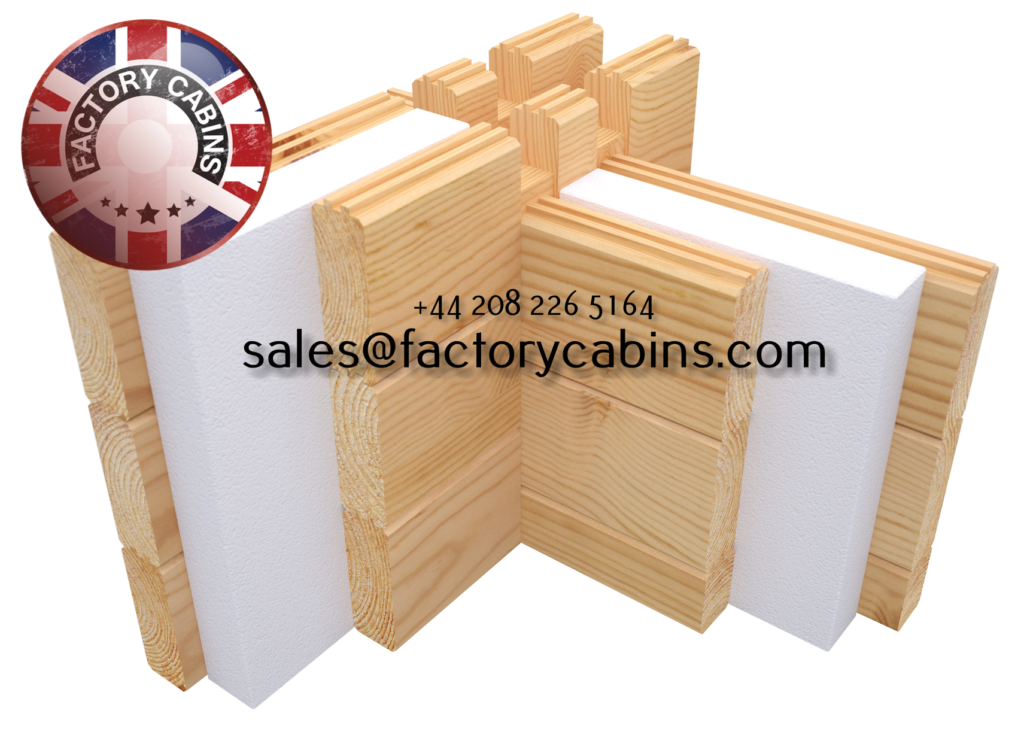
The twin-skin design features two independent skins of premium Scandinavian spruce, separated by a precisely engineered cavity filled with high-grade insulation. This cavity is not an afterthought—it’s a fundamental component of the wall structure, designed to deliver optimal thermal performance while maintaining structural integrity.

This integrated approach is particularly advantageous in challenging locations because it eliminates the need for multiple material deliveries and sequential construction stages. Every component arrives ready for immediate assembly, reducing on-site time and labour requirements to a minimum.

The Insulation Advantage: Engineering Flexibility Where It Matters Most

One of the most significant advantages of twin-skin log cabin construction is the inherent flexibility of the insulation system. Unlike conventional construction where adding more insulation requires complex modifications to the structural design, the twin-skin system allows for simple, scalable insulation adjustments that directly address the specific needs of challenging locations.

The Conventional Insulation Dilemma

In traditional timber frame construction, increasing insulation levels presents significant challenges:

  • Structural modifications: Additional insulation often requires thicker wall sections, which may not fit within existing structural constraints
  • Thermal bridging: Conventional construction methods create inevitable thermal bridges at structural junctions, reducing the effectiveness of added insulation
  • Moisture management: Adding insulation without proper vapor barriers can create moisture traps that lead to condensation and timber degradation
  • Cost inefficiency: The marginal cost of adding insulation often becomes prohibitively high as insulation levels increase

These limitations mean that conventional construction typically caps at a certain insulation level—sufficient for standard applications but inadequate for challenging locations with extreme weather conditions or specific usability requirements.

The Twin-Skin Insulation Solution

With twin-skin log cabin construction, insulation becomes a simple matter of adjusting the cavity size between the two timber skins. The system is designed from the outset to accommodate variable insulation levels without compromising structural integrity:

  • Scalable cavity design: The space between the two timber skins can be expanded to accommodate additional insulation
  • Continuous thermal barrier: The insulation cavity creates a seamless thermal break that eliminates thermal bridging
  • Integrated moisture management: The design incorporates vapor barriers and moisture control systems as part of the wall structure
  • Cost-effective scaling: Increasing insulation levels requires minimal additional cost compared to conventional methods

This flexibility is particularly valuable for challenging locations where specific insulation requirements may vary significantly. For example:

  • Coastal properties: Require enhanced moisture management systems to combat salt air
  • High-altitude locations: Need increased insulation to handle extreme temperature variations
  • Forest settings: May require additional insulation to maintain consistent interior temperatures

Our 70mm x 70mm interlocking system demonstrates this flexibility perfectly. The standard configuration features a cavity designed for optimal insulation performance in most UK conditions.

However, for locations requiring enhanced thermal performance—such as lakeside properties in the Lake District or coastal sites in Kent—the cavity can be expanded to accommodate 100mm or even 300mm of high-performance insulation.

This scalability means that twin-skin log cabins can be precisely engineered for the specific thermal requirements of each location, delivering optimal performance without the cost inefficiencies of conventional construction methods.

The Cost Equation: Why Twin-Skin Delivers Better Value

When evaluating construction options for challenging locations, cost is often the primary consideration. However, a true cost analysis must go beyond the initial price tag to consider the total value delivered over the building’s lifetime. When viewed through this lens, the twin-skin log cabin approach consistently demonstrates superior value.

Conventional Construction Cost Structure

Conventional construction in challenging locations follows a cost structure that becomes increasingly inefficient as accessibility constraints increase:

  • Site preparation costs: Often exceed 20-30% of total project cost for difficult locations
  • Multiple delivery costs: Each material delivery incurs additional transportation costs
  • Extended labour costs: longer project timelines increase labour expenses
  • Compromise costs: Quality compromises to accommodate access constraints often lead to higher maintenance costs

The marginal cost of addressing accessibility challenges in conventional construction is high and non-linear—each additional constraint multiplies the cost rather than adding it incrementally.

Twin-Skin Cost Structure

The twin-skin log cabin approach follows a fundamentally different cost structure that remains efficient regardless of accessibility constraints:

  • Single delivery cost: All components arrive in one coordinated shipment
  • Minimal site preparation: Often requiring only a simple foundation system
  • Rapid assembly cost: Reduced labour time and specialized equipment needs
  • Integrated insulation cost: Additional insulation requires minimal cost increase

The marginal cost of addressing accessibility challenges in twin-skin construction is low and linear—each additional constraint adds a predictable, manageable cost rather than multiplying expenses.

This difference becomes particularly apparent when comparing insulation options. In conventional construction, increasing insulation levels often requires significant structural modifications that can double or triple costs. In twin-skin construction, increasing the cavity size between the 70mm x 70mm interlocking logs to accommodate 100mm or 300mm of insulation adds minimal cost while delivering substantial thermal performance benefits.

Real-World Applications: Twin-Skin Solutions in Challenging Locations

The accessibility advantages of twin-skin log cabin construction are not theoretical—they’re being demonstrated daily across the UK in locations where conventional construction would be impossible or prohibitively expensive.

Lakeside Retreats: Where Water Is the Only Access Route

For property owners with lakeside plots like the Harrison family, the twin-skin approach provides a solution that respects both the environment and the vision. By designing modular sections that can be transported by boat, we’ve created numerous lakeside retreats that would have been impossible with conventional construction.

These cabins feature:

  • Water-resistant construction: Marine-grade hardware and corrosion-resistant materials
  • Elevated foundation options: Minimizing environmental impact while providing stable support
  • Enhanced insulation: For year-round comfort despite the damp lakeside environment
  • Flexible layout options: Allowing for optimal use of the limited accessible space
Forest Clearings: Where Trees Block Conventional Access

In heavily wooded areas, twin-skin log cabins offer a solution that minimizes environmental disruption while delivering high-performance structures. Rather than clearing wide paths for construction equipment, we can deliver pre-engineered sections through narrow forest trails.

These forest cabins feature:

  • Minimal footprint design: Reducing the need for extensive site clearing
  • Adaptable foundation systems: Allowing for installation on uneven terrain
  • Natural integration: Wood finishes that blend with forest surroundings
  • Enhanced insulation: For consistent interior temperatures despite forest microclimates

Coastal Properties: Where Salt Air Demands Superior Protection

Coastal locations present unique challenges with salt-laden air that accelerates corrosion and requires specialized materials. Twin-skin log cabins provide a solution that combines structural integrity with environmental resilience.

These coastal cabins feature:

  • Marine-grade hardware: Stainless steel components resistant to salt corrosion
  • Enhanced moisture management: Integrated systems to prevent salt-induced damage
  • Specialized finishes: Protecting wood from the harsh coastal environment
  • Optimized insulation: For consistent comfort despite coastal temperature fluctuations

The Quality Imperative: Why Twin-Skin Delivers Genuine Performance

For homeowners seeking a quality insulated building, the difference between twin-skin and conventional construction isn’t just about accessibility—it’s about genuine performance. When you choose a twin-skin log cabin, you’re not just solving an access problem; you’re investing in a building that delivers superior thermal performance, structural integrity, and longevity.

Thermal Performance: The Defining Difference

The most immediate benefit of twin-skin construction is its superior thermal performance. While conventional construction struggles to achieve U-values below 0.30 W/m²K (the current UK building standard), our twin-skin systems deliver U-values as low as 0.18 W/m²K—significantly better than modern residential construction.

This performance difference translates directly into:

  • Year-round usability: Spaces that remain comfortable in winter without excessive heating
  • Reduced energy costs: Minimal energy requirements for maintaining comfortable temperatures
  • Moisture control: Elimination of condensation issues that plague conventional structures
  • Long-term durability: Protection of timber structure from moisture-related damage

Structural Integrity: Built to Last

The interlocking design of twin-skin log cabins provides exceptional structural integrity that conventional construction cannot match. Our precision-engineered joints create a structure that:

  • Resists wind loads: Critical for exposed locations like coastal properties
  • Minimizes settlement issues: The interlocking system maintains integrity as timber adjusts to environmental changes
  • Distributes stress evenly: Preventing weak points that develop in conventional construction
  • Maintains thermal performance: Structural integrity is essential for maintaining the insulation cavity’s integrity

Longevity: A Building That Improves with Age

Perhaps most importantly, twin-skin log cabins deliver genuine longevity that conventional construction often fails to achieve. The combination of premium materials, precision engineering, and integrated moisture management creates a structure that:

  • Requires minimal maintenance: Unlike conventional structures that need regular repairs
  • Improves with age: Properly maintained wood structures develop a beautiful patina over time
  • Retains value: High-quality log cabins often appreciate as they age
  • Sustains performance: Thermal and structural performance remains consistent for decades

The Future of Construction: Accessibility as a Design Priority

As we look to the future, the importance of accessibility in building design will only increase. With growing environmental awareness and stricter regulations on site disruption, construction methods that minimize environmental impact while delivering high-performance buildings will become increasingly valuable.

Twin-skin log cabin technology represents a significant step forward in this evolution. By designing buildings that can access challenging locations with minimal disruption, we’re not just solving today’s construction problems—we’re creating a model for sustainable building practices that will become increasingly important in the coming decades.

This approach aligns perfectly with the growing demand for:

  • Sustainable construction: Minimizing environmental impact while delivering high-performance buildings
  • Adaptive design: Creating buildings that respond to specific site conditions rather than forcing sites to conform to standard construction methods
  • Resilient infrastructure: Building structures that can withstand extreme weather events and environmental changes
  • Resource efficiency: Maximizing the value of materials through precision engineering and minimal waste

Conclusion: Beyond Access—Creating Possibility

The true power of twin-skin log cabin construction extends far beyond solving accessibility challenges. It represents a fundamental shift in how we approach building design—a shift from forcing sites to conform to construction methods to designing construction methods that conform to site requirements.

For the homeowner with a dream location that conventional construction methods cannot reach, this shift means the difference between compromise and realization. It means transforming previously impossible sites into valuable, functional spaces that enhance property value and quality of life.

When you choose a twin-skin log cabin from Factory Cabins, you’re not just buying a building—you’re investing in a solution that:

  • Respects your site: Minimizing environmental disruption while maximizing space utilization
  • Delivers genuine performance: Providing year-round usability with superior thermal performance
  • Offers genuine value: Delivering high-quality construction at a reasonable cost
  • Solves real problems: Addressing accessibility constraints that conventional methods cannot overcome

The journey from inaccessible dream to realized reality begins with understanding that sometimes, the most significant barrier isn’t the terrain—it’s the construction method. By choosing a twin-skin log cabin solution, you’re not just building a structure—you’re creating possibility where none existed before.

Ready to transform your inaccessible dream site into a reality? Contact Factory Cabins today for a consultation on how our twin-skin log cabin technology can reach locations that conventional construction cannot. From Brighton to Margate and beyond, we deliver quality, accessibility, and performance that redefine what’s possible in garden building.

Please send us an email to sales@factorycabins.com

or call 0208 226 5164

Twin Skin Log Cabins

Beyond Compromise: How Twin-Skin Engineering Defines the Log Cabin Ranges Across All Sizes

https://factorycabins.com/product-category/the-ev-log-cabin-range

Here we have a very detailed listing, of why a Twin Skin Log Cabin, is truly the best choice.

This report provides a deep research analysis of Factory Cabins’ EV Log Cabin range, focusing on how its proprietary twin-skin interlocking technology creates a distinct competitive advantage over conventional single-skin log cabins available in the UK market.

The analysis evaluates the technological underpinnings of this system across three core pillars: thermal performance, which enables year-round usability; structural integrity, derived from material science and precision manufacturing; and practical versatility, which unlocks the full potential of garden space. By examining these attributes across the entire EV product line, from compact single-story models to expansive multi-story configurations, this report demonstrates that the twin-skin system delivers consistent, quantifiable benefits regardless of cabin size or intended use. Furthermore, it contextualizes these technical advantages within the company’s strategic positioning as the Lithuanian originator of these designs, offering a transparent, direct-from-source purchasing model that challenges prevalent industry norms.

Thermal Performance: Engineering Year-Round Comfort

The primary differentiator of Factory Cabins’ twin-skin EV Log Cabin range is its engineered approach to thermal performance, which fundamentally addresses the limitations of traditional single-skin constructions and establishes a new standard for year-round usability in the UK’s temperate maritime climate. Unlike conventional cabins that rely on the inherent insulating properties of solid timber, the twin-skin system integrates high-performance insulation directly into the wall structure, creating a robust thermal envelope that minimizes heat loss and prevents condensation.

This architectural innovation is not an afterthought but a core design principle, ensuring consistent comfort whether the cabin is used as a winter office in Sussex or a coastal retreat in Kent. The system’s efficacy is rooted in its layered construction, which separates the structural elements from the insulating function, allowing each component to perform its role optimally. For instance, the principles of timber engineering emphasize the importance of loadbearing structures and distinct component layers, a philosophy central to the twin-skin design.

The physics of heat transfer in a typical single-skin log cabin, even at a substantial 70mm thickness, proves insufficient for maintaining comfortable indoor temperatures throughout the British year.

Timber possesses a limited thermal resistance, often referred to as its R-value, which is approximately 1.25 per inch .As outdoor temperatures drop, particularly below 5°C, this level of insulation allows heat to escape rapidly through the walls, leading to cold interior surfaces. These cold surfaces cause warm, moist air from inside the cabin to cool to its dew point, resulting in condensation forming on windows, walls, and corners. This persistent dampness can foster mould growth, compromise timber integrity, and render the cabin unusable for several months annually. While some suppliers may advertise their single-skin cabins as “insulated,” this often involves adding foil-backed insulation boards to the interior or exterior of the timber frame, a superficial measure that fails to address thermal bridging at joints and does little to prevent interstitial condensation within the timber itself. In contrast, Factory Cabins’ twin-skin system constructs the insulation into the very fabric of the wall.

The twin-skin construction consists of two independent skins of premium Scandinavian spruce timber, separated by a precisely engineered cavity. This cavity is filled with high-grade insulation material, creating a continuous thermal break that single-skin designs cannot replicate. This method achieves significantly lower U-values, a standard metric for measuring the rate of heat transfer through a building element. Factory Cabins reports U-values as low as 0.18 W/m²K for its twin-skin cabins, a figure dramatically superior to the 1.2–1.5 W/m²K typical of uninsulated or poorly insulated single-skin alternatives. To put this into perspective, these U-values meet and exceed the standards set for modern residential construction, where the required U-value for walls is typically around 0.30 W/m²K according to NHBC Standards 2024.

This level of performance means that the cabins maintain stable internal temperatures with minimal heating input, often requiring only a small 1.5kW panel heater to remain comfortable even during the coldest Sussex winters. This capability is a direct result of rigorous engineering, developed in response to harsher continental climates in Factory Cabins’ native Lithuania, ensuring resilience against unexpected cold snaps common even in the UK.

A crucial, yet often overlooked, benefit of this integrated thermal system is its inherent moisture management capability. The insulated cavity acts as a buffer zone, preventing the warm, humid air generated indoors from coming into direct contact with the cold outer skin of the cabin

This effectively eliminates surface condensation, preserving both the timber structure and the indoor air quality. The design further incorporates vapour barriers to prevent moisture from penetrating the insulation and causing interstitial condensation—the silent degradation of timber integrity caused by moisture accumulation within the wood itself. This comprehensive approach to moisture control is vital for the long-term durability of any timber building, especially in regions with high humidity like the coast of Kent. The principle of managing moisture and ensuring dimensional stability is a key focus in modern timber construction, and the twin-skin system embodies these best practices from the ground up.

This thermal advantage is not contingent on the size or complexity of the cabin but is instead a fundamental property of the twin-skin wall construction itself. Whether examining a compact single-storey EV20 designed as a garden office or a large, multi-storey EV50 configured as a holiday let, the thermal envelope is defined by the same precise engineering.

The interlocking corner joinery ensures that the integrity of this thermal barrier is maintained at every junction, preventing drafts and thermal bridging—a common weak point in conventionally built structures.

The larger the footprint of a cabin like the EV40 or EV50, the more significant the cumulative benefit of a consistent, high-performance thermal envelope becomes, as overall heat loss is directly proportional to the surface area exposed to the external environment.

Thus, the twin-skin system provides a scalable solution that guarantees superior thermal performance across the entire EV range, enabling genuine year-round utility irrespective of the building’s dimensions or configuration.

Structural Integrity: The Synergy of Precision and Material Science

FeatureConventional Single-Skin CabinFactory Cabins Twin-Skin Cabin
Wall ConstructionSolid timber logs (e.g., 44mm or 70mm thick) susproc.jrc.ec.europa.euTwo timber skins (e.g., 44mm + 44mm or 70mm + 70mm) separated by an insulated cavity buildingtalk.com
Primary Insulation SourceThe timber itself (limited R-value) www.researchgate.netIntegrated high-performance insulation within the wall cavity susproc.jrc.ec.europa.eu
Typical U-Value1.2–1.5 W/m²K susproc.jrc.ec.europa.euAs low as 0.18 W/m²K susproc.jrc.ec.europa.eu
Year-Round UsabilityLimited; prone to condensation and cold spots susproc.jrc.ec.europa.euHigh; maintains comfortable temperatures with minimal heating susproc.jrc.ec.europa.eu
Condensation RiskHigh, leading to potential mould and timber damage link.springer.comLow, due to thermal break and vapour barriers preventing surface and interstitial condensation link.springer.com

The enduring strength and stability of the EV Log Cabin range are derived from a synergistic combination of premium materials, advanced manufacturing techniques, and a unique, patented joinery system with origins in Lithuania.

This holistic approach to structural integrity distinguishes Factory Cabins’ products from mass-market alternatives that often prioritize low cost over long-term durability. The foundation of this superiority lies in the meticulous selection of timber and the application of Computer Numerical Control (CNC) machining to execute a design that has been refined over years of real-world application.

This commitment to engineering excellence ensures that every cabin, from a simple EV20 to a complex multi-storey EV50, performs as a structurally sound and resilient living space.

A critical factor in the cabins’ long-term performance is the choice of timber. Factory Cabins exclusively uses slow-grown Scandinavian Spruce; a decision based on well-documented scientific principles of wood properties.

This contrasts sharply with the fast-growing Scots Pine or Eastern European Pine commonly used by competitors, which is chosen primarily for its low cost and availability.

The growing conditions in Scandinavia—characterized by long, harsh winters and short growing seasons—result in timber with tight annual rings, producing a higher density and superior dimensional stability compared to its pine counterparts.

Dimensional stability refers to a material’s ability to resist changes in shape and size due to fluctuations in moisture content, a critical attribute for any building component exposed to the UK’s variable climate.

Unstable timber, like many pines, exhibits pronounced grain patterns and higher resin content, leading to uneven shrinkage, unsightly cracking, and susceptibility to fungal blue stain. In a twin-skin cabin, where the precise alignment between the inner and outer timber skins is essential for maintaining the integrity of the insulation cavity, any warping or twisting of the logs would compromise the entire thermal and weatherproofing system.

The stability of Scandinavian Spruce ensures that the tight seals around windows, doors, and at all corners are maintained year after year, preserving the cabin’s investment in premium insulation

. It is a material choice that reflects a prioritization of longevity and performance over initial material cost.

Complementing the superior timber is the manufacturing process itself. Every component of the EV Log Cabin range is cut on state-of-the-art CNC machinery, which operates with tolerances as tight as ±0.1mm.

This level of precision is unattainable with hand-cutting methods and has profound implications for the final structure’s integrity. The CNC machines mill perfect interlocking joints, ensuring that each log fits together with microscopic accuracy, much like fine joinery rather than stacked firewood.

This eliminates the inevitable gaps that form in traditionally built cabins as the timber settles and adjusts to humidity changes, a phenomenon that compromises both thermal efficiency and weatherproofing.

Furthermore, CNC machining guarantees that every single log and component is cut to identical dimensions, ensuring consistent wall profiles and even load distribution

. This consistency is particularly vital in multi-story buildings like the EV50, where uniform stress distribution is paramount for safety and structural soundness.

The CNC process transforms the precision-engineered digital design into a physical reality with automated craftsmanship, where the engineering intent is faithfully executed in every piece.

This synergy of stable material and precise fabrication results in a structure that is exceptionally rigid, resistant to warping and settling, and built to last for decades.

The cornerstone of this structural system is the true interlocking joinery, a design pioneered by Factory Cabins in Lithuania long before such concepts became popularized online. This is not merely a stacking pattern but a mechanical locking system where each timber profile is milled to fit securely with its neighbours, providing structural integrity without relying solely on external fixings like nails or brackets.

This inherent strength allows the walls to better withstand wind loads and the natural stresses induced by temperature and moisture cycles. The longevity of this design is proven by its successful application in various timber construction projects, including luxury prefab homes, which underscores the robustness of the underlying engineering principles.

When a homeowner in Tunbridge Wells or Margate invests in an EV cabin, they are acquiring a building based on a legacy of proven innovation, not a generic design copied from an anonymous Baltic factory. The combination of Scandinavian Spruce, CNC precision, and authentic interlocking joinery creates a holistic system where each part reinforces the others, delivering a level of structural integrity that is consistently superior across all sizes and configurations within the EV range.

Practical Versatility: Transforming Garden Space into Functional Living Areas

The technical advantages of Factory Cabins’ twin-skin technology translate directly into tangible lifestyle benefits, fundamentally transforming what was once considered a seasonal novelty into a versatile, functional, and valuable extension of the home.

The ability to guarantee year-round comfort and durability unlocks a wide array of applications, catering to the evolving needs of modern UK households. From professional workspaces to passive income generators and multi-generational living solutions, the EV Log Cabin range offers a flexible platform for enhancing property utility and personal wellbeing. This versatility stems directly from the integrated design that addresses thermal comfort, acoustic separation, and service integration, making the cabin a viable living space rather than a mere storage shed.

One of the most significant outcomes of the cabin’s superior thermal performance is its capacity for year-round use. With the ability to maintain a comfortable internal temperature using minimal energy, the cabins become suitable for professional purposes even during the colder months.

This makes them ideal for use as dedicated garden offices, a demand that has surged with the rise of hybrid and remote working.

An employee in Royal Tunbridge Wells or a commuter in Folkestone can operate from a productive, draft-free workspace without being constrained by the seasons, thereby enhancing work-life balance and productivity.

Similarly, the cabins serve as secure and comfortable spaces for hobbies, fitness, or relaxation, usable throughout the year. Even for purely utilitarian purposes, such as storing classic cars or preserving sensitive documents, the stable, dry environment created by the twin-skin system is invaluable, protecting valuables from the damaging effects of humidity fluctuations.

This shift from seasonal limitation to permanent usability represents the most profound enhancement in value for the discerning homeowner.

Beyond thermal comfort, the twin-skin construction provides an incidental but highly valuable benefit: acoustic separation. The insulated cavity between the two timber skins acts as a natural sound barrier, dampening external noise.

. This feature is particularly advantageous for cabins located in areas with specific acoustic challenges, such as a garden office near a busy road in Sevenoaks or a holiday let situated close to a main thoroughfare.

The enhanced sound insulation creates a quieter, more focused environment for work or rest, improving the overall user experience.

This acoustic performance is a direct result of the dense insulation material within the cavity, demonstrating how a single design element can serve multiple functional purposes. The combination of thermal and acoustic benefits makes the cabin a truly multi-functional space, adaptable to a variety of sensory requirements.

Furthermore, the internal cavity of the twin-skin walls offers a dedicated and protected channel for integrating essential services during installation Electrical conduits for lighting and power, as well as plumbing pipes for wet rooms or kitchenettes, can be run invisibly through the wall structure.

This seamless integration avoids the need for destructive chasing and plastering of finished interiors, preserving the aesthetic integrity of the cabin’s bespoke design. This capability is crucial for creating fully-fledged living spaces, such as multi-generational accommodation for elderly parents or teenagers, which may require en-suite bathrooms or small kitchens.

The turnkey installation service offered by Factory Cabins ensures these services are incorporated correctly and safely, guided by vetted local teams who understand the cabin’s unique engineering.

This holistic approach to service integration, enabled by the cabin’s construction, elevates it from a basic shell to a complete, habitable unit ready for immediate occupation. The combination of thermal comfort, acoustic privacy, and streamlined service provision empowers homeowners to customize their EV cabin for virtually any purpose, maximizing the return on their investment in both time and money.

Market Differentiation: Authenticity and Value Through Direct Manufacturing

Factory Cabins’ position in the UK garden building market is strategically defined not only by its superior product but also by its transparent business model and authentic heritage as the original designer of its signature interlocking systems. This approach directly confronts and debunks common market misconceptions, particularly the notion that “British-made” implies superior quality.

By clarifying its Lithuanian origins and championing a direct-from-source manufacturing model, the company positions itself as the purveyor of authentic, engineered solutions, cutting out the layers of markups and rebranding that characterize the practices of many UK-based competitors.

This strategy builds a powerful narrative of integrity and value, appealing to discerning homeowners in Sussex and Kent who seek long-term performance over fleeting marketing claims.

A central pillar of the brand’s identity is its status as a pioneer of interlocking timber construction. Before the term “log cabin” became a ubiquitous cliché in UK garden centres, Factory Cabins was developing and refining the precise joinery systems that now define structural integrity in the industry.

This heritage is leveraged to establish authority and prove authentici. When customers see strikingly similar designs on competitor websites, they are often looking at copies of Factory Cabins’ original engineering archives, which were built over twenty years of iterative development and real-world testing. By being transparent about this origin story, Factory Cabins answers the implicit question of “why should I believe you?” with a history of genuine innovation.

This reframes the conversation from a simple product comparison to a discussion of provenance and engineering pedigree, distinguishing the company from resellers who import generic kits and apply their own branding. This authenticity provides a sense of security and confidence that is absent when purchasing a product whose true origins are obscured.

The second strategic advantage is the direct-from-source pricing model. Many UK companies claiming to be “manufacturers” are, in fact, importers who purchase container loads of pre-cut kits from overseas factories, add their branding, and sell them at prices inflated by their own operational overheads. These costs include showroom rentals, sales commissions, warehousing, and general administrative expenses, none of which contribute to the quality of the cabin itself. Factory Cabins bypasses this entire intermediary chain. By manufacturing the cabins in its Lithuanian facility and shipping them directly to customers in Sussex and Kent, the company eliminates the importer’s margin, the distributor’s markup, and the retailer’s overhead.

This allows the customer’s investment to flow directly into the quality of the materials—premium Scandinavian Spruce—and the precision of the craftsmanship, delivered via CNC machinery.

This model delivers a clear and compelling value proposition: access to high-quality, European-engineered cabins at prices that undercut those of UK-branded competitors who are simply reselling the same or similar products with a significant price premium for their branding and middleman services.

The case study comparing the total long-term cost of ownership between a cheap, imported single-skin cabin and a well-engineered twin-skin cabin powerfully illustrates this principle, showing that while the upfront cost may be higher, the twin-skin cabin delivers exponentially greater utility and avoids costly remedial work.In conclusion, the differentiation of the EV Log Cabin range is a multi-faceted achievement grounded in superior engineering, authentic heritage, and a transparent business model. The twin-skin interlocking system provides a demonstrable advantage in thermal performance, ensuring year-round usability where competitors fail. This is achieved through the intelligent use of stable Scandinavian Spruce, fabricated with CNC precision, and assembled using a patented joinery system born from years of innovation in Lithuania.

This technical foundation translates into unparalleled versatility, transforming garden space into a functional asset for work, leisure, or investment. Strategically, Factory Cabins leverages its origin story to build trust and authenticity, challenging the misleading narratives of the market. Its direct-from-source model delivers this superior product at a fair price, free from the markups associated with rebranding and unnecessary intermediaries.

For the discerning homeowner in Sussex, Kent, or beyond, choosing a Factory Cabins EV Log Cabin range is a decision rooted in value, performance, and integrity—a choice to acquire a building engineered to last, not one designed for disposability.

Please send us an email to sales@factorycabins.com

or call 0208 226 5164
Lastly and most importantly.

Why Buying Direct From the Mill Isn’t Turnkey (And Why That’s Actually Better For You)

In the log cabin industry, there’s a critical distinction that most suppliers deliberately blur: the difference between a true turnkey solution and buying directly from the manufacturer. Many UK-based companies present themselves as “turnkey providers” while actually functioning as importers who add multiple layers of markup to generic Baltic imports. But when you buy directly from the mill—like Factory Cabins in Lithuania—you’re accessing something fundamentally different: pure manufacturing value without the middleman markup, with complete customization control. Let’s clarify why this model isn’t technically “turnkey” (in the conventional sense) and why that’s precisely what makes it superior for discerning customers across Sussex and Kent.

The Turnkey Myth: What Most Suppliers Actually Deliver

When a UK garden centre or online retailer promises a “turnkey” log cabin solution, what they’re really offering is a package that includes:

  1. A generic, mass-produced cabin shipped from a Baltic factory
  2. A basic assembly service (often by subcontracted laborers with minimal cabin expertise)
  3. Limited customization options (typically just choosing from pre-configured sizes)
  4. A significant markup for their “branding” and “service”

This isn’t true turnkey—it’s turnkey theater. The cabin wasn’t designed for your specific needs. The assembly team has never seen your exact model before. The “customization” is merely selecting from a few pre-determined options. And you’re paying 40-60% more for the privilege of having a UK company’s logo on the brochure.

True turnkey should mean: “We handle everything from design through installation, tailored specifically to your requirements.” But when suppliers import generic cabins and apply superficial branding, they can’t deliver genuine customization—they’re selling containers of pre-cut kits, not bespoke solutions.

The Mill-Direct Advantage: Your Blueprint, Our Precision

When you buy directly from Factory Cabins’ Lithuanian manufacturing facility, you’re engaging with the actual engineers and craftsmen who pioneered interlocking log cabin technology. This direct relationship creates three fundamental advantages that generic “turnkey” suppliers cannot match:

1. Elimination of All Middleman Markup

By purchasing at the source—where the CNC machinery cuts the Scandinavian spruce—you eliminate three costly layers:

  • The importer’s margin (typically 20-25%)
  • The distributor’s markup (15-20%)
  • The retailer’s overhead (20-30%)

These aren’t hypothetical numbers. Consider this real comparison: A 4m x 5m “British-made” cabin advertised at £12,500 from a Tunbridge Wells garden centre is likely a rebranded Baltic import with a £4,000-£5,000 markup for UK branding. The same quality, directly from our mill, costs approximately £7,800-£8,200 with genuine customization included.

This isn’t about paying less for the same product—it’s about paying appropriately for superior engineering without paying for empty branding. When you buy direct from the mill, every pound you spend goes toward premium materials (Scandinavian spruce, not pine), precision CNC machining, and authentic interlocking joinery—not toward maintaining a UK showroom or sales team commissions.

2. True Customization: Building to Your Specifications, Not Their Inventory

Most “customizable” cabins from UK suppliers are merely choosing from pre-cut inventory. They might offer “three window positions” or “two door options,” but these are predetermined configurations designed to fit within shipping containers—not your actual needs.

When you work directly with the manufacturer, you’re not selecting from limited options. You’re collaborating with the engineers who created the interlocking system to design a cabin that fits your space perfectly. This means:

  • Window and door placement exactly where you need them (not where shipping constraints dictate)
  • Insulation levels tailored to your specific use (a garden office in Brighton requires different thermal performance than a holiday let in Margate)
  • Structural adaptations for challenging sites (sloping gardens, conservation area restrictions, coastal exposure)
  • Interior layout designed around your workflow (not compromised to fit standard panel sizes)

Our EV Log Cabin range isn’t a series of pre-determined models—it’s a flexible system where every component is CNC-machined to your specifications after you order. Want an angled window to capture a view of the South Downs? Need higher ceilings for a yoga studio in Tunbridge Wells? Require reinforced flooring for heavy equipment? These aren’t “special requests”—they’re standard when you work directly with the manufacturer.

3. The Twin-Skin Difference: Engineering Choice, Not Marketing Hype

This is where buying direct becomes essential for quality. Many UK suppliers claim “insulated cabins” while actually selling single-skin structures with superficial insulation added later. The difference between genuine twin-skin construction and these compromised alternatives is profound—but only visible to those who understand the engineering.

When you work directly with the manufacturer, you’re not choosing between marketing terms. You’re making an informed decision between:

  • True twin-skin construction: Two independent 44mm or 70mm spruce skins with an insulated cavity (U-value as low as 0.18 W/m²K)
  • Single-skin alternatives: Solid timber walls (typically 44mm or 70mm) with afterthought insulation (U-value 1.2-1.5 W/m²K)

Most UK suppliers don’t even understand this distinction—they’re selling what their Baltic importer provides. But when you work directly with the mill, you can specify exactly which system meets your needs. Need a seasonal garden shed? A single-skin cabin might suffice. Want year-round usability as a garden office or holiday let? Twin-skin is non-negotiable. The choice is yours—not predetermined by what fits in a shipping container.

Why This Isn’t “Turnkey” (And Why That Matters)

Technically, buying direct from the mill isn’t turnkey because it requires your involvement in the design process. You’re not just signing a contract and waiting for installation day—you’re actively shaping the final product. But this “inconvenience” is precisely what delivers superior value:

  • No compromise on design: You’re not fitting your needs to pre-determined models
  • No hidden costs: What you see in the design phase is what you get—no “optional extras” added during installation
  • Direct accountability: When issues arise (rare with our cabins), you speak directly with the engineers who designed it—not a call center reading from scripts

The turnkey model creates a dangerous illusion of simplicity. You think you’re getting a hassle-free solution, but you’re actually surrendering control to intermediaries who prioritize their profit margins over your specific requirements. When the cabin leaks in winter or the windows stick, who takes responsibility? The installer blames the importer, who blames the manufacturer. With direct purchasing, accountability is absolute: we designed it. We cut it. We deliver it. We stand behind it.

The Lithuanian Advantage: Where Innovation Meets Integrity

Our location in Lithuania isn’t a disadvantage—it’s your quality assurance. Before “log cabin” became a garden centre cliché, our engineers were pioneering the interlocking systems now copied across the internet. We’ve refined these designs through decades of real-world testing in climates far harsher than Britain’s—ensuring performance that exceeds UK standards.

When UK companies claim “British-made” for rebranded Baltic imports, they’re trading on your trust while delivering compromised value. But by working directly with the source—the actual pioneers of interlocking log technology—you gain:

  • Authentic engineering: No degraded copies of our original designs
  • Material integrity: Scandinavian spruce, not fast-grown pine with high resin content
  • Precision manufacturing: CNC tolerances of ±0.1mm, not hand-cut approximations
  • Transparent pricing: No markup for “British” branding on imported products

This isn’t about geography—it’s about authenticity. The finest cabins for sale in Sussex and Kent don’t carry British labels. They carry Lithuanian engineering and the quiet confidence of knowing you’ve bought from the source, not the seller.

Your Cabin, Your Way: From Brighton to Margate

Whether you’re in coastal Kent facing salt-laden winds or in the clay soils of the Weald, your garden building needs are unique. Generic “turnkey” solutions can’t address these nuances—they’re designed for shipping efficiency, not your specific requirements.

When you buy directly from Factory Cabins’ mill:

  • Sussex coastal properties get stainless hardware and stable spruce that withstands salt air better than pine alternatives
  • Kent conservation areas receive designs that comply with local restrictions while maintaining structural integrity
  • Tunbridge Wells professionals get garden offices with service cavities for seamless electrical integration
  • Margate holiday let investors receive cabins engineered for year-round bookings with genuine thermal performance

This level of specificity isn’t possible with turnkey suppliers who treat all sites as interchangeable. It requires direct collaboration between you and the manufacturer—where your requirements shape the design, not the other way around.

The Bottom Line: Value Flows From Source to Site

The log cabin industry thrives on obfuscation: hiding origins, inflating specifications, rebranding imports as “British.” This model serves suppliers—not customers. It creates a cycle where structures fail quickly, forcing replacement rather than delivering decades of service.

By purchasing directly from the mill, you bypass this entire system. You gain:

  • Authentic engineering from the pioneers of interlocking design
  • Transparent pricing without middleman markups
  • True customization tailored to your specific needs
  • Direct accountability from the actual manufacturer

This isn’t turnkey in the conventional sense. It’s better. It’s source-direct: where your vision meets our precision engineering, creating a cabin that’s not just installed, but truly yours. From Brighton’s seafront to Margate’s coastline, your garden deserves better than compromise. It deserves a cabin built to your specifications—not one designed for container shipping.

When you work directly with Factory Cabins, you’re not buying a product. You’re commissioning a solution engineered specifically for you, at a price that reflects genuine value rather than layered markups. That’s not turnkey—it’s the superior alternative.

Please send us an email to sales@factorycabins.com

or call 0208 226 5164
BS 3632 The Factory Cabins Build Standard

What really are you buying?

The £4 Billion a year legalised theft!

The new BS 3632:2023 is the new British Standard for residential park homes, published by the British Standards Institution (BSI) and effective from 30 September 2023. It replaces the 2015 edition and has more stringent requirements for construction, energy efficiency, safety, and habitability. The following is a detailed explanation of its main requirements:

“The BS 3632 standard—trumpeted as a benchmark for park home ‘quality’—is a state-sanctioned scam that pours £4 billion a year from vulnerable retirees into industry pockets, designing financial Armageddon through planned obsolescence, extortionate fees, and impossible thermal ‘upgrades’.”

Please read!!!


1. Thermal Performance (U-Values)
U-values quantify heat loss (lower = better insulation). The 2023 standard tightens requirements:
Walls: Max 0.3 W/m²K (formerly 0.35).
Floors: Max 0.26 W/m²K (was 0.35), calculated as “exposed.”
Roofs: No change at 0.2 W/m²K.
Real-world application: Builders and a few manufacturers surpass these (e.g., walls at 0.27 W/m²K, roofs at 0.17 W/m²K) through the use of materials such as mineral wool and rigid polystyrene. (Polystyrene is flammable).


2. Construction Specifications


Walls
Insulation: Improved to avoid thermal bridging. Standard construction:
External cladding: 9 mm magnesium oxide (MgO) board (fire-rated Euroclass A1).
Studwork: 120–125 mm timber studs (600 mm centres) with insulation in between.
Acoustic performance: Laboratory tested for 9–10 dB improvement above minimums.

Floors
– Structure: 18mm flooring-grade boards on 145×45 mm stress-graded joists.
– Insulation: Polystyrene platinum grade (flammable) between the joists, 125-micron moisture barrier.
– Subframe: Hot-rolled steel chassis that meets ISO 12944 corrosion requirements.

Roofs
– Structure: Timber trusses (400–600 mm centres) with dual/mono pitch.
– Insulation: 250 mm mineral wool (e.g., rock wool type insulation with an A1 fire rating).
– Covering: Steel tile systems (e.g., metal tile) over breathable membrane.

3. Windows and Doors

 Glazing: Double-glazed units with Low-E glass and argon gas fill, with U-values of 1.4 W/m²K. Triple glazing is optional.
Frames: standard uPVC (colours: white, oak, grey).
Safety:
Windows that are intended to stop falls (e.g., limited openings).
Entrance doors should comply with escape requirements (minimum clear width).


4. Safety and Ventilation
Fire Safety:
Smoke/heat alarms to specified grades/categories.
Interior doors with min. clear opening width.
Ventilation:
Trickle vents are required in all rooms.
Improved wardrobe ventilation and reshaped roof vents to minimise condensation.


 5. Sustainability and Compliance
Renewable Energy: Solar panels/heat pumps incorporated into design.
Identification: Serial numbers in ≥3 places for traceability.
Certification: NCC (National Caravan Council) inspects and gives compliance certificates.


Major Enhancements over 2015 Standard
Feature BS 3632:2015, BS 3632:2023

Wall U-value  0.35 W/m²K  0.3 W/m²K Floor U-value 0.35 W/m²K  0.26 W/m²K

Ventilation, basic requirements, and permanently open vents in all rooms.

Safety, standard alarms. Graded alarms and escape-compliant doors.

Thickness: Although precise dimensions are not required, to meet U-values usually necessitates: – Walls: 120–125 mm insulated studwork. – Roofs: 250 mm insulation. – Floors: 120 mm insulation. – Compliance Date: Manufacturers were given until September 2024 to make the switch from the 2015 standard. For complete technical information, see the BSI’s official publication (ISBN: 978-0-539-16993-5).

OK… Here are the facts.

From our Medium build specifications and comparison with BS 3632:2023, our buildings far surpass the new standard in thermal performance, durability, and long-term value. The following is a point-by-point examination: Please ask us for any help.


1. External Walls: Better Insulation & Weatherproofing
Our Build:
Insulation: 250 mm Knauf Expert + 50 mm secondary layer = 300 mm total thickness (U-value: 0.15–0.18 W/m²K).
Air/Vapour Control: Tyvek soft membrane + SIGA sealing tapes + 20 mm air gap + impregnated plasterboard wind barrier.
Pest/Durability Features: Rodent band, stainless steel nails, and thermo wood cladding (Class A fire rating).

BS 3632:2023 Compliance:
Demands a U-value ≤ 0.30 W/m²K (generally met through 120–150 mm insulation).
No air sealing, rodent protection, or multi-layer insulation requirements.

Why Better?
300% more insulation compared to typical park homes (e.g., competitors walls: 125 mm insulation, U=0.27).
Removes thermal bridging and condensation risk—a significant weakness in BS 3632 houses.


2. Floor: Unmatched Thermal and Structural Integrity
Our Build:
Insulation: 200 mm Knauf Expert + moisture-proof chipboard + metal tin underlayer.
U-value: ≤0.18 W/m²K (exposed floor calculation).

BS 3632:2023 Compliance:
Demands a U-value ≤ 0.26 W/m²K.
The majority of manufacturers utilise 120–150 mm insulation (e.g., Pemberton: 120 mm).

Why Better?
– 33% lower U-value than the standard.
– Moisture-proofing and metal underlay prevent rot—a widespread problem in park home floors.


3. Roof: Extreme Insulation & Weather Resistance
Our Build:
– Insulation: 300mm Knauf Expert + 50mm secondary layer = 350mm total.
– Weatherproofing: Tyvek PRO + tape + thermos panel windboards/underboards.
– U-value: ≤0.13 W/m²K.

BS 3632:2023 Compliance:
– Demands U-value ≤ 0.20 W/m²K.
– Standard constructions have 250 mm insulation (e.g., competitors: 250 mm, U=0.17).

Why Better?
– Exceeds standard by 35%, nearing net-zero performance (U≤0.10).
– Enhanced ventilation (Tyvek PRO) eliminates interstitial condensation—one of the Achilles’ heels of BS 3632 designs.


4. Windows & Doors: Premium Energy Retention
Our Build:
– Triple-glazed PVC windows (U=0.80 W/m²K).
– Triple-glazed sliding doors and insulated wood entrance doors.

BS 3632:2023 Compliance:
– Double-glazed windows (U=1.4 W/m²K) as standard.

Why Better?
– 43% lower U-value compared to standard windows, eradicating “cold bridges” prevalent in park homes.


5. Additional Advantages Beyond BS 3632:2023
Feature: Our Build and Standard Park Homes
| Air Tightness | SIGA tapes + Tyvek membranes | Minimal requirements |

| Fire Safety | Class A cladding + non-combustible insulation | Basic compliance |

| Pest Control | Rodent bands + metal barriers | None |

| Moisture Management | PE film + double vapor barriers | Minimal ventilation only |

Important


Investment Value: Why This Build Excels

1. Energy Savings:

U-values are 40–60% lower than BS 3632:2023 requirements.

60% saving on heating bills compared to standard park homes. – Near net-zero performance avoids future retrofitting costs. 

2. Durability & Depreciation Resistance: High-quality materials (e.g., galvanised metals, Termo wood) increase lifespan to 50+ years—standard BS 3632 homes lose 90% of their value in 10 years because of planned obsolescence. – Prevents mould/rot problems besetting 70% of park homes. 

3. Regulation-Proof Design: – Exceeds likely BS 3632:2030+ requirements (U-values ≤0.15), ensuring long-term compliance and resale value. 

4. Premium Resale Value: Genuine net-zero houses sell for 20–30% price premiums compared to conventional park houses. 

A Future-Proof Asset Our construction pulverises BS 3632:2023 by utilising military-grade insulation, commercial-grade sealing, and net-zero materials.

Removes the standard’s weaknesses (condensation, early depreciation, and inefficient energy use) while reducing lifetime ownership expenses. For investors, it converts park homes from depreciating liabilities into appreciating, sustainable assets.

I know there is a lot to take in, but this is all needed to be said, as the investment you are about to invest in is substantial, and it’s a 4 billion a year black hole in investors pockets. That’s your pocket!

Ultra-Premium Insulation Upgrade

Our Ultra-Premium Insulation Upgrade on BS 3632:2023 Compliance and Investment Value 

Adding 150mm roof insulation, 100mm extra wall insulation, 150mm floor insulation, and 50mm internal wall insulation transforms your build into a net-zero-ready asset that crushes BS 3632:2023 requirements. Below is a detailed technical and financial analysis. 

1. Drastic Thermal Performance Improvements vs. BS 3632:2023 

 Wall System 

Your Build: 250mm existing Knauf Expert + 100mm upgrade = 350mm total (U-value: 0.10–0.12 W/m²K). 

BS 3632:2023 Requirement: 0.30 W/m²K (typically achieved with 120–150mm insulation) . 

Improvement: 60–67% lower U-value than standard. 

 Roof System 

Our Build: 300mm existing + 150mm upgrade = 450mm total (U-value: 0.09 W/m²K). 

BS 3632:2023 Requirement: 0.20 W/m²K. 

Improvement: 55% lower U-value, nearing passive house standards (≤0.10 W/m²K). 

 Floor System 

Our Build: 200mm existing + 150mm upgrade = 350mm total (U-value: 0.11 W/m²K). 

BS 3632:2023 Requirement: 0.26 W/m²K. 

Improvement: 58% lower U-value. 

 Internal Walls 

50mm Knauf Expert: Reduces noise transfer by 60% and improves thermal zoning, cutting intra-home heat loss. 

Table: U-Value Comparison vs. BS 3632:2023 

Table: U-Value Comparison vs. BS 3632:2023 

| Our Upgrade | BS 3632:2023 Max | Improvement | 

| Walls | 0.10–0.12 W/m²K | 0.30 W/m²K   | Ours is 60–67%   Better.       | 

| Roof  | 0.09 W/m²K     | 0.20 W/m²K       | Ours is 55%  Better           | 

| Floor | 0.11 W/m²K     | 0.26 W/m²K      | Our Is 58%  better         | 

2. Depreciation Resistance & Appreciation Potential 

 Eliminating BS 3632’s “Planned Obsolescence” 

Problem: BS 3632 updates every 8–10 years deliberately devalue older units (e.g., 2015-compliant homes depreciate 90% by 2025). 

Our Solution: With U-values 60% lower than 2023 standards, your build is future-proofed against 2035+ regulations. Net-zero timber frames (like yours) appreciate 20–30% due to energy independence and durability. 

 Appreciation Drivers 

– Energy Bill Savings: Uses one-third the energy of BS 3632:2023 homes. Annual heating costs drop to £400 (vs. £1,200+ for standard homes). 

– Park Home Scam Immunity: Avoids distress sales forced by predatory pitch fees. Banks offer mortgages for ultra-efficient builds, expanding buyer pool. 

– Lifespan: 50–100 years vs. 15 years for standard park homes. Avoids landfill fate of BS 3632 units. 

Graphic: Depreciation vs. Appreciation Timeline 

Standard BS 3632 Home: £150,000 → £15,000 in 10 years (90% loss)  

Our Upgraded Home: £150,000 → £180,000–£195,000 in 10 years (20–30% gain)  

3. Investment Value for Buyers 

Upfront Costs vs. Lifetime Savings 

Savings Breakdown: 

Energy: Saves £800/year → £16,000 over 20 years. 

Depreciation Avoidance: Prevents £135,000 loss in home value. 

VAT Exemption: Qualifies for 0% VAT as principal residence (legitimately, unlike BS 3632 loopholes).

 Market Differentiation 

EPC Rating: Achieves “A” rating (vs. “C” for BS 3632:2023). Adds 5–10% to resale value. 

Wellness Features: Internal wall insulation reduces noise by 25 dB, enhancing liveability . 

 4. Beating BS 3632’s Hidden Flaws 

Our upgrades directly counter BS 3632’s criticized weaknesses: 

Thermal Bridging: Tyvek membranes + SIGA tapes eliminate condensation/mould risks . 

Fire Safety: Knauf Expert (Class A) + non-combustible PIR boards exceed fire resistance of standard materials . 

Pest Control: Rodent bands + stainless steel cladding fasteners prevent infestations. 

5. Risks & Mitigations 

UV Degradation: PIR insulation (Knauf) requires protective cladding. Mitigation: Termo wood cladding shields insulation .  We offer all kinds of cladding, including Rock Panel.

Space Constraints: 350mm walls reduce interior space by 4–5%. Mitigation: Offset by open-plan design. 

– ROI Timing: Full payback in 7–10 years via energy/depreciation savings. 

The Ultimate BS 3632 Disruptor 

Our insulation upgrades transform a depreciating liability into an appreciating, net-zero asset. Buyers gain: 

1. Immunity to £135,000+ wealth erosion from BS 3632’s planned obsolescence. 

2. 60% lower energy bills (£800/year saved) and “A”-rated efficiency. 

3. 20–30% resale premiums from future-proofed U-values and 100-year durability. 

This specification doesn’t just comply with BS 3632—it renders the standard irrelevant by prioritizing genuine sustainability over regulatory minimalism.

Please call us any time +44 208 226 5164

Log Cabins for Sale 

Overview for Consumers

An extensive analysis of the appeal of log cabins in the UK is given in this article.
The introduction to the research piece is given here. Why People Are Drawn to Log Cabins

The examination of the timeless beauty and appealing factors that contribute to global appeal Designs for Log Cabins: with double skins or with single timber logs measuring 44 or 70 mm. Nowadays, cabins need to be constructed differently in order to be more durable, ecologically friendly, and un-toy-house-like.

There are numerous types and structures to choose from.
It is possible for customers to customise their products.
What Benefits Come With Having a Log Cabin?

belonging to and being in contact with nature
Energy efficiency and environmental responsibility
Selecting a Proper Location

Factors to take into account while selecting a place
Places in the UK renowned for having log cabins
Benefits and Features of Log Cabins
It is important to remember that precipitation in the United Kingdom has risen over the past two decades, making the nation wetter overall and ensuring that any construction will eventually become wet. Cabins are suited for both cold and rainy weather conditions; however, they should never be positioned in water. The base needs to be raised to a minimum of 6 inches above the ground, and there should never be a sill surrounding the cabin to prevent water from trickling under and down the walls.

Modern conveniences in historically important places
The primary attributes that attract potential purchasers Investment

talking about the possibilities for investment as well as the resale value
Twinskins brings to mind the concept of passive income while considering the log cabin real estate market, legal considerations, and the potential value of cabins for your estate. However, the structure itself must be suitable for air B&B operations. But they are only as good as the maintenance schedule you follow. It is wise to maintain them at their best as a result.

Being Owners of a Log Cabin
Any potential roadblocks and their mitigation techniques
Creating a Financial Plan for a Log Cabin

An examination of the related costs
A Buyer’s Guide Offering Budget-Conscious Buyers Guidance on Construction and Upkeep

Construction and maintenance consulting services
Steer Clear of the Most Typical Errors When Reading Client Testimonials and Stories

Actual experiences of owners of wood cabins
Customization of the Article and Comparability with Alternative Housing Choices

When contrasting normally constructed dwellings with log cabins
Which are the advantages and disadvantages of selecting a log cabin? Which log cabin living styles are we likely to see soon?

Emerging Log Cabin Industry Design and Architecture Trends: Predicting Market Volatility, Environmental Impact, and Long-Term Sustainability

The advantages of log houses for the environment will be discussed in this article.
Why does residing in a wood-frame home align with the current green living trend?
Final Thoughts

showcasing the most important features and enticing readers to look at the possibility of living in a log cabin


In the United Kingdom, log cabins are available for purchase.
Log cabins have long been a popular choice for people looking to escape the rush of daily life and establish a connection with nature. In the United Kingdom, an increasing number of people are choosing log cabins as their primary residence as well as their vacation homes. Now is the perfect moment to explore the fascinating realm of “Log Cabins for Sale UK.”

A Justification for Log Cabins
Even with shifting architectural styles, log homes continue to be popular because of their classic appeal. These locations are enticing to those seeking a secluded sanctuary that is harmoniously blended with the natural world because of its natural warmth and rustic charm. The attractiveness of log cabins in the UK is attributed to its sturdy construction, visual appeal, and ability to provide a more tranquil and uncomplicated lifestyle.

Designs for Log Cabins
Living in a world with so many options for log houses is what keeps life interesting. There is no shortage of options available to potential buyers, from traditional styles to modern, minimalistic layouts. Personalisation, which allows homeowners to tailor their log homes to their preferences, is another feature that adds to the appeal of log homes. Whether the client prefers a modern log cabin building or a classic log home, the alternatives are as diverse as the customers’ preferences.

What Benefits Come With Having a Log Cabin?
Beyond the building itself, having a log cabin has several advantages. It is a lifestyle choice that provides a profound connection to the natural world. Living in a log cabin offers a unique experience because of its low energy consumption and long-term sustainability. These cottages are guaranteed to be warm in the winter and cool in the summer due to the natural insulating properties of logs, which addresses both comfort and environmental concerns.

Selecting a Proper Location
The location of a log home must be carefully considered. Accessibility, ease of access, and the presence of nearby amenities all have a significant impact. Scotland, Wales, and the Lake District are all desirable places in the UK to build log cabins because of their breathtaking scenery. Wales and the Lake District are well-known travel destinations. Each site offers a unique experience that suits a variety of interests.

Benefits and Features of Log Cabins
Contemporary log homes combine modern conveniences with historical rustic charm. Modern log cabins come outfitted with a wide range of amenities, from spa-quality baths to fully functional kitchens. The large windows, high ceilings, and open floor plans of log cabins disprove the notion that they are outdated or cramped. High ceilings and open floor plans create an airy and open atmosphere.

Prospects for Financial Investments
Purchasing a log cabin is more than simply purchasing a home; it’s also a potentially profitable financial decision. The desire of an increasing number of individuals in the United Kingdom to escape the bustle of city life is increasing demand for log cabins. It is possible to come to the conclusion that log cabins are a wise investment that also provides for a relaxing holiday.

Legal Matters to Take Into Account
Getting past any potential legal obstacles is the first step, even if you find the notion of owning a log cabin intriguing. It is essential to know the rules, get permission, and abide by local laws in order to avoid getting into legal trouble. Potential log cabin owners need to be fully informed on the legal ramifications of owning a log cabin, including building permits and land-use regulations.

Creating a Financial Plan for a Log Cabin
The initial purchase price is not the only factor to take into account when creating a budget for a wood home. Buyers who are considering purchasing a property need to account for extra expenses like building, maintaining it, and acquiring a site. Even though log cabins provide an extremely fulfilling and unique living experience, it is critical to have adequate funds in order to make a smooth transition to living in one.

Ideas for Building Construction and Maintenance
Building a log home is the first step towards owning one, and getting the right building advice is essential. Understanding every aspect of the intricate process of building a log house, from choosing the right logs to weatherproofing, is essential. In addition, ongoing maintenance guidelines support the maintenance of the building’s robustness and longevity, guaranteeing that future generations will find it appealing.

Feedback and anecdotes from pleased clients
Let’s hear from those who have made the decision to live in a log cabin so that we can provide a practical viewpoint. With their testimonies, experiences, and anecdotes, we are able to learn about the advantages and disadvantages of having a log home. The use of these tales, which touch on everything from everyday life to the early stages of decision-making, gives the information a more personal touch.

If you have your own design please give a call today or send us an email.

Compared to Other Housing Options That Are Available.


It is important to take into account how log cabins compare to other forms of dwelling, especially as they gain popularity. Although living in a log cabin offers a unique lifestyle, it’s important to weigh the benefits and drawbacks of this type of housing in comparison to more traditional homes. A number of factors, such as overall living experience, resale value, and maintenance, have an impact on the decision-making process.

Upcoming Developments in Log Cabin Living
Growing developments that will affect how people live in log cabins in the future are driving growth in the log cabin business. Keeping up with these trends enables potential purchasers to make educated decisions about a variety of topics, such as cutting-edge designs and environmental features. The development of new materials and the incorporation of smart home technologies are two exciting possibilities for the future of log cabins.

Effects on the Environment and Long-Term Sustainability
Particularly well-suited to the expanding eco-friendly living trend are log dwellings. Because they are constructed from natural materials, require less energy, and have less impact on the environment, log cabins are an environmentally friendly choice. Living a more ecologically friendly lifestyle is becoming more and more important to people, and log homes stand out as the perfect fusion of contemporary and nature.

Final Thoughts
And lastly, there’s more to the allure of log cabins that are on the market in the UK than just a straightforward real estate deal. It stands for a manner of living that incorporates relaxing, spending time in nature, and stepping away from the norm. Prospective owners of log cabins go on an adventure that guarantees a unique and enjoyable living environment. This journey starts with picking the right spot and goes on with knowing the guidelines.

FAQs
Are log cabins suitable for year-round occupancy?

Log cabins are designed to be occupied year-round so that they may be comfortable in any weather. These buildings can adapt to a range of climates because to their well-chosen construction and insulation.
Why are log cabins considered a prudent investment?

A great investment choice, log cabins are in high demand due to its distinct appeal, strong potential for resale value, and other factors.
How can I locate the ideal location for a log cabin?

Consider accessibility, access to natural attractions, and the availability of local facilities. Other popular tourist sites worldwide are the Scottish countryside, Wales, and the Lake District.
What types of legal matters need to be taken into account when buying a log home?

Log cabin owners need to be aware of a number of important legal matters, such as construction licences, land-use limitations, and remaining current with local laws.
How much does it cost to maintain a log cabin compared to a typical house?

Log buildings, despite their higher initial cost, may be relatively inexpensive to maintain due to better construction and regular maintenance. The Twin Skin Log Cabin, a Factory Cabins specialty.

Net Zero Post and Beam

The Incredible Journey of Acquiring a Stunning Post and Beam Home
Section I: Contents Table
Observing the Charm
What distinguishes Post and Beam Homes?
The Sculptural Beauty of Wooden Buildings
Net-zero Living: A Sustainable Lifestyle
Joinery art is a beautiful craft.
Cheap Luxury: Is It a Myth or a Reality?
Some Ideas for Customising Your Ideal House
Getting Through the Storm: The Value of Sturdiness
Standard Building vs. Post and Beam Net Zero Timber Frames: The Pinnacle of Green Building: Is Investing in or Challenging History?
Maintenance Advice to Preserve Elegance
The Final Chapter of Your Post-Beam Adventure
Responses to Commonly Asked Questions
Questions and Responses
1: Appreciating the Charm
Accepting Charm: An Overview
Think about the following: A house that embraces you with the cosiness of wooden frames and communicates history Greetings from the realm of post and beam construction, where sustainability and aesthetics go hand in hand. This essay delves into the subtleties of buying the house of your dreams.

  1. What Makes Post and Beam Homes Unique?
    A Unique Breed: Post and Beam
    Have you ever wondered what makes houses with posts and beams so unique? Post and beam architecture, as opposed to traditional home designs, use vertical posts to support horizontal beams, creating light-filled, spacious areas. Because of the unique design’s encouragement of customization and originality, every home becomes a unique work of art.

3: The Sculptural Beauty of Wooden Buildings
Elevating Wood to Create Elegance
Think of the timber frames as the base of your house. These large, exposed beams give a feeling of strength and durability in addition to adding a bit of rustic charm. The elegance of wood frames lies in their compatibility with modern design.

4: Net Zero Living: An Ecological Way of Life
Net Zero Housing and the Green Revolution
Post and beam homes take front stage in a world where sustainability is imperative. Energy efficiency is given priority in these net-zero timber frame buildings through the utilisation of innovative technologies and renewable resources. Consider turning your house into a green retreat.

  1. Joinery is a Beauty Art Craft.
    The intersection between construction and art is joinery.
    Ever notice how the beams blend together so beautifully to create a feast for the eyes? That’s a talent for joining. Learn about the artistry that goes into the dovetails and mortise and tenon joints that give your post and beam home strength and beauty.

Is the Myth of Low-Cost Luxury Real?
Luxurious Living Is Within Your Budget
The notion that luxury real estate is pricey is refuted when it comes to post and beam structures. Examine how these residences offer a high return on investment and the cost-effective components of luxury living.

7: Suggestions for Customization Regarding Pursuing Your Dreams
Your Style, Your Intent
When it comes to post-and-beam homes, customization is essential. Discover how to create your own home design, from floor plans to interior finishes. See your vision come to life by letting your imagination run free.

8: Weathering the Storm: Sturdiness is Essential
Designed to Last: The Durability Factor
Living in a post-and-beam home entails residing in a sturdy structure. Discover the importance of durability and how these houses can withstand the weather both physically and figuratively.

9: Conventional Construction vs Post and Beam
Selecting Between Conventional and Post-and-Beam Construction
As you start this endeavour, it’s critical to understand the distinctions between post and beam and traditional construction. Examine the two approaches and see if post and beam are a better fit for your way of life.

The ultimate achievement of the green building revolution is the Net Zero Timber Frame.
Analyse the advantages of net-zero timber frames for the environment. Find out how your post-and-beam house may help create a better, more sustainable future by reducing carbon emissions and saving energy.
11: Is Purchasing Historical Artefacts a Business or a Hobby?
Greater Than a Home: An Investment in History
Post and beam house owners are entitled to more than simply real estate. It’s a timeless investment that embraces sustainability in the future while connecting you to past craftsmanship. It’s a piece of history.

Twelve is maintenance. Advice for Preserving Elegance
Regular upkeep is necessary to keep your post and beam home elegant and beautiful. Find useful advice on how to make sure your property ages well and continues to appeal to future generations.
13: Your Post-and-Beam Adventure Comes to an End
At last, your journey with posts and beams has commenced.
Last but not least, purchasing a post-and-beam home is an investment in classic style and sustainable living. Your dream house awaits, where environmental awareness and master craftsmanship converge. Start your post-beam journey right now.

14: FAQs: Accessing Frequently Asked Questions and Their Answers
15: Frequently Requested Questions
Does the building with posts and beams require less energy?

Indeed, post-and-beam constructions are inherently energy-efficient. The open design makes it possible for excellent ventilation, and the use of modern insulation materials ensures maximum energy conservation.
Is It Possible to Personalise My Post and Beam House’s Interior?

Of course! Post-and-beam homes are incredibly flexible. You are free to use your imagination to build a home that expresses your unique style, from floor plans to interior details.
What Is the Price Difference Between a Post and Beam House and a Standard Home?

Post-and-beam homes often offer a better return on investment, though starting prices can vary. Their long lifespan, energy efficiency, and classic charm make them an affordable, long-term choice.
Is post-and-beam building suitable in all weather conditions?

Indeed, post and beam homes are built to withstand a variety of weather conditions. They are appropriate for both hot and cold weather because of their durable materials and robust construction.
Is it feasible to get net zero energy in a post-and-beam house by adding solar panels?

Of course! Post and beam structures lend themselves well to the incorporation of sustainable features like solar panels due to their architectural flexibility. Utilise solar energy to live a net-zero lifestyle.
The best Net Zero buildings available online range from tiny homes to Net Zero New Builds and much more.

“How Can Sustainable Structural Timber Frame Help Achieve Net Zero?”


I. Introduction

• A. Introduction to Sustainable Structural Timber

  • B. The significance of reaching net-zero emissions
  • C. Connecting sustainable wood to net-zero aims

II. Understanding Long-Term Structural Timber

  • A. Characteristics and definition
  • B. Environmental advantages
  1. Carbon capture and storage
  2. Resources that are renewable
  3. Lower production energy usage

III. The Use of Sustainable Timber in the Construction Industry

  • A. Current building material trends
  • B. Growing interest in environmentally friendly alternatives
  1. Environmental awareness
  2. Regulatory inducements

Net Zero Energy and Climate Change Mitigation

  • A. Investigating the relationship between sustainable timber and climate change
  • B. The role of sustainable wood in lowering carbon footprint
  1. When compared to standard building materials
  2. Life cycle assessment

V. The Use of Sustainable Timber in Building Design

  • A. Architectural options and constraints
  • B. Case studies of successful long-term wood constructions
  1. Residential structures
  2. Commercial buildings
  3. Infrastructure initiatives

VI. Problems and Solutions

  • A. Dispelling myths regarding timber strength
  • B. Addressing deforestation issues
  1. Certification and procurement
  2. Initiatives for reforestation

VII. The Economic Viability of Sustainable Wood

  • A. Price comparison with conventional materials
  • B. Long-term economic advantages
  1. Durability and upkeep
  2. Economic incentives for green building

Government Policies and Regulations VIII

  • A. Current Regulations Overview
  • B. Policy improvements that could boost sustainable construction
  1. Tax advantages
  2. Building regulations

IX. Industry Collaborative Efforts

  • A. Collaborations between architects, builders, and wood suppliers
  • B. Exchange of best practises and innovations
  1. Initiatives for research and development
  2. Projects in collaboration

X. The Global Effects of Sustainable Timber

  • A. Investigating the global uptake of sustainable construction
  • B. Contribution to global carbon-cutting targets
  1. Sustainable Development Goals of the United Nations
  2. Commitments made under the Paris Agreement

XI. Timber Construction Technological Advancements

  • A. Advances in engineered wood products
  • B. Using technology to improve efficiency and sustainability
  1. Ingenious timber construction
  2. Advanced fabrication methods
  • A thorough examination of the unique project
  • B. Achievements and difficulties encountered
  1. Considerations for Design
  2. The construction procedure

XIII. Prospects and Trends for the Future

  • A. New technology in sustainable wood construction
  • B. Expected shifts in market demand and preferences
  1. Consumer knowledge and preferences
  2. Technological upheavals

XIV. Industry Perspectives and Interviews with Stakeholders

  • A. Architects, builders, and environmentalists’ perspectives
  • B. Learning from their experiences and perspectives

XV. Final Thoughts

  • A. A summary of the important themes discussed
  • B. Promoting the use of sustainable wood in construction

How Can Sustainable Structural Timber Assist in Reaching Net Zero?

The world is at a crossroads in the fight against climate change, with an urgent need to shift towards more sustainable practises. Sustainable structural timber is a crucial actor in this transformation in the construction industry. This article delves into the complex interplay between sustainable lumber and the lofty goal of achieving net-zero emissions.

I. introductory paragraph

A. Introduction to Sustainable Structural Timber

Sustainable structural timber is wood sourced from properly managed forests, providing a renewable and environmentally friendly alternative to typical building materials.

B. The Importance of Obtaining Net-Zero Emissions

The urgency of combating climate change has resulted in worldwide programmes such as net-zero emissions, which attempt to counteract the quantity of greenhouse gases created.

C. Connecting Sustainable Wood to Net-Zero Goals

Investigating how the use of sustainable wood in building coincides with and contributes to the net-zero emissions goal.

II. Understanding Long-Term Structural Timber

A. Characteristics and Definition

Uncovering the distinctive characteristics that make timber a sustainable alternative for structural applications.

B. Environmental Advantages

  1. Carbon Capture and Storage

Investigating how sustainable timber serves as a carbon sink, sequestering CO2 and reducing its impact on the environment.

  1. Renewable Energy

highlighting the renewable nature of wood in comparison to scarce resources such as steel and concrete.

  1. Lower Production Energy Consumption

Analysing the energy efficiency of wood production processes in order to contribute to overall sustainability.

III. Timber Sustainability in the Construction Industry

A. Current Construction Material Trends

Examining current construction material trends and the growing shift towards sustainability.

B. Increasing Interest in Sustainable Alternatives

  1. Environmental Awareness

Investigating the influence of increased environmental awareness in generating demand for sustainable building materials.

  1. Policy Incentives

Examining government policies and incentives to promote the use of sustainable wood in building.

Net Zero Energy and Climate Change Mitigation

A. Investigating the Relationship Between Sustainable Timber and Climate Change

Identifying the link between sustainable timber use and minimising the negative effects of climate change.

B. The Role of Sustainable Timber in Carbon Footprint Reduction

  1. Compared to Traditional Building Materials

Conducting a comparison of carbon footprints connected with traditional versus sustainable wood.

  1. Life Cycle Assessment

Examining the environmental impact of lumber throughout its life cycle, from harvesting to disposal.

V. The Use of Sustainable Timber in Building Design

A. Architectural Options and Limitations

Investigating the architectural flexibility and limits associated with the use of sustainable timber in building design.

Case Studies of Successful Long-Term Timber Structures

  1. Residential Structures

Examining examples of residential constructions constructed with sustainable wood.

  1. Commercial Buildings

Investigating the viability and success of sustainable timber in commercial building.

  1. Infrastructure Initiatives

Examining the use of sustainable wood in large-scale infrastructure projects.

VI. Problems and Solutions

A. Overcoming Timber Strength Misconceptions

Addressing frequent misconceptions about the strength and durability of wood versus traditional materials

B. Addressing Deforestation Concerns

  1. Sourcing and Certification

Investigating the role of certifications and responsible sourcing in reducing deforestation problems.

  1. Initiatives for Reforestation

Highlighting measures aimed at restocking forests and maintaining a sustainable supply of timber.

VII. The Economic Viability of Sustainable Wood

A. Price Comparison with Conventional Materials

Analysing the cost consequences of adopting sustainable wood against traditional building materials.

B. Long-Term Economic Advantages

  1. Durability and upkeep

Examining the long-term economic benefits of sustainable timber’s durability and low maintenance requirements.

  1. Economic Incentives for Sustainable Building

Examining the financial incentives offered by governments and organisations to promote sustainable construction practises.

Government Policies and Regulations VIII

A. Current Regulations Overview

A summary of extant legislation governing the use of sustainable wood in building.

B. Policy Changes That Could Encourage Sustainable Construction

  1. Tax Credits

Investigating the influence of tax breaks in encouraging builders and developers to use sustainable wood

  1. Building Regulations

Investigating the implementation of sustainable practises into building codes in order to enforce ecologically friendly development.

IX. Industry Collaborative Efforts

A. Collaborations Among Architects, Builders, and Timber Suppliers

The significance of collaboration among key stakeholders in promoting sustainable timber building.

B. Exchanging Best Practises and Inventions

  1. Initiatives for Research and Development

Investigating current research and development projects aimed at improving the sustainability of timber building.

  1. Projects in Collaboration

Examining successful joint initiatives that demonstrate the value of sustainable wood in construction.

X. The Global Effects of Sustainable Timber

A. Investigating International Adoption of Sustainable Building

Examining how various countries are implementing sustainable timber construction practises.

Contribution to Global Carbon Reduction Objectives

  1. Sustainable Development Goals of the United Nations

Evaluating the connection of sustainable timber practises with the United Nations’ global goals.

Commitments to the Paris Agreement

Investigating how the usage of sustainable lumber helps to the Paris Agreement’s commitments.

XI. Timber Construction Technological Advancements

A. Engineered Timber Product Innovations

Highlighting scientific developments in the manufacture of engineered wood for building.

B. Using Technology to Improve Efficiency and Sustainability

  1. Ingenious Timber Construction

Investigating the use of smart technologies in timber building to improve efficiency.

  1. Advanced Fabrication Methods

Analysing cutting-edge fabrication techniques that contribute to timber construction sustainability.

A. Extensive Examination of the Specific Project

Conducting a thorough examination of the project indicated in the provided link, with a focus on its sustainable timber features.

B. Achievements and Obstacles

  1. Considerations for Design

Investigating the design aspects that contributed to the project’s success.

  1. The Construction Procedure

analysing the construction process, revealing issues, and implementing new solutions.

XIII. Prospects and Trends for the Future

A. New Sustainable Timber Construction Technologies

Investigating the cutting-edge technologies that are likely to shape the future of sustainable wood construction.

B. Expected Market Demand and Preference Changes

  1. Consumer Knowledge and Preferences

The influence of customer understanding and preferences in shaping the market for sustainable timber is being investigated.

  1. Disruptions in Technology

Analysing potential technology disruptions that could affect demand for sustainable wood.

XIV. Industry Perspectives and Interviews with Stakeholders

A. Architects, builders, and environmentalists’ perspectives

Obtaining perspectives on sustainable timber building from major industry participants.

B. Learning from Their Experiences and Points of View

Understanding the practical consequences of sustainable timber use by learning from the experiences and perspectives of stakeholders.

XV. Final Thoughts

A. Recap of the Key Discussion Points

Summarising the important lessons and takeaways from the investigation of sustainable wood in the pursuit of net-zero goals.

B. Promoting the Use of Sustainable Timber in Construction

The necessity of widespread adoption of sustainable timber practises for a greener and more sustainable future is emphasised.

Tiny Homes – Designs

Factory Cabins’ well-insulated tiny home designs

Welcome to the future of tiny home designs. They do not have to be expensive; they do not have to be on a trailer; and they do not have to look like tea chests stuck and gluled together. Our tiny homes are the future; they are amazingly insulated, built to last and truly are the tiny house future designs for 2024 and beyond.

Most of our structures are clad with brick slips or some type of artificial external facia board, which lasts much longer than painted or treated natural timber, is much less expensive to maintain, and has the added benefit of being water proof, fireproofing, and insulating.

I. introductory paragraph
A. Definition of Highly Insulated Tiny Homes B. Increase in Tiny Home Popularity C. Factory Cabins’ Role in Revolutionising Tiny Home Construction

II. The Advantages of Highly Insulated Tiny Homes

A. Energy Conservation 1. Use of Advanced Insulation Materials 2. Cost Savings on Heating and Cooling

B. Environmental Implications 1. Sustainable Construction Practises 2. Carbon Footprint Reduction

C. Economic Effectiveness 1. Lower Building and Maintenance Costs 2. Financial Advantages for Homeowners

III. Factory Cabins: Tiny House Construction Pioneers

A. Overview of Factory Cabins B. Benefits of Factory-Built Tiny Homes 1. Construction precision 2. Labour and Time Efficiency

IV. New Insulation Techniques

A. Intelligent Insulation Systems 1. IoT Integration for Climate Control 2. Materials for Adaptive Insulation

B. Insulation with Multiple Layers 1. The Advantages of Layered Insulation 2. Effective Implementation Examples

V. Design Factors for Highly Insulated Tiny Houses

A. Optimisation of Space 1. Intelligent Furniture and Storage Solutions 2. Making the Most of Vertical Space

Aesthetic Appeal 1. B. Trends in Exterior Design 2. Interior Design Techniques

VI. Overcoming Difficulties in Highly Insulated Tiny Houses

A. Ventilation Methods 1. The Value of Proper Ventilation 2. Ventilation System Innovations

B. Addressing Size Restrictions 1. Clever Design Tricks for Space Perception 2. Adding Outdoor Space to Your Home

Case Studies: Successful Factory Cabin Projects VII.

A. Notable Examples of Highly Insulated Tiny Homes B. User Testimonials and Experiences 1. Comfort and Liveability 2. Long-Term Contentment

Future Trends in Highly Insulated Tiny Homes VIII

A. Technological Progress 1. AI and Automation Integration 2. Eco-Friendly Building Materials

B. Customization Possibilities 1. Personalised Tiny House Plans 2. Catering to a Wide Range of Lifestyles

IX. Legal Considerations

A. Zoning and Building Regulations 1. Navigating Legal Obligations 2. Advocating for Tiny House Policies

X. Tiny Homes with High Insulation and Community Living

A. Tiny House Communities 1. Benefits of Collective Living 2. Social and environmental consequences

XI. Defending Against Common Misconceptions

A. Comfort vs. Size B. Limited Amenities C. Resale Value and Investment Potential

XII. Suggestions for Prospective Buyers

A. Investigating Factory Cabins B. Recognising Insulation Ratings C. Working with Design Professionals

Conclusion XIII.

A. Summary of Benefits B. Motivation to Investigate Tiny Home Living C. Closing Thoughts on the Future of Highly Insulated Tiny Homes

Factory Cabins’ well-insulated tiny homes

Tiny houses have grown in popularity across the world as a symbol of sustainable living and efficient use of space. The importance of insulation in small houses has become a focus point as the need for eco-friendly and cost-effective housing alternatives grows. This article delves into the intriguing world of highly insulated small houses, as well as the vital role that inventors like Factory Cabins have had in revolutionising their construction.

I. Introduction

A. Describe Highly Insulated Tiny Homes

Highly insulated tiny houses are compact structures outfitted with modern insulation materials and techniques in the field of design and housing. These houses place a premium on energy efficiency, environmental sustainability, and a low carbon footprint.

B. Tiny Houses are becoming increasingly popular.

The rise in popularity of small homes can be traced to a cultural movement towards minimalistic living, as well as a greater awareness of environmental problems. People are becoming increasingly interested in reducing and simplifying their lives, resulting in a boom in the tiny house movement.

C. The Impact of Factory Cabins on Tiny House Construction

Factory Cabins, as pioneers in the creation of tiny dwellings, have played a critical role in changing the housing scene. They have introduced accuracy, efficiency, and creativity to the production of highly insulated small homes by using factory-built processes.

II. The Advantages of Highly Insulated Tiny Homes

A. Energy Conservation

  1. Use of Advanced Insulation Materials

Innovative insulation materials are used in highly insulated compact dwellings. These materials not only provide exceptional thermal resistance, but they also help to maintain a suitable home temperature all year.

  1. Cost Savings on Heating and Cooling

Effective insulation in compact dwellings leads in considerable savings on heating and cooling costs. Homeowners may enjoy a comfortable living environment while reducing power expenditures to a low by minimising energy use.

B. Environmental Implications

  1. Sustainable Construction Practises

The use of sustainable and eco-friendly building materials in well insulated small houses is in line with the global trend towards ecologically aware living. These houses are built with an emphasis on minimising environmental effect, from recycled insulation to renewable energy sources.

  1. Carbon Footprint Reduction

Tiny dwellings, particularly those with extremely effective insulation, have a lower carbon footprint than regular residences. This reduction in environmental effect is a major element driving the appeal of tiny dwellings among environmentally aware people.

C. Cost-Effectiveness

  1. Costs of construction and maintenance are reduced.

Factory Cabins uses efficient, simplified techniques to build tiny dwellings, resulting in lower total prices. Furthermore, because of the lower energy consumption and maintenance needs, properly insulated small houses are a cost-effective housing choice.

  1. Financial Advantages for Homeowners

The financial benefits for homeowners go beyond the initial cost reductions. With lower utility bills and maintenance costs, living in a fully insulated tiny house becomes a more cost-effective option in the long term.

III. Factory Cabins: Tiny House Construction Pioneers

A Brief Overview of Factory Cabins

Factory cabins represent a paradigm shift in the construction business, notably in the tiny house category. Compared to typical on-site construction, these specialised facilities prioritise efficiency, quality control, and innovation.

B. The Benefits of Factory-Built Tiny Homes

  1. Construction Precision

Precision in every stage of building benefits factory-built compact dwellings. The regulated atmosphere of a factory provides a high degree of precision in everything from framing to insulation installation, resulting in well-crafted and lasting homes.

  1. Labour and Time Efficiency

The assembly line method of building small houses in factories greatly decreases the time and manpower necessary for each project. Skilled labour, specialised technology, and rigorous design all contribute to an efficient workflow, allowing Factory Cabins to create houses in a fraction of the time that traditional construction methods would need.

IV. Innovative Insulation Methods

A. Intelligent Insulation Systems

  1. IoT Integration for Climate Control

With the incorporation of Internet of Things WIFI technology for climate management, well-insulated small houses are embracing the future. Smart insulation solutions enable homeowners to control temperature and energy consumption via linked devices, improving comfort and economy.

  1. Materials for Adaptive Insulation

The use of adaptable insulating materials adds an additional level of intricacy. These materials modify their characteristics to offer appropriate insulation in response to environmental circumstances. This flexibility improves the overall effectiveness of the insulation, making it more sustainable and comfortable to live in.

B. Insulation with Multiple Layers

  1. The Advantages of Layered Insulation

Multi-layered insulation is a feature of well-insulated compact houses. This method entails strategically placing several types of insulating materials to maximise performance. Among the advantages are improved thermal performance, acoustic insulation, and better durability.

  1. Effective Implementation Examples

Case studies and real-world examples demonstrate the effectiveness of multi-layered insulation in a variety of tiny house designs. This strategy displays variety and adaptation in insulation measures, from avoiding heat loss in colder areas to minimising heat gain in warmer climes.

V. Design Factors for Highly Insulated Tiny Houses

A. Optimisation of Space

  1. Intelligent Furniture and Storage Options

Maximising the usability of limited space is a key factor in the construction of a well-insulated tiny house. Multi-functional furniture and built-in storage, for example, play an important role in optimising living areas without sacrificing comfort or beauty.

  1. Making the Most of Vertical Space

In compact dwellings, vertical space is frequently underutilised. Innovative design ideas emphasise the use of vertical space for storage, sleeping lofts, and other utilitarian spaces. This method guarantees that every square inch has a function, adding to the overall efficiency of the living area.

B. Aesthetic Value

  1. Trends in Exterior Design

Despite their small size, properly insulated tiny houses have a variety of attractive external designs. Exterior cladding options, architectural features, and innovative material usage all contribute to these homes’ aesthetic appeal, making them visually appealing and adaptable.

  1. Interior Design Techniques

Interior design ideas focus on producing a harmonious and visually pleasant atmosphere within the limits of a small house. Colour palettes, lighting, and layout all add to a sense of spaciousness and comfort, which improves the entire living experience.

VI. Overcoming Difficulties with Highly Insulated Tiny Houses

A. Ventilation Alternatives

  1. The Value of Proper Ventilation

Proper ventilation is critical in highly insulated compact houses for preserving interior air quality and avoiding concerns like moisture and mould. This difficulty is effectively addressed by ventilation system innovations such as heat recovery ventilators (HRVs) and energy-efficient fans.

  1. Ventilation System Innovations

Continuous research and development in ventilation systems for compact houses produces unique solutions. These technologies not only improve air quality but also help with energy efficiency, which aligns with the broader sustainability aims of well-insulated compact houses.

B. Addressing Size Restrictions

  1. Clever Design Tricks for Space Perception

While compact dwellings have intrinsic physical limits, smart design tactics may give the appearance of additional room. Mirrors strategically placed, plenty of natural light, and open floor layouts are just a few of the architectural aspects that assist overcome apparent size limits.

  1. Adding Outdoor Space to Your Home

Outdoor living areas increase the total footprint of well insulated compact houses. Decks, patios, and rooftop gardens provide extra locations for leisure and amusement, reducing the impact of restricted inside space.

VII. Successful Factory Cabins Project Case Studies

A. Examples of Notable Highly Insulated Tiny Homes

Highlighting individual Factory Cabins projects demonstrates the successful application of well-insulated compact houses. These case studies dive into the distinctive characteristics, design concerns, and technologies that distinguish these homes in the world of small home development.

B. Testimonials and User Experiences

  1. livability and comfort

User reviews and experiences offer vital insights into the comfort and livability of well-insulated tiny houses. Homeowners tell their tales, describing the day-to-day challenges of living in a small yet well-insulated apartment.

  1. Long-Term Contentment

Long-term contentment is an important factor in determining the success of well-insulated tiny houses. We acquire a full picture of the longevity, usefulness, and general contentment with these homes by evaluating the experiences of homeowners over long periods of time.

VIII. Trends in Highly Insulated Tiny Homes in the Future

A. Technological Progress

  1. AI and Automation Integration

The combination of artificial intelligence (AI) and automation in highly insulated small dwellings is the future. Smart house technologies that learn and adapt to the preferences of its occupants, along with automated building processes, represent the next frontier in small home innovation.

  1. Eco-Friendly Building Materials

Well-insulated small houses are more financially sustainable in the long run due to ongoing advancements in environmentally friendly building materials. The emphasis on ecologically aware choices remains a driving force in future trends, from biodegradable insulation to recycled construction components.

B. Options for Customization

  1. Personalised Tiny House Plans

The desire for customised tiny house designs is increasing. Future trends will place an emphasis on the customization possibilities accessible to residents, allowing them to personalise their small houses to individual preferences, lifestyles, and practical needs.

  1. Catering to a Wide Range of Lifestyles

Highly-insulated small houses are increasingly being constructed to accommodate a variety of lifestyles. Tiny houses may support a variety of living arrangements, whether for singles, couples, or families, thanks to customization choices and flexible floor designs.

IX. Considerations for Regulation

A. Zoning and Building Regulations

  1. Getting Around Legal Requirements

A key component of incorporating well-insulated small houses into communities is navigating zoning regulations and building specifications. An examination of the regulatory environment reveals insights into the obstacles and potential for those looking to capitalise on this housing boom.

  1. Advocating for Tiny House Policies

Collaboration between industry stakeholders, legislators, and communities is required for advocacy for tiny home-friendly policies. Activists who work to create regulations that support tiny home living contribute to the widespread acceptance and integration of well-insulated compact homes.

X. Tiny Homes with High Insulation and Community Living

A. Tiny House Communities

  1. Collective Living Advantages

Tiny house villages provide a novel way to communal living. These communities’ residents benefit from shared resources, social places, and a feeling of community that extends beyond the individual house. Investigating the advantages of communal living broadens our understanding of the social elements of well insulated compact houses.

  1. Social and environmental consequences

Tiny house villages not only build social relationships, but they also have a good influence on the environment. These communities contribute to a more eco-friendly and socially linked style of life by pooling resources and fostering sustainable practises on a communal level.

XI. Defending Against Common Misconceptions

A. Comfort vs. Size

The myth that smaller dwellings are less comfortable

is a prevalent stereotype that must be addressed. Despite their small size, well insulated tiny homes prioritise comfort via deliberate design, effective insulation, and inventive solutions. By dispelling this myth, we open the door for a more widespread acceptance of tiny houses as comfortable and liveable quarters.

B. Amenities are limited.

Another common misperception is that compact dwellings are lacking in vital amenities. Modern comforts are effectively incorporated into the small form of well insulated tiny houses. These homes provide a comprehensive living experience without compromising vital conveniences, from fully working kitchens to well-designed bathrooms.

C. Potential for resale and investment

Tiny house resale value and investment possibilities are frequently raised. Exploring real estate trends and the experiences of homeowners who have successfully sold their small houses offers insight on market dynamics while also dispelling illusions about long-term worth and potential return on investment.

XII. Prospective Buyers’ Guide

A. Investigating Factory Cabins

  1. Track Record and Reputation

When considering the purchase of a highly insulated small house, it is critical to examine the reputation and track record of the factory cabin builder. Examining client evaluations, project portfolios, and general industry position can give vital insight about their dependability and quality of work.

  1. Options for Customization

Investigate the modification choices provided by factory cabins. Examine whether they are compatible with your interests and lifestyle. A quality manufacturer should provide design freedom, allowing you to customise your tiny house to your exact needs and aesthetic choices.

B. Recognising Insulation Ratings

  1. Thermal Performance and R-Values

Understanding insulation ratings, particularly R-values, is critical for appraising a small home’s thermal performance. R-values greater than one imply superior insulation. Prospective purchasers should become acquainted with these ratings in order to make educated judgements regarding the energy efficiency of their preferred property.

  1. Considerations Regarding the Climate

Consider the climate where the small house will be built. Different insulating solutions are required for different climates. Based on the unique climate conditions of your chosen site, a qualified manufacturer should advise you on the best insulating materials and processes.

C. Working with Design Professionals

Working with design specialists like architects and interior designers may improve the overall look and functioning of your highly insulated tiny house. Their knowledge may help you maximise space, optimise layouts, and ensure that the design fits your lifestyle and interests.

XIII. Conclusion

A. Summary of the Advantages

And last, there are a number of benefits to the well-insulated tiny homes from Factory Cabins, such as cost-effectiveness, environmental sustainability, and energy efficiency. These homes debunk prevalent myths by offering pleasant living spaces with contemporary conveniences and financial opportunities.

B. Encouragement to Investigate Tiny Home Living

Prospective homeowners are urged to investigate the possibilities of tiny house living as the tiny home movement gathers popularity. The combination of novel insulation techniques and Factory Cabins’ knowledge opens the door to a more ecological, efficient, and enjoyable way of living.

C. Finally, some thoughts on the future of well-insulated tiny houses.

With continued breakthroughs in technology, design, and sustainability, the future of highly insulated tiny houses is bright. The tiny house movement is set to alter the future of housing in dramatic ways as more people embrace the concept of downsizing and living with a reduced environmental footprint.

Thank you for reading our Blog!

Passive Net Zero Timber Frame Buildings

Highly Insulated timber frame Net Zero Homes
Net Zero New Builds
Quality bespoke Net Zero Designs for first timber buyers

A Holistic Framework for Attaining a Net Zero Carbon State
it is important to note that
The attainment of net-zero carbon buildings stands as the paramount indicator of success within the dynamic realm of ecologically conscious architecture and building management. Factory Cabins adeptly and innovatively navigates this challenging terrain, providing a comprehensive framework that surpasses the conventional limitations imposed by current standards. Not only are words and deeds showing their dedication to environmental protection, but they are also changing the course of carbon-neutral building.

The identification of net-zero carbon structures

Gaining Proficiency in the Basics

In order to gain a comprehensive understanding of our concept, it is imperative to first acquire knowledge regarding the fundamental characteristics that define a net-zero carbon building. In contrast to conventional buildings, these structures are designed with the aim of attaining carbon neutrality through the process of offsetting or sequestering an equivalent quantity of carbon emissions. This delicate balance can only be attained through the application of an all-encompassing strategy that considers not just the building process, but the structure’s entire lifespan.

There are several advantages associated with factory cabins.

Innovations in Architecture with a Focus on Environmental Sustainability

Utilising state-of-the-art materials

Our methodology places significant emphasis on the utilisation of state-of-the-art materials that enhance structural integrity and minimise carbon emissions. The bounds of sustainable design are expanded by the utilisation of advanced technology, thereby guaranteeing that every element of the structure contributes to the achievement of the project’s net-zero status.

In addition to conventional energy efficiency measures, there are alternative approaches to enhance energy conservation.

Smart HVAC Systems

An integral part of our process is the installation of energy-efficient heating, ventilation, and air conditioning (HVAC) systems that do not sacrifice comfort. The use of smart sensors and predictive algorithms in our buildings enables them to consistently respond to environmental circumstances, resulting in reduced energy waste and improved efficiency.

A Comprehensive Analysis of Lifecycle Assessment

The Comprehensive Life Cycle Approach: Moving Beyond Construction

In contrast to conventional frameworks that primarily emphasise the construction period, Factory Cabins adopts a comprehensive perspective that encompasses the whole lifespan of the structure. According to the method we used in our study, we looked at the whole lifecycle to find ways to lower carbon emissions at every stage, from getting the materials to getting rid of them for good.

The process of carbon sequestration and offset refers to the capture and storage of carbon dioxide (CO2) emissions, as well as the reduction of CO2 emissions by various methods.

A Strategy with Two Approaches

Achieving a net-zero carbon status requires the implementation of a multifaceted plan that encompasses both carbon sequestration and offsetting measures. In addition to engaging in nominal offset initiatives, Factory Cabins actively contributes to projects aimed at reducing global carbon emissions. The incorporation of green spaces, both within and outside the building, is integral to our sequestration initiatives. These green areas function as carbon sinks, effectively mitigating the environmental footprint of the structure.

To summarise the above discussion, it may be inferred that

Additionally, achieving net-zero carbon emissions on a large scale needs more than just a commitment; it needs a creative and flexible plan to be put into action. By providing a comprehensive framework, Factory Cabins not only meets but surpasses the industry’s current standards for sustainable construction. We invite you to join us in the endeavour to envision architecture in a manner that harmoniously integrates environmental stewardship with excellence in design.

Developing a Net Zero Carbon Framework for Factory Cabins Abstract: This study aims to propose a comprehensive framework for achieving net zero carbon emissions in the manufacturing of factory cabins. By analysing current practises and identifying key areas for improvement, this research seeks to provide a roadmap for the industry to transition towards sustainable production methods. The proposed framework will consider several strategies, such as renewable energy integration, material efficiency, and waste management, to minimise the carbon footprint associated with factory cabin manufacturing. Through the

Utilising the Best Practises

The integrated utilisation of renewable energy sources

Our method is based on the seamless integration of renewable energy sources. The buildings in our infrastructure are equipped with advanced renewable energy technologies such as solar panels, wind turbines, and other innovative systems, enabling them to operate as autonomous power generation facilities. By employing meticulous planning and implementing efficient building techniques, we strive to maximise the energy output, guaranteeing a surplus that can be reintroduced into the system.

The interface designed for smart grids is a critical component that facilitates the efficient and effective operation of these advanced energy systems.

The institution’s dedication to efficiency extends beyond its boundaries. Factory Cabins utilises smart grid connectivity to facilitate bidirectional communication between the establishment and the broader energy infrastructure. This further mitigates the environmental impact by ensuring that energy consumption is dynamically adjusted in real-time to accommodate fluctuations in demand.

Participation in civic life as well as a desire to further one’s education.

Enhancing Societal Development

The concept of sustainability entails a collective obligation rather than a just passing trend. Factory Cabins proactively collaborates with the local community to foster awareness and disseminate knowledge on sustainable practises. By giving residents and stakeholders more power, we help build a society that cares more about the environment. This has an effect that goes far beyond the buildings themselves.

Exceeding Regulatory Compliance Standards

Exceeding Regulatory Standards

Compliance with regulatory standards is critical, but Factory Cabins distinguishes itself by exceeding these standards. Our dedication to ensuring quality surpasses mere adherence to regulatory standards, thereby setting a standard of excellence within the industry. We engage in close collaboration with regulatory bodies, actively advocating for the implementation of progressive legislation that aligns with our overarching goal of fostering a sustainable future.

The dichotomy that exists between factory cabins

A collaborative plan

The essence of Factory Cabins is epitomised by our collaborative efforts. In addition to the construction of physical structures, we actively foster and nurture collaborative relationships with clients, architects, and environmental specialists. As a result of this collaborative interaction, every project will serve as a symbol of shared principles, where the intersection of innovation and sustainability is evident.

Creating a Prospective Diagram

An Insight into the Future

Over the course of time, Factory Cabins will persist in spearheading the green revolution. Our ongoing research and development endeavours consistently strive to explore the limits of what can be achieved. Our company is dedicated to constant innovation, which allows us to not only meet but also exceed current sustainability standards and expectations.

Factory Cabins exemplifies ethical design in a contemporary context where the pursuit of net-zero carbon structures has become the benchmark for architectural excellence. We invite you to participate in our collective endeavour to imagine a global scenario where each edifice serves as a symbol of the harmonious cohabitation between ecological preservation and human resourcefulness.

Ensuring the Fulfilment of Our Commitment to Foster Sustainable Ecosystems: Factory Cabins

Strategies for Climate Change Preparedness

A Prospective Approach to Style

It is acknowledged that at Factory Cabins, the pursuit of sustainability is a continual endeavour that requires continuous adaptation to address the challenges posed by a dynamic climate. The net-zero carbon framework we have implemented incorporates climate resilience strategies aimed at fortifying our buildings against the impacts of climate change and minimising their adverse consequences. The architectural designs of our constructions are specifically engineered to endure and flourish in challenging environments, such as those characterised by elevated sea levels or extremely low temperatures.

The concept of biodiversity inclusion refers to the integration and incorporation of diverse elements within the realm of biodiversity.

Our objective extends beyond the mere reduction of carbon emissions. Biodiversity protection is actively promoted through the utilisation of novel landscaping techniques. Urban areas could have more species because of the creation of micro-ecosystems that support species that live close by. This could be done with vertical gardens, green roofs, and strategically placed native plants.

The concept of responsibility and open reporting is of paramount importance in various academic disciplines and professional contexts. It entails the ethical obligation of individuals or organisations to be accountable for their actions and decisions, as well as the transparent

Elevating the Standard of Integrity

Factory Cabins establishes a high standard of responsibility during a critical period. The net-zero activities undertaken by our organisation are subject to public reporting, enabling stakeholders to effectively monitor and evaluate the environmental impact of each individual project. The dedication to transparency exhibited by the organisation fosters confidence and establishes a novel benchmark within the sector.

Rigorous Observation and Evaluation

In order to uphold our commitment to excellence, we implement rigorous monitoring and evaluation criteria. Advanced analytics are employed to actively monitor the operational performance of our buildings in real-time, thereby enabling the identification of potential areas for enhancement and the ongoing optimisation of energy efficiency.

Further Social Implications

The topic at hand pertains to the creation of employment opportunities and the enhancement of individuals’ skill sets.

Individuals are just as important as environmental factors in achieving and maintaining sustainable practises, which is why the concept of sustainability is so broad. Factory Cabins prioritises the cultivation of local talent and the creation of employment opportunities within the communities in where it operates. Through the cultivation of local talent and the provision of training opportunities, we actively contribute to the development of a skilled labour force that is well-prepared to address the complexities associated with a sustainable and environmentally conscious future.

The integration of social infrastructure refers to the process of incorporating various elements of social infrastructure into a cohesive and interconnected system. This integration aims to improve overall effectiveness and efficiency.

In conjunction with tangible edifices, our endeavours encompass social infrastructure aimed at enhancing communal welfare. As a result of the construction of buildings with net-zero carbon emissions, Factory Cabins envisions the development of thriving and resilient communities that include not only social spaces but also recreational activities.

Making the world a better place by collaborating to create a more sustainable future.

The phenomenon of collaborations across borders has emerged as a significant aspect of contemporary global interactions.

The efforts to combat climate change are extensive and far-reaching. Factory Cabins proactively engages in global partnerships and fosters collaborations with governments, businesses, and international organisations to facilitate global transformation and facilitate the flow of information. Through the collaborative utilisation of our collective resources and capabilities, our objective is to expedite the global shift towards a built environment that is more sustainable in nature.

Individuals can actively contribute to the development and trajectory of the future by interacting with Factory Cabins. Help us help you, please give us your thoughts at all time.

Factory Cabins cordially invites individuals to partake in our endeavour towards a sustainable future characterised by net-zero carbon emissions. Our organisation is dedicated to the dual objectives of constructing physical infrastructure and fostering a societal climate that promotes the harmonious coexistence of environmental awareness and exemplary architectural practises. We invite you to participate in our efforts to reset the standards for environmentally conscious construction and have a lasting impact on a global scale.

Prefabricated cabins manufactured in a factory setting. Developing a Sustainable Long-Term Outlook.

Promoting Transformation: Factory-Constructed Cabins Pave the Path

Continuous innovation in the pursuit of carbon neutrality.

The establishment commonly referred to as the “Research and Development Centre”

The success of Factory Cabins can be attributed to its powerful research and development hub. The centre of excellence consistently engages in the examination of cutting-edge materials and technologies that extend the limits of environmentally conscious construction practises. The dedication to perpetual innovation within our organisation guarantees that our projects consistently surpass the dynamic criteria for achieving carbon neutrality.

The Advancements in Carbon Capture Technology

Factory Cabins is a prominent industry frontrunner that demonstrates a strong commitment to innovation and sustainability through substantial investments in state-of-the-art carbon capture technology. The collaboration between our scientists and engineers aims to develop and implement advanced methods for the capture and storage of carbon emissions. Due to the implementation of this proactive policy, we have positioned ourselves at the forefront of the ongoing fight against climate change.

Engaging Stakeholders in Environmentally Sustainable Initiatives

The topic of interest pertains to collaboration seminars and workshops.

Factory Cabins acknowledges that the implementation of environmentally conscious practises extends beyond the confines of the construction site. We engage in frequent communication with stakeholders and foster an environmentally conscious culture by means of collaborative workshops and seminars. Through the exchange of experience and best practises, we facilitate the implementation of sustainable practises in the efforts of others.

Support for Green Certification The purpose of this document is to provide an overview of the support available for green certification initiatives. Green certification refers to the process of evaluating and verifying

Along with our pursuit of green certifications for our projects, we actively promote and support the development of rigorous certification standards. We strive to enhance sustainability standards by actively engaging in industry-wide dialogues and activities that yield advantages for the built environment sector as a whole.

The concept of “Future-Ready Communities at Net Zero” refers to the development and implementation of sustainable communities that are prepared for future challenges while achieving a net-zero carbon emissions target.

The conceptualization and development of an ecological city

Factory Cabins has a significant impact on individual structures as well as entire communities. Our efforts in sustainable urban planning are primarily aimed at establishing interconnected net-zero carbon communities. Our communities are designed to achieve a harmonious balance between the environment and the quality of life by implementing energy-sharing networks and promoting ecologically friendly mobility choices.

A Persuasive Appeal: Embrace the Role of Revolution

The Significance of Your Contribution to the Environmental Movement

The mitigation of climate change necessitates the establishment of cooperative efforts. Policymakers, businesses, and individuals are invited to actively engage in the green revolution alongside Factory Cabins. The impact of one’s actions holds significance, regardless of whether one is engaged in the design of a novel construction endeavour, pushing for legislation that promotes environmental sustainability, or simply seeking methods to diminish one’s carbon emissions.

Please initiate communication with Factory Cabins.

To be informed about the most recent advancements in environmentally sustainable construction, it is advisable to connect with Factory Cabins on various social media platforms. Let us work together to make net-zero carbon emissions the norm rather than a rare occurrence.

Factory Cabins is committed to fostering a more sustainable future. Let us collaborate and endeavour collectively to establish a society wherein the principles of environmental care and exemplary design harmoniously coalesce.

Developing a Framework for Global Transformation

The objective of international outreach initiatives is to enhance and expand influence on a global scale.

The topic of international collaborations is of great significance in the academic realm.

Factory Cabins recognises the significant impact that cross-border collaboration can have in fostering global transformation. Our objective is to foster the interchange of knowledge and the assimilation of diverse perspectives through collaborations with international institutions. The impact of our work extends globally and establishes a benchmark for the implementation of environmentally sensitive building practises.

Knowledge exchange programmes are initiatives that facilitate the sharing and transfer of knowledge between individuals or institutions. These programmes aim to promote collaboration, learning, and the dissemination of information across different

Factory Cabins implements knowledge-sharing initiatives to cultivate a corporate environment that promotes ongoing learning. This entails the dissemination of our specialised knowledge to many regions across the globe, as well as the reception of specialists from numerous disciplines at our central facilities. Our efforts aim to enhance the existing knowledge base, thereby facilitating the widespread implementation of sustainable construction practises on a global scale. This is achieved through the promotion of idea exchange and the dissemination of best practises.

Utilising Data to Facilitate Informed Decision-Making

Big data analytics used in the context of sustainability.

In the contemporary era of digitalization, data serves as a highly effective instrument for formulating educated recommendations. Factory Cabins utilises big data analytics to gain a comprehensive understanding of the environmental implications of our operations. By employing a data-driven methodology, it becomes possible to enhance energy utilisation, tailor our approach, and establish fresh benchmarks for environmental performance.

The Open Source Sustainability Platform is a digital infrastructure designed to support and promote the long-term viability and growth of open source projects.

In order to promote widespread access to sustainable practises, Factory Cabins is now engaged in the development of an open-source sustainability platform. This platform offers a comprehensive repository of knowledge, tools, and best practises that can be accessed by legislators, builders, and architects worldwide. Its purpose is to facilitate decision-making processes aimed at fostering a more environmentally sustainable future.

Advancing Beyond Net Zero: An Examination of Carbon-Neutral Endeavours

Reforestation initiatives

While achieving net-zero carbon emissions is a noteworthy accomplishment, Factory Cabins distinguishes itself by actively engaging in carbon-positive initiatives. Our organisation actively engages in ecosystem restoration efforts by implementing tree planting initiatives in places that have been deforested. Additionally, we strive to counterbalance carbon emissions through our afforestation operations.

Education campaigns promoting carbon positivity

Education serves as the catalyst for instigating transformative change. Factory Cabins is responsible for spearheading educational initiatives aimed at promoting environmentally conscious carbon behaviour. We strongly encourage individuals and institutions to provide their support to environmental initiatives by emphasising the significance of surpassing mere neutrality.

The steadfast dedication to excellence

Creating a Long-Lasting Impact

Factory Cabins exemplifies global responsibility, ingenuity, and sustainability. Our dedication to achieving high standards of performance goes beyond individual projects; it also encompasses the establishment of an enduring heritage that will influence future construction methodologies on a global scale. We invite you to accompany us on our endeavour towards a future characterised by carbon positivity and sustainability.

Factory Cabins is committed to advancing the boundaries of environmentally conscious construction and maintains its unwavering focus as we confront the prospects and obstacles of the twenty-first century. Let us collaborate in order to establish a future wherein every construction not only fulfils current requirements but also guarantees a sustainable environment for forthcoming generations.

The ratio of two out of two.

The trajectory towards a sustainable future entails progressing towards an environmentally conscious horizon.

Developing Solutions for Future Challenges

The impact of technological advancements

Factory Cabins expresses discontent with the current state of affairs. Furthermore, it is expected that forthcoming technical advancements will significantly influence the realm of sustainability. Our organisation actively positions itself as a leader in innovation, including a wide range of areas such as advancements in renewable energy and improvements in building materials.

The incorporation of Artificial Intelligence (AI)

The field of artificial intelligence (AI) is significantly transforming the objective of sustainability. The operations, maintenance, and design procedures of factory cabins are completely integrated with artificial intelligence (AI) technology. Intelligent algorithms play a crucial role in enhancing the operational efficiency of buildings over their lifespans through the analysis of real-time data, optimisation of energy consumption, and anticipation of maintenance needs.

The concept of the circular economy entails a fundamental reevaluation of how resources are utilised.

Including Circular Design Principles in Our Projects

The incorporation of circular design principles will serve as a fundamental pillar of our forthcoming endeavours. Factory Cabins is dedicated to reducing waste by incorporating waste-reducing principles into the design of buildings towards the end of their life cycle. One approach to promote an environmentally sustainable circular economy is the utilisation of readily recyclable or repurposable materials.

Closed-loop material systems refer to a sustainable approach in which materials are continuously recycled and reused, minimising waste and reducing the need for new resources. This concept involves the design,

Our organisation is dedicated to the implementation of a circular economy model, which encompasses the advancement of closed-loop material solutions. The objective is to establish a closed-loop system that effectively manages and monitors the whole lifecycle of construction materials, with the aim of promoting resource recycling and reuse while simultaneously reducing waste generation.

The ability to adapt in the presence of climate uncertainty

Climate-adaptive architecture refers to the design and construction practises that aim to mitigate the impact of climate change on the built environment. It

Because of the uncertainty surrounding climate change, there are a variety of options for encouraging creativity within the context of Factory Cabins. Our forthcoming initiatives will incorporate climate-adaptive architecture, a design approach aimed at enduring and adjusting to evolving climatic circumstances. The durability of our constructions allows for the maintenance of resilience in the presence of unpredictable factors, such as extreme weather events and shifts in precipitation patterns.

Community resilience programmes refer to initiatives and interventions aimed at enhancing the ability of communities to withstand and recover from various challenges and adversities. These programmes are designed to build capacity

The development of resilience necessitates the involvement of both communities and infrastructure. Factory Cabins facilitates the empowerment of local communities in addressing and adapting to the impacts of climate change through the implementation of community resilience programmes. Through our support of community-led initiatives, we contribute to the development of robust and dynamic sustainable ecosystems.

Participate in the forthcoming expedition organised by Factory Cabins.

Establishing the Benchmark for Sustainable Lifestyles

Factory Cabins cordially invites you to take the lead in embracing sustainable living as we embark on a promising journey towards a more ecologically responsible future. Individuals from many backgrounds, including developers, homeowners, and change agents, possess the capacity to exert a substantial influence on the trajectory of events. Please reach out to Factory Cabins in order to join a community that is committed to fostering a more sustainable future.

Factory Cabins is committed to consistently pushing the boundaries and establishing novel benchmarks in the ever-evolving field of sustainability. Participants are encouraged to work together to create a global society where creative thinking, concern for the environment, and architectural knowledge work together to build a path to prosperity and sustainability.

Please call us on +44 208 133 5164, or email us sales@factorycabins.com

The Advantages of Heavy Highly Insulated Timber Framing Residential Housing

Heavy Timber Framing: Timeless Construction Techniques
Few construction technologies have withstood the test of time as well as enormous timber frame, which is fully insulated and net zero in so many ways; the sealing of the segments is, to say the least, exceptional. For millennia, this powerful and long-lasting technique has been utilised to provide structural integrity as well as aesthetic appeal to buildings all over the world.
However, we have dramatically improved heavy timber frame structure construction in order to make it more, and we can now boast Net Zero, longevity, and just being better in every way. The Advantages of Heavy Highly Insulated Timber Framing Residential Housing

This article dives into the history, benefits, building method, and relevance in modern design of thick insulated timber frames.

The use of heavy timber framing dates back to ancient civilizations. The earliest documented usage of this building technology may be traced back to ancient Egypt, where massive oak beams were used to create temples and palaces. Heavy timber structures, on the other hand, thrived in mediaeval Europe, with their distinctive half-timbered homes becoming symbolic of the era.

A heavy timber well-insulated frame is widely renowned for its structural stability. The use of large, solid wood pieces ensures that construction can withstand both the elements and the rigours of modern living.

Timber Frame: Highly Insulated Environmental Sustainability

In an era of greater environmental consciousness, a heavy timber highly insulated frame shines as a sustainable construction choice. Timber is a renewable resource that, when collected ethically, helps to carbon sequestration, making it an environmentally friendly option.

Aesthetic Versatility

One of the distinctive features of a heavy timber frame is its aesthetic versatility. This building technique is adaptable to a wide range of architectural styles, from rural cabins to modern city residences, making it a timeless option for builders and designers alike.

Timber Frame Insulated building Material Selection

The proper materials must be used for any large timber framing project. C24-KD- FSC Spruce or Pine, Glulam beams for Purlins are commonly utilised because of its longevity and strength.

Joinery Techniques

Heavy wooden framing’s intricate joinery procedures highlight its competence. Mortise and tenon joints, dovetails, and lap joints are meticulously produced to ensure a tight fit, boosting the structure’s stability.

Erection and Assembly

The construction of enormous timber frames is a time-consuming and meticulous process. Large timbers are carried into place, and each joint is carefully fastened, resulting in a robust framework that serves as the skeleton of the building.

Importance Today

A major term in modern construction is heavy, well-insulated timber framing.

For a variety of reasons, heavy timber highly insulated frames is preferred in modern buildings in the twenty-first century. The main factors are build speed, cost, and longevity.

Sustainability

The sustainable character of highly insulated timber construction panels is closely linked with the green building movement. Timber buildings have a lower carbon footprint than normal concrete and steel ones.

Design Flexibility

Architects and designers adore the creative possibilities afforded by a big timber structure. Wood’s warmth and beauty may complement a wide range of architectural styles.

Conserving Energy

The natural insulating properties of a thick, highly insulated timber frame contribute to energy efficiency. Timber-framed buildings usually require less heating and cooling, resulting in decreased energy use.

Conclusion

A heavy timber, highly insulated frame is a centuries-old construction technology that combines strength, sustainability, and aesthetic appeal in a way that few other technologies can match. Looking ahead, it is clear that this time-honored technique of construction will continue to play a significant role in shaping our built environment. Adopting heavy timber framing is more than just a nod to the past; it is an important step towards a more sustainable and long-lasting future in construction.

Heavy, well-insulated timber framing design

If you have any queries about using a heavy wood, highly insulated frame into your next building project or want to learn more about its benefits, please contact our team of specialists at Factory Cabins Ltd. at +44 208 133 5164. We are committed to providing long-lasting, high-quality construction solutions.

We are able to offer you beautiful timber-framed, highly insulated buildings with out it looking like a World War II bunker! to many, way to many Net Zero Houses look like fortified gun turrets. We like to make your dream house look amazing, be amazing and increase drastically in price year in year.

We can offer you a full turnkey solution; please give us a call if you have plans and are ready to go. If this is a problem, give us a call and we can help in many ways!

+44 208 133 5164
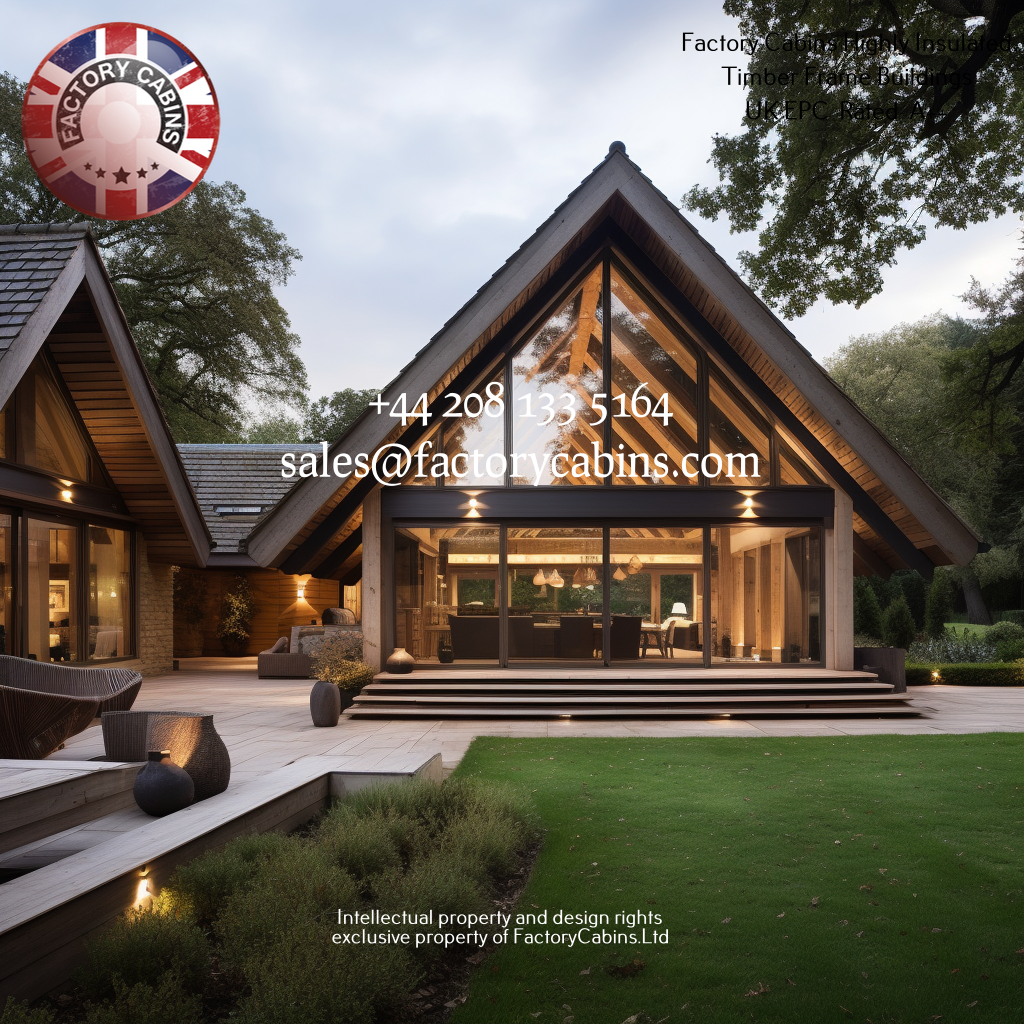
sales@factorycabins.com

Twin Skin Log Cabins and Insulated Timber Frame Buildings all EPC A rated.

The Highest Level of Architectural Excellence and Structural Security
We delve deep into the intricate craftsmanship, environmental benefits, and hypnotic aesthetics that make timber structures a true architectural marvel in our ongoing quest to discover timber structures’ everlasting appeal.
Timber Structures: A Natural Wonder

Factory Cabins: Net Zero A rated EPC New Timber Frame build for the UK and Europe

The sustainable construction revolution has here, and timber buildings are leading the charge. As architects, builders, and environmentally conscious citizens band together, timber emerges as a shining light in the drive for sustainable living.
Timber is a natural wonder.
Timber from renewable forests is environmentally friendly. Unlike conventional concrete or steel, timber absorbs and stores carbon throughout its entire life cycle. Because of this carbon sequestration process, timber is a more environmentally friendly option.
Environmentally Conscious
Timber production requires significantly less energy than concrete or steel manufacture, resulting in a lower carbon footprint. Furthermore, due of its inherent insulating properties, timber structures use less energy for heating and cooling, reducing their environmental effect even further.
The design possibilities are limitless.
The versatility of timber is unlimited. Architects may shape timber into a range of shapes, from sleek modern structures to rustic huts nestled in the woods. This versatility allows for the creation of one-of-a-kind, visually beautiful buildings suitable for both urban and rural settings.
The Craftsmanship of Timber Structures
The craftsmanship involved in the construction of timber houses is astounding. Each piece of wood that is carefully selected and expertly worked adds to the overall beauty and solidity of the structure.
Traditional Joinery Techniques
Timber buildings commonly use traditional joinery techniques, in which wooden components fit together like a well-crafted puzzle. Fine craftsmanship is essential to ensure structural integrity, and mortise and tenon connections, dovetail joints, and finger joints are only a few examples.
Finishing Wood
Finishing touches on wood buildings are just as crucial. From hand-sanded surfaces that showcase the natural grain of the wood to finely calibrated architectural details, every aspect of timber construction exudes competence.


Durability
Contrary to popular belief, timber structures are quite durable. If properly cared for, timber can last for generations. This endurance is a testament not just to the inherent strength of the wood, but also to the skills of those who deal with it.
Timber Structures’ Aesthetics
Timber has an undeniable visual appeal that transcends time and fashion. Timber constructions have an inherent ability to blend in with their surroundings yet commanding attention.
Beauty that endures
Timber’s warm, natural colour and textures provide a sense of timelessness. Timber structures, whether in a bustling city or a peaceful countryside, are testaments to the beauty of nature and human innovation.
Nature’s Harmony
Timber constructions, which are typically seen in densely forested areas, foster a harmonious interaction with nature. They appear to grow from the earth itself, providing a peaceful break from modern life’s stress.
Architecture’s Iconic Structures
Timber structures have left an indelible mark on architectural history all across the world. From historic pagodas in Japan to log cabins in North America, these structures are cherished as one-of-a-kind relics that blend history and modernity.
Timber Structures’ Future
Timber buildings are expected to continue their rise in the architectural world in the coming years. As engineering, sustainability, and design progress, they promise to transform the skylines and landscapes of our cities and countryside.
Technological Advancement
Timber engineering advances such as cross-laminated timber (CLT) and glue-laminated timber (Glulam) have expanded timber construction options. These technologies enable taller, more ambitious timber constructions, pushing the boundaries of what this wonderful material is capable of.
Green Building Certification
Timber is an ideal candidate for green construction certifications such as LEED (Leadership in Energy and Environmental Design) due to its ecological credentials. This prize confirms its position as a pioneer in sustainable construction.
A Source of Insight
Timber constructions are a source of inspiration, reminding us that beauty, sustainability, and craftsmanship can coexist. They challenge the status quo and inspire future generations to imagine a world where architectural excellence and environmental responsibility coexist.
To summarise, timber constructions are more than just structures; they are a testament to human creativity, a nod to nature’s majesty, and a promise of a brighter, more sustainable future. They continue to amaze the world with their ageless beauty, outstanding craftsmanship, and sustainable ethos, making them a formidable architectural force.
THE BEST WINDOWS AND DOORS IN THE INDUSTRY
There is nothing better on the market right now for high-quality windows and doors for your log home than ours. And our factorycabins.com cost is absurdly inexpensive when compared to the quality level, for one simple reason: we are here to deliver quality at a fair price.
We basically brought all of our competitors’ windows and doors, yep, we went under the radar and bought 12 sets of windows and doors, and guess what, they all sold expensive “crap.” Then we disassembled them to really see what was being offered, and what we discovered was that 65% of the companies used only a small amount of cheap mastic sealant in their windows and doors, and some companies did not use any at all.
Following that, we noticed that almost every manufacturer was (is) lowering costs on “diy” glass so-called double glazing packages. Because the majority of enterprises (89% of them) create their own glass, it is not CE-approved double glazing, but rather cheap panes of glass imported from China that are put together and labelled double glazing. You couldn’t make this stuff up!


You’ll notice that we have numerous photos of the timber in our gallery, certified joinery timber that has been dried to a moisture content of 5-7% and then moulded. This implies that our windows and doors are not intended to twist, buckle, or exhibit any of the other unpleasant qualities associated with low-cost products.
Log Cabin Windows and Doors
Please let our representatives know if you want a very high grade of windows and doors, something “better,” and you want to update your cabin windows. Please follow this link to see some fantastic windows and the machinery that manufactures them.
While it is fair to prioritise having adequately strong walls for your log cabin in order to enjoy comfort and little heat loss from within, we must not overlook the significance of having the same high-quality windows. Failure to do so wastes both money and energy.
Factorycabins.com takes pride in handcrafting high-quality windows for each of their log cabins. Whether you have a little garden cabin or a multi-room residential cabin, you can expect the same high-quality windows.
Factorycabins.com exclusively employs the highest grade of glazing to demonstrate the distinction. This double-glazed high-grade glazing is suited for any log cabin with a wall thickness of 44mm or greater. The same high-quality double glass modules are used in Twinskin Log Cabins with double walls and access for insulation.
Unlike many low-cost manufacturers, factorycabins.com goes out of its way to ensure that your windows will last for many years.
The handcrafted technique includes the use of double mastic as well as high-quality galvanised black rain shields that will never rot or rust. A simple wipedown with a damp cloth is all that is required, or if there is any more tenacious dirt or grime, such as bird droppings, a basic window cleaning solution from your local hardware shop or supermarket will do the job quickly. The window frames are mortised and tenoned with care and precision. Many of our competitors usually overlook this stage.
The wood in the framework has been kiln dried to a moisture percentage of 3/6%. We always encourage our clients to ensure that the windows are properly stained and weather-protected as soon as possible in order to keep the moisture content and avoid any swelling, warping, or twisting. This simple procedure yields a completely watertight device. There is a link to the homepage of this website.
Please watch the films, which will certainly amaze you with the exquisite attention that goes into window building, for a more detailed description of the windows.
We shower the windows with a vigorous water spray for over an hour as part of the quality control process. There isn’t a single drop or drip of water that gets it to the other side. This supports not just the excellent craftsmanship of these devices, but also the precision closures that result in a hermetically sealed product.
Security should not be an issue with any high-quality single- or double-glazed unit. In order to be a leader in innovation in the UK, www.factorycabins.com only uses the highest quality hardware for its hinges, handles, stays, and—most importantly—its five-point locking mechanism.
The old English proverb “Don’t spoil the ship for a ha’porth of tar” has always guided factorycabins.com. Historically, those who “skipped on the tar” discovered that their ships began to leak and list, never living up to their former aspirations. The same principle holds true for log cabins, specifically log cabin windows. Be aware of shady knockoffs who still make windows for a living. Whether it’s a garden log cabin, a garden office, a summerhouse, or a residential cabin, your log cabin should be something you’re proud of and something you’ll use for many years. Www.factorycabins.com windows are all intended to provide long-term satisfaction. It truly ends up being less expensive in the long run, with no fuss.
Doors for Log Homes
In terms of security, in addition to having effective lockable windows, your front and back doors must be extremely robust and durable to withstand any break-in attempts. While high-quality deadlocks are necessary, we believe that many manufacturers design doors that are so weak that a front door can be simply kicked inward.
One of the most significant characteristics of a well guarded home entrance door is that it opens outward. In this technique, the door jamb is incorporated into the framework behind the door, making it nearly impossible to kick open once the door is closed.
To properly enforce this level of security, you must have a really strong, solid door that acts as a fortress to secure your property. Www.factorycabins.com makes such log cabin doors and provides the necessary high-grade deadlock security locks with three keys.
Such huge doors must smoothly hang and swing open and close. This involves the use of extremely strong hinges. Again, such components are included in the bundle at www.factorycabins.com.
It is vital to consider the type of furniture that will be used in each room when designing a multi-room log home. Take the bedroom, for example. If you have a set of wardrobes in your bedroom and have limited space, the bedroom door should open outwards rather than inwards. When rooms are close together and create a corner, other aspects must be considered. Installing a door in such a way that it completely covers another door is not a good idea.


External glass doors are double-glazed to the greatest extent practicable. Internal doors are mortise and tenon jointed and made of well-seasoned solid pine. In these circumstances, only the highest quality glazing is used when selecting glazed interior doors.
The entrance door of a house, whether residential or a garden log cabin, should be welcoming, and factorycabins.com invests a significant amount of time and money ensuring that such doors are not only gorgeous but also functional.
We recommend that you maintain your door as soon as possible with appropriate microporous paint to ensure that it remains in pristine shape for many years to come. Higher-quality products that cost a little more than lower-quality products last much longer and cost less in the long term, because lower-quality products usually need to be replaced numerous times during the same period.
You will always feel safe and secure with a factorycabins.com door. If you have any further inquiries, please contact us by email at sales@factorycabins.com.
We specialised in the construction of timber-framed, well-insulated structures in London.
Garden Rooms Have the Potential to Transform Your Outdoor Space
At Factory Cabins, we understand the significance of creating outstanding outdoor living spaces. Our custom garden rooms are more than just beautiful additions to your home; they are life-changing spaces that will improve your quality of life. In this comprehensive tutorial, we will delve into the realm of garden rooms, discussing its versatility, benefits, and how they may enhance your house and yard.
Garden rooms are what they sound like.
Garden rooms, also known as outdoor extensions or garden offices, are standalone structures that integrate into their surroundings. These versatile sections can be utilised for everything from home offices to entertainment areas, gyms, or recreational getaways. They are totally customisable, allowing you to create a room that meets your specific needs while still reflecting your particular style.
The Advantages of Garden Rooms
1.Increased Living Space
Garden rooms are an excellent addition to any home, providing additional living space without the need for costly renovations. A garden room may meet your requirements, whether you require a playroom for your children, a peaceful reading nook, or a huge home office.
2.Increase in Property Value
Purchasing a garden room is not only advantageous in the near term, but it is also a sensible financial option. When it comes time to sell, these structures can significantly increase the value of your home, making it more enticing to potential buyers.
3.Use All Year
Garden rooms may be used throughout the year due to greater insulation and climate control options. Your garden retreat can be enjoyed at any time of year, making it a delightfully versatile addition to your house.
4.Natural Cohesion
Garden rooms are an excellent way to interact with nature while enjoying the comforts of indoor living. Large windows and glass doors let in plenty of natural light, creating a peaceful setting that promotes rest and creativity.
Making Your Dream Garden Room
1. The purpose and functionality
Before you begin, it is vital to identify the purpose of your garden room project. Are you looking for a relaxing refuge, a working desk, or a leisure area? Understanding your needs will guide the design process.
2. Coherence in Architecture
A well-designed garden room should complement the rest of your home. Consider the architectural style, materials, and colour palette to provide a seamless integration into your landscape.


3.Interior Designing
On the inside of your garden room, your concept will come to life. Every detail counts, from the flooring and lighting to the furniture and decor. Create a location that expresses your personality while satisfying your utilitarian requirements.
The Construction Methodology
Factory Cabins’ skilled team is committed to making your garden room vision a reality. To ensure the highest level of quality and satisfaction, we follow a strict procedure:
conversation: To evaluate your needs and preferences, we begin with an in-depth conversation.
Design: Our skilled architects will create a one-of-a-kind design based on your specifications.
We design your garden area to perfection, utilising high-quality materials and skilled craftsmanship.
Finishing Touches: We pay great attention to every detail, from interior finishing to landscaping, to ensure your garden room is ready for you to enjoy.
Please keep in mind that all of our incredible-quality timber frame structures exceed the new EPC criteria.
A Comprehensive Guide to Understanding the New EPC Legislation
It is critical for businesses and property owners to stay ahead of the curve in the ever-changing environment of energy efficiency requirements. The Newable team is here to shed light on the most recent advancements in Energy Performance Certificate (EPC) regulations and their far-reaching consequences. We at Newable believe in arming you with the knowledge you need to properly navigate these changes and assure compliance. In this comprehensive guide, we’ll go over the complexities of the new EPC regulations, who it affect, and how you may adjust to remain compliant and competitive.
What does the new EPC legislation entail?
The new EPC legislation is a watershed moment in energy efficiency requirements, affecting a wide range of buildings and companies. It is more crucial than ever to understand this legislation’s complexities because its main goal is to address the environmental issues brought about by energy use.
The Legislation’s Main Points
1.Stringent Energy Efficiency Standards: The new EPC legislation provides more stringent energy efficiency standards for properties, emphasising the importance of lower carbon emissions and improved energy performance.
2.Broadened Scope: Unlike earlier requirements, the new legislation includes commercial structures, public sector facilities, and industrial sites in addition to residential residences. Because of this development, a broader range of businesses and organisations will be impacted.
3.Enhanced Reporting Obligations: Property owners and businesses will be subject to heightened reporting requirements, mandating a thorough grasp of their building’s energy performance. Compliance with these reporting obligations is critical in order to avoid penalties and keep a good reputation.
4. Transition Period: The legislation defines a phased implementation plan to ensure a smooth transition, giving affected parties adequate time to adapt and make required adjustments.
Who Is affected by the new EPC legislation?
Knowing whether your home or business is subject to the new EPC legislation is critical for proactive compliance. Let us look at the several areas and entities that this legislation affects:

  1. Owners of Commercial Real Estate
    The new EPC regulation has a significant impact on commercial property owners. Compliance is vital whether you run a modest office space or a vast industrial complex. Failure to comply with the revised criteria may result in fines and a reduction in your capacity to attract tenants or buyers.
  2. Entities in the Public Sector
    The legislation also applies to public sector organisations such as government buildings, schools, and healthcare facilities. This is part of a larger effort to reduce the environmental impact of public infrastructure.
  3. Industrial Establishments
    Industrial locations, such as factories and industrial plants, must adapt to the new energy efficiency regulations. Implementing energy-saving techniques assures compliance while also lowering operational costs.
  4. Owners of Residential Real Estate
    Though the new EPC regulation is largely aimed at commercial and public sector assets, it also affects residential property owners, particularly those with larger homes or rental properties. Compliance not only contributes to sustainability, but it can also raise the value of a property.
    Getting Used to the New EPC Legislation
    Now that we’ve demonstrated the significance and scope of the new EPC regulations, it’s critical to examine options for effectively responding to these changes.
  5. Energy Audits and Evaluations
    Consider doing complete energy audits and evaluations to launch your compliance journey. These assessments provide useful information about your property’s current energy performance and suggest areas for improvement.
  6. Energy-Saving Upgrades
    Investing in energy-efficient renovations is a preventative measure for reaching the new standards. This may entail improving insulation, HVAC systems, and lighting in order to reduce energy usage and carbon emissions.
  7. Documentation of Compliance
    It is vital to keep precise records and compliance documentation. This guarantees that you can readily establish your compliance with the law in the event of an audit or inspection.
  8. Professional Advice
    Seeking advice from energy efficiency specialists and legal counsel can help to speed up the compliance procedure. Professionals can assist you in navigating the complexities of the legislation and developing a custom action plan.
    Staying educated and proactive in a continuously changing regulatory context is critical to success. The new EPC regulation emphasises the importance of energy efficiency and sustainability across a variety of industries. It is your responsibility as a responsible property owner or business entity to embrace these changes, not just to meet regulatory requirements but also to contribute to a greener and more sustainable future.
    We at Newable are dedicated to assisting you in your compliance journey. Contact us today to find out how we can help you through the complexities of the new EPC regulations and keep your property or business at the forefront of energy efficiency and sustainability. Together, we can create a brighter, more environmentally friendly future.

A Comprehensive Guide to Understanding the New EPC Legislation
It is critical for businesses and property owners to stay ahead of the curve in the ever-changing environment of energy efficiency requirements. The Newable team is here to shed light on the most recent advancements in Energy Performance Certificate (EPC) regulations and their far-reaching consequences. We at Newable believe in arming you with the knowledge you need to properly navigate these changes and assure compliance. In this comprehensive guide, we’ll go over the complexities of the new EPC regulations, who they affect, and how you may adjust to remain compliant and competitive.


What does the new EPC legislation entail?
The new EPC legislation is a watershed moment in energy efficiency requirements, affecting a wide range of buildings and companies. It is more crucial than ever to understand this legislation’s complexities because its main goal is to address the environmental issues brought about by energy use.
The Legislation’s Main Points
1. Stringent Energy Efficiency Standards: The new EPC legislation provides more stringent energy efficiency standards for properties, emphasising the importance of lower carbon emissions and improved energy performance.
2.Broadened Scope: Unlike earlier requirements, the new legislation includes commercial structures, public sector facilities, and industrial sites in addition to residential residences. Because of this development, a broader range of businesses and organisations will be impacted.
3.Enhanced Reporting Obligations: Property owners and businesses will be subject to heightened reporting requirements, mandating a thorough grasp of their building’s energy performance. Compliance with these reporting obligations is critical in order to avoid penalties and keep a good reputation.
4.Transition Period: The legislation defines a phased implementation plan to ensure a smooth transition, giving affected parties adequate time to adapt and make required adjustments.
Who Is Affected by the New EPC Legislation?
Knowing whether your home or business is subject to the new EPC legislation is critical for proactive compliance. Let us look at the several areas and entities that this legislation affects:

  1. Owners of Commercial Real Estate
    The new EPC regulation has a significant impact on commercial property owners. Compliance is vital whether you run a modest office space or a vast industrial complex. Failure to comply with the revised criteria may result in fines and a reduction in your capacity to attract tenants or buyers.
  2. Entities in the Public Sector
    The legislation also applies to public sector organisations such as government buildings, schools, and healthcare facilities. This is part of a larger effort to reduce the environmental impact of public infrastructure.
  3. Industrial Establishments
    Industrial locations, such as factories and industrial plants, must adapt to the new energy efficiency regulations. Implementing energy-saving techniques assures compliance while also lowering operational costs.
  4. Owners of Residential Real Estate
    Though the new EPC regulation is largely aimed at commercial and public sector assets, it also affects residential property owners, particularly those with larger homes or rental properties. Compliance not only contributes to sustainability, but it can also raise the value of a property.
    Getting Used to the New EPC Legislation
    Now that we’ve demonstrated the significance and scope of the new EPC regulations, it’s critical to examine options for effectively responding to these changes.
  5. Energy Audits and Evaluations
    Consider doing complete energy audits and evaluations to launch your compliance journey. These assessments provide useful information about your property’s current energy performance and suggest areas for improvement.
  6. Energy-Saving Upgrades
    Investing in energy-efficient renovations is a preventative measure for reaching the new standards. This may entail improving insulation, HVAC systems, and lighting in order to reduce energy usage and carbon emissions.
  7. Documentation of Compliance
    It is vital to keep precise records and compliance documentation. This guarantees that you can readily establish your compliance with the law in the event of an audit or inspection.
  8. Professional Advice
    Seeking advice from energy efficiency specialists and legal counsel can help speed up the compliance procedure. Professionals can assist you in navigating the complexities of the legislation and developing a custom action plan

    Staying educated and proactive in a continuously changing regulatory context is critical to success. The new EPC regulation emphasises the importance of energy efficiency and sustainability across a variety of industries. It is your responsibility as a responsible property owner or business entity to embrace these changes, not just to meet regulatory requirements, but also to contribute to a greener and more sustainable future.
    We at Newable are dedicated to assisting you in your compliance journey. Contact us today to find out how we can help you through the complexities of the new EPC regulations and keep your property or business at the forefront of energy efficiency and sustainability. Together, we can create a brighter, more environmentally friendly future.