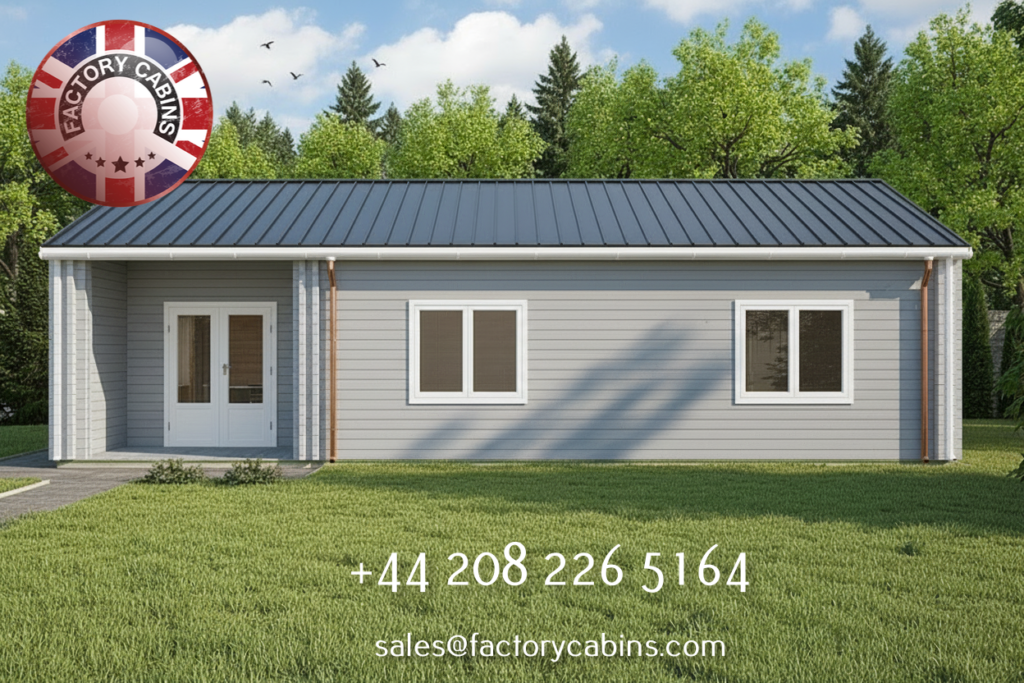
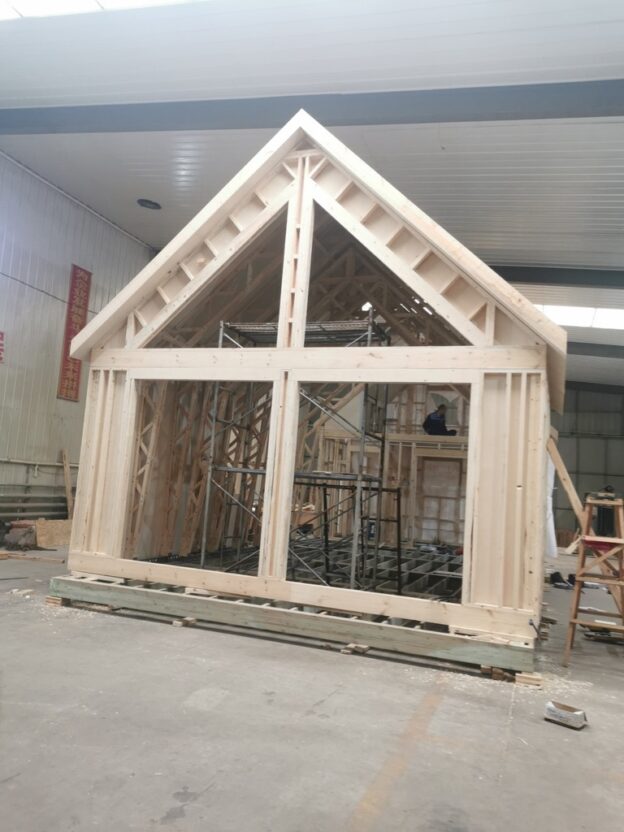
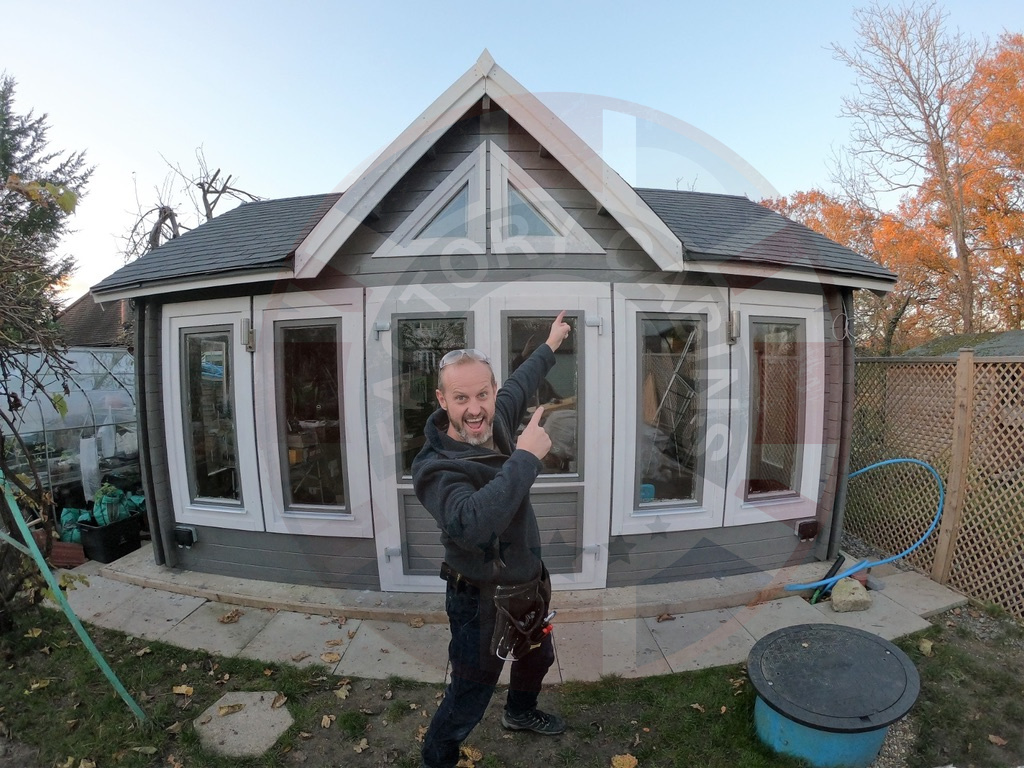
Step into your garden and picture a space that feels just as inviting as your own living room.
Maybe you want a quiet office where you can finally get some work done, a cozy summer house you’ll use all year, or just a smart way to make a little extra money. Whatever you’re after, the answer’s right outside your back door with our 44mm twin skin cabins.
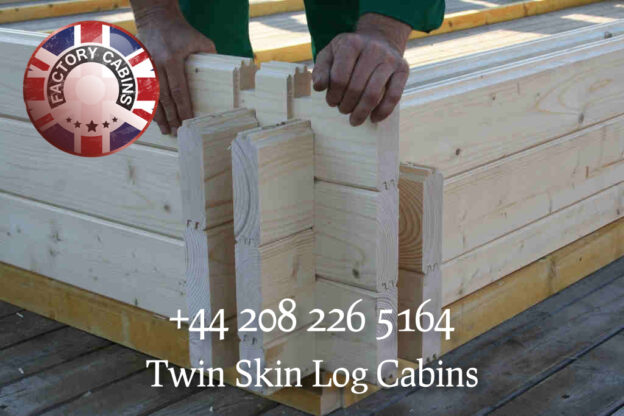
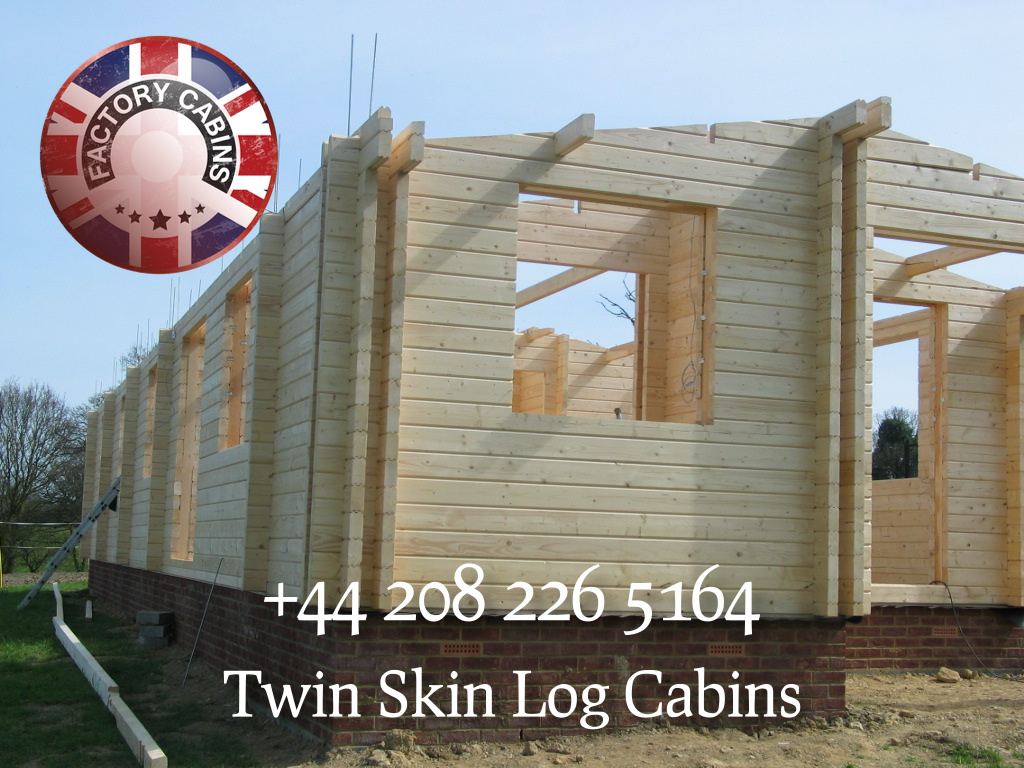
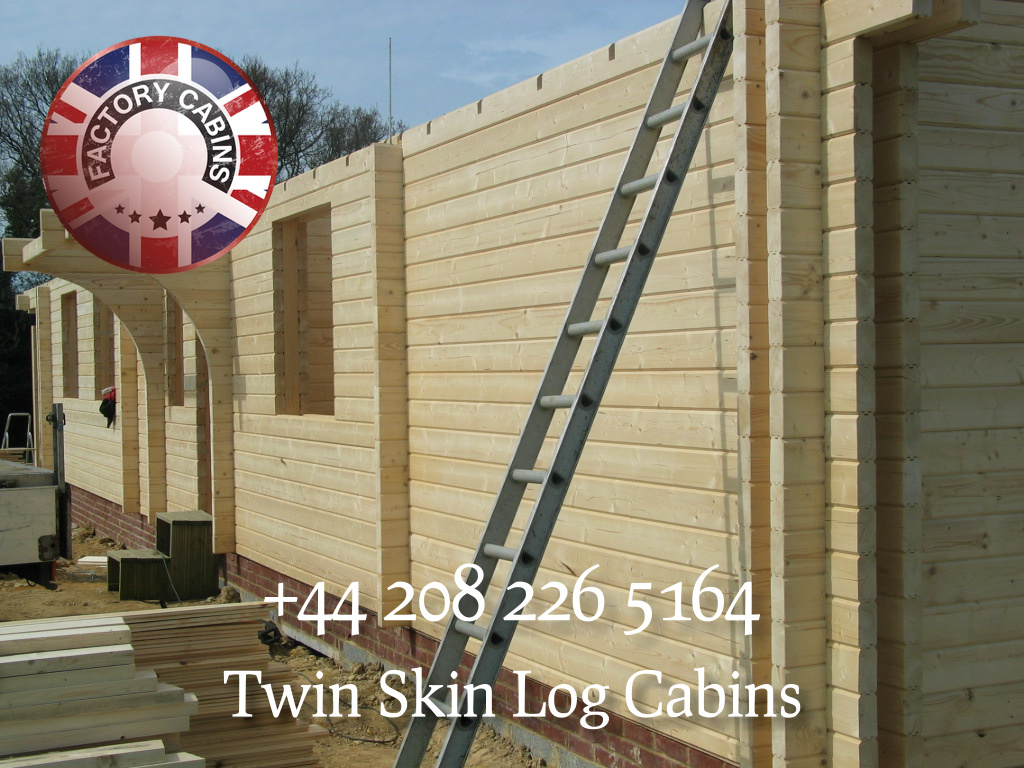
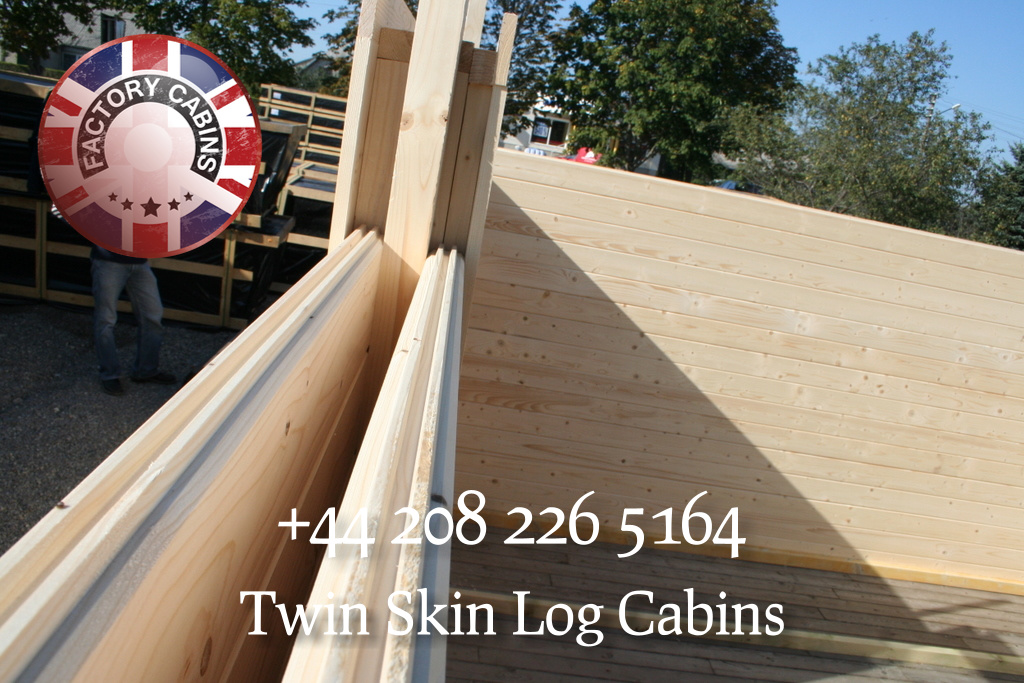
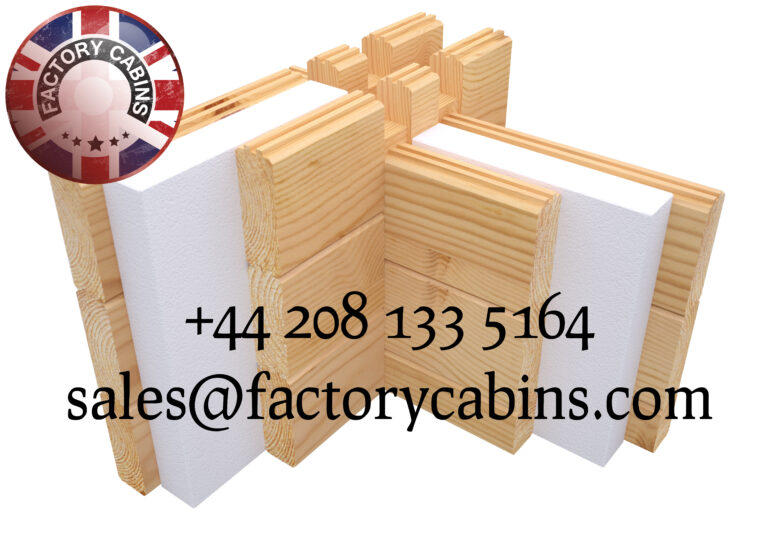
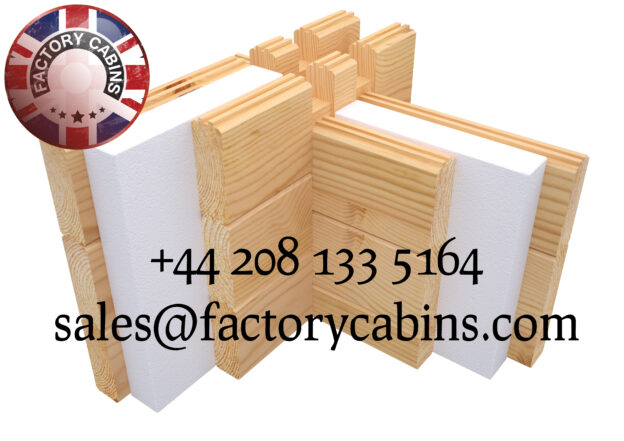
Homeowners all over the UK love these—they really do change the game for garden buildings. All those numbers—44mm x 44mm twin skin—sound a bit technical at first, but here’s what matters: you’re getting two sturdy timber walls, not just one, with an insulated gap in between.
That gap acts like a built-in thermal blanket. So, when winter’s biting cold rolls in, your cabin stays warm. And when summer brings the heat, you’re cool and comfortable inside.
There’s no bulky insulation taking up space, just clever design that keeps things cozy or breezy, no matter the season. If you’re after a proper garden office, this cabin’s a lifesaver.
We’ve all tried working from home with the TV blaring or kids running around—it’s tough. Step into a twin skin cabin, and you’ve got a peaceful, warm, proper workspace. The layout makes everything easy to reach, whether you need a desk, shelves, or just a comfy corner to think.
And it’s not just for summer—those insulated walls mean you’ll actually use it all year, not just when the sun’s out. It quickly becomes your personal retreat, whatever the weather’s doing outside.
Now, if you’re thinking about renting out your cabin for holidays or short stays, you’re onto something. People love unique getaways, and a well-built log cabin in your garden is a big draw. Sure, it’s not a luxury villa with massive walls, but it’s a fantastic, comfortable spot for guests. You get real quality and insulation without blowing your budget, and it’s tough to beat for return on investment if you’re looking at the rental market.
Let’s talk about those thicker 70mm cabins everyone mentions. They’re great—no denying it—but they cost a lot more. The 44mm twin skin cabin is the smart choice if you want durability and insulation without paying for features you don’t really need. It’s not trying to be a year-round, full-time house, but as a garden office, family hangout, or rental, it hits the sweet spot.
You get the quality and comfort, but keep your wallet happy. That’s why so many people go for this model. When we say these cabins are built to last, we’re not joking. Factory Cabins designs them to handle whatever the British weather throws at you—rain, wind, frost, you name it.
You can relax, knowing your investment stands up to the elements year after year. That kind of toughness really matters when you’re counting on your garden building to stay solid and dry. What really sets our cabins apart is the attention to detail. The walls and ceiling are made from Swedish winter-cut seasoned spruce.
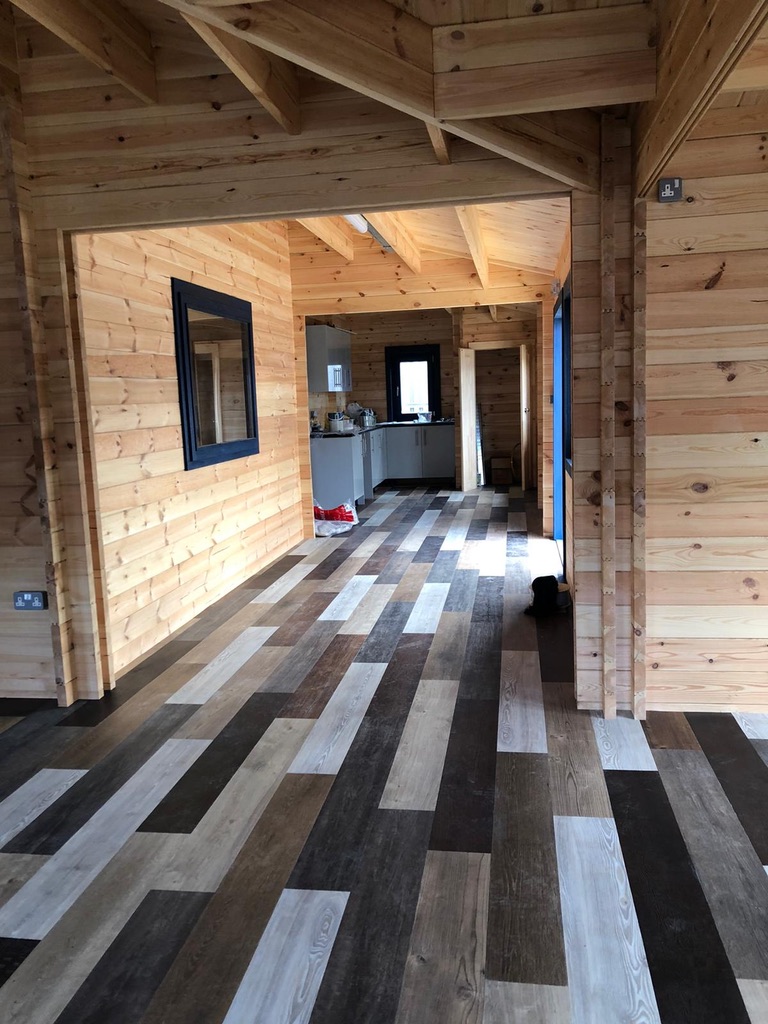
That’s not just fancy talk—it means the timber is denser, more stable, and less likely to twist or crack as time goes by. It looks beautiful and stays that way with just a little care. And let’s not forget the floors. Unlike some companies that charge extra for proper flooring, our cabins come with 28mm thick spruce boards as standard. You won’t have to pay more for a floor that actually feels solid under your feet—it’s included, right from the start.
All in all, if you want a comfortable, hard-wearing, and good-looking garden retreat, this is the cabin for you.
What really sets our cabins apart is the care we put into every detail, right down to the wood itself.
We use Swedish winter-cut seasoned spruce for the walls and ceiling. That’s not just fancy talk—these trees are cut in winter when the sap is low, so the wood stays stable over the years.
No weird warping or cracking. It’s dense, strong, and honestly, it just looks great. Take care of your cabin, and it keeps looking amazing for decades. Let’s talk about the floor. A lot of other companies try to sneak in thin floorboards as standard, then ask you to pay extra for something sturdier.
We don’t play that game. Every cabin comes with 28mm thick spruce floorboards—no upcharge, no surprises. From day one, the floor feels solid and substantial under your feet. It really adds to the quality and insulation inside.
Then there are the windows and doors. We’re pretty proud of these. They come as standard, not as flimsy afterthoughts. The glass is toughened for safety and security, and everything seals up tight to keep out drafts.
You get a space that’s energy efficient—so your heating bills stay low, and you stay comfortable, no matter the season. Honestly, we believe these are the best cabins Factory Cabins has ever designed for this kind of use. We’ve nailed the balance between cost, performance, and durability.
You get that premium feel, but you don’t have to shell out for those massive 70mm walls. If you’re looking for real quality without having to compromise, this is it. Ready to give your garden a serious upgrade? Picture a space that works for you—whether that’s for business, relaxing, or something in between.
A place that stays warm in winter, cool in summer, and keeps looking beautiful year after year. The 44mm x 4mm twin skin log cabin makes all of that real. So go on—stop imagining and start building your perfect garden retreat with Factory Cabins.
Please send us an email to sales@factorycabins.com
All bespoke designs are welcome. PLEASE call 0208 226 5164
Beyond the Roadblock: How Twin-Skin Log Cabins Revolutionize Construction in Inaccessible Locations
When Traditional Building Methods Hit a Dead End
Imagine standing on the edge of your dream property—a secluded lakeside plot, a forested hilltop, or a narrow coastal strip—and realizing that your vision for a quality insulated building is impossible. Not because of planning restrictions or budget constraints, but because there’s simply no way to get construction materials to the site.
No road access. No vehicle pathway. No conventional building method can reach your location. For decades, this scenario has left homeowners with two unpalatable choices: abandon their vision or settle for inferior, temporary structures that fail to deliver genuine year-round usability.
This is where the limitations of traditional construction methods become painfully apparent. Conventional brick-and-mortar construction requires extensive site preparation, heavy machinery, and multiple delivery trips with materials that simply cannot be transported to challenging locations.
Even standard timber frame construction—often marketed as “flexible”—requires multiple visits from skilled laborers and specialized equipment that cannot navigate tight spaces or water barriers. When accessibility becomes the primary constraint, most building solutions fail before they even begin.
But what if there was a way to bypass these limitations entirely? What if you could deliver a fully insulated, high-performance building to virtually any location—regardless of terrain or access constraints? This is the revolutionary promise of twin-skin log cabin technology, a solution that transforms previously impossible building sites into reality while delivering superior thermal performance at a fraction of the conventional construction cost.
The Accessibility Advantage: Reaching the Unreachable
The most transformative aspect of twin-skin log cabin construction isn’t merely its thermal performance—it’s the ability to access locations that conventional building methods simply cannot reach. This capability stems from the fundamental design of the twin-skin system, which allows for modular delivery and assembly in even the most challenging environments.
Consider the case of the Harrison family in the Lake District, who dreamed of creating a lakeside entertainment space on their 2.5-acre property overlooking Windermere. Their idyllic location presented significant obstacles:
No vehicular access: The only route to the desired building site was across a narrow strip of water
Environmental restrictions: The property sits within an Area of Outstanding Natural Beauty with strict building regulations
Year-round usability requirement: They wanted a space that could be enjoyed in all seasons, not just summer
Structural challenges: The lakeside terrain featured unstable soil that would have required expensive foundation work for conventional construction
Traditional building methods were immediately ruled out. Brick-and-mortar construction would have required extensive site preparation, temporary road construction across sensitive terrain, and months of disruptive work. Portable buildings lacked the insulation and quality they desired for year-round use. Even standard single-skin log cabins would have struggled with the damp lakeside environment and failed to deliver the thermal performance needed for winter gaming sessions.
What they needed was a solution that combined structural integrity with genuine insulation performance, delivered in a way that respected both the environment and their challenging site access. The answer was clear: a fully insulated twin-skin log cabin, engineered for British weather and designed specifically for their unique requirements.
Unlike conventional construction that requires multiple material deliveries and heavy machinery, our twin-skin log cabins arrive as a single, coordinated shipment. Every component is pre-cut and pre-engineered at our Lithuanian manufacturing facility, then packaged for efficient transport. For the Harrison family’s lakeside location, we designed the cabin in modular sections that could be safely transported by boat:
Pre-assembled wall sections: Two-person manageable sizes that maintained structural integrity
Waterproof packaging: Each component sealed against lake moisture during transit
Sequential delivery plan: Components organized in precise assembly order to minimize on-site handling
This modular approach—only possible because of our direct manufacturing control—turned what could have been a logistical nightmare into a smooth operation. The entire cabin was delivered in three boat trips, with assembly beginning immediately upon arrival of the first components.
The Real Cost of Inaccessibility: When Conventional Construction Fails
The inability to access challenging building sites isn’t just a logistical inconvenience—it’s a significant economic barrier that prevents homeowners from realizing the full potential of their properties. When traditional construction methods hit accessibility limitations, homeowners face several costly consequences:
Compromised Design and Functionality
Without the ability to deliver conventional building materials to challenging locations, homeowners often settle for inferior structures that fail to meet their actual needs. Instead of a properly insulated, year-round usable space, they’re forced to accept seasonal sheds or poorly constructed temporary structures that require constant maintenance and cannot be used during winter months.
Extended Project Timelines
Conventional construction in difficult locations often requires extensive site preparation before any building can begin. This preparation phase—clearing paths, creating temporary access routes, or installing specialized equipment—can add weeks or even months to project timelines, significantly delaying the realization of the homeowner’s vision.
Environmental Impact
The extensive site preparation required for conventional construction often causes significant environmental disruption. Creating temporary roads through sensitive ecosystems, disturbing soil stability, or altering natural drainage patterns can have lasting impacts on the environment—impacts that many homeowners seeking natural retreats specifically want to avoid.
Cost Overruns
The hidden costs of conventional construction in challenging locations are substantial. Specialized equipment rentals, additional labour for site preparation, extended project timelines, and potential environmental mitigation measures can easily double or triple the initial project estimate.
Compromised Quality
Perhaps most damaging is the inevitable compromise on quality when conventional construction methods are adapted to challenging sites. Builders often cut corners on materials, insulation, or structural elements to accommodate accessibility constraints, resulting in buildings that fail to deliver the promised performance or longevity.
For homeowners seeking a quality insulated building, these consequences are particularly devastating. They’ve invested significant resources in finding the perfect location only to discover that the very features that make the property special—its seclusion, natural beauty, or unique terrain—become barriers to construction. The result is a cycle of disappointment where dreams are deferred or compromised, and the full potential of the property remains unrealized.
Twin-Skin vs. Conventional Construction: The Structural Difference That Matters
To understand why twin-skin log cabins succeed where conventional construction fails, we must examine the fundamental structural differences between these approaches. The key distinction lies not just in the materials used, but in the engineering philosophy that drives the design.
Conventional Timber Frame Construction: The Layered Approach
Traditional timber frame construction follows a sequential, on-site assembly process that requires multiple visits from skilled laborers and specialized equipment:
Foundation work: Often requiring heavy machinery and extensive site preparation
Frame construction: Multiple trips to deliver and assemble structural components
Insulation installation: Additional visits to add insulation materials
Exterior cladding: Further deliveries and labour for weatherproofing
Interior finishing: Final trips for internal walls, flooring, and services
This layering approach creates multiple points of vulnerability. Each stage depends on the previous one being completed correctly, and any delay or issue at one stage impacts the entire project. In challenging locations, this sequential process becomes particularly problematic—each delivery requires navigating the same access constraints, multiplying the logistical challenges.
Most critically, the insulation in conventional timber frame construction is typically added as an afterthought—a layer sandwiched between structural elements. This approach creates thermal bridges at structural junctions, compromises the integrity of the insulation layer, and makes it difficult to achieve consistent thermal performance throughout the building.
Twin-Skin Log Cabin Construction: The Integrated Approach
In contrast, twin-skin log cabin construction follows an integrated design philosophy where all elements work together from the outset:
Single manufacturing process: All components are precision-cut and assembled at the factory
Modular delivery: Pre-engineered sections designed for efficient transport
Rapid assembly: Minimal on-site labour with standardized connections
Integrated insulation: Thermal performance built into the wall structure from the beginning
The twin-skin design features two independent skins of premium Scandinavian spruce, separated by a precisely engineered cavity filled with high-grade insulation. This cavity is not an afterthought—it’s a fundamental component of the wall structure, designed to deliver optimal thermal performance while maintaining structural integrity.
This integrated approach is particularly advantageous in challenging locations because it eliminates the need for multiple material deliveries and sequential construction stages. Every component arrives ready for immediate assembly, reducing on-site time and labour requirements to a minimum.
The Insulation Advantage: Engineering Flexibility Where It Matters Most
One of the most significant advantages of twin-skin log cabin construction is the inherent flexibility of the insulation system. Unlike conventional construction where adding more insulation requires complex modifications to the structural design, the twin-skin system allows for simple, scalable insulation adjustments that directly address the specific needs of challenging locations.
The Conventional Insulation Dilemma
In traditional timber frame construction, increasing insulation levels presents significant challenges:
Structural modifications: Additional insulation often requires thicker wall sections, which may not fit within existing structural constraints
Thermal bridging: Conventional construction methods create inevitable thermal bridges at structural junctions, reducing the effectiveness of added insulation
Moisture management: Adding insulation without proper vapor barriers can create moisture traps that lead to condensation and timber degradation
Cost inefficiency: The marginal cost of adding insulation often becomes prohibitively high as insulation levels increase
These limitations mean that conventional construction typically caps at a certain insulation level—sufficient for standard applications but inadequate for challenging locations with extreme weather conditions or specific usability requirements.
The Twin-Skin Insulation Solution
With twin-skin log cabin construction, insulation becomes a simple matter of adjusting the cavity size between the two timber skins. The system is designed from the outset to accommodate variable insulation levels without compromising structural integrity:
Scalable cavity design: The space between the two timber skins can be expanded to accommodate additional insulation
Continuous thermal barrier: The insulation cavity creates a seamless thermal break that eliminates thermal bridging
Integrated moisture management: The design incorporates vapor barriers and moisture control systems as part of the wall structure
This flexibility is particularly valuable for challenging locations where specific insulation requirements may vary significantly. For example:
Coastal properties: Require enhanced moisture management systems to combat salt air
High-altitude locations: Need increased insulation to handle extreme temperature variations
Forest settings: May require additional insulation to maintain consistent interior temperatures
Our 70mm x 70mm interlocking system demonstrates this flexibility perfectly. The standard configuration features a cavity designed for optimal insulation performance in most UK conditions.
However, for locations requiring enhanced thermal performance—such as lakeside properties in the Lake District or coastal sites in Kent—the cavity can be expanded to accommodate 100mm or even 300mm of high-performance insulation.
This scalability means that twin-skin log cabins can be precisely engineered for the specific thermal requirements of each location, delivering optimal performance without the cost inefficiencies of conventional construction methods.
The Cost Equation: Why Twin-Skin Delivers Better Value
When evaluating construction options for challenging locations, cost is often the primary consideration. However, a true cost analysis must go beyond the initial price tag to consider the total value delivered over the building’s lifetime. When viewed through this lens, the twin-skin log cabin approach consistently demonstrates superior value.
Conventional Construction Cost Structure
Conventional construction in challenging locations follows a cost structure that becomes increasingly inefficient as accessibility constraints increase:
Site preparation costs: Often exceed 20-30% of total project cost for difficult locations
Multiple delivery costs: Each material delivery incurs additional transportation costs
Extended labour costs: longer project timelines increase labour expenses
Compromise costs: Quality compromises to accommodate access constraints often lead to higher maintenance costs
The marginal cost of addressing accessibility challenges in conventional construction is high and non-linear—each additional constraint multiplies the cost rather than adding it incrementally.
Twin-Skin Cost Structure
The twin-skin log cabin approach follows a fundamentally different cost structure that remains efficient regardless of accessibility constraints:
Single delivery cost: All components arrive in one coordinated shipment
Minimal site preparation: Often requiring only a simple foundation system
Rapid assembly cost: Reduced labour time and specialized equipment needs
The marginal cost of addressing accessibility challenges in twin-skin construction is low and linear—each additional constraint adds a predictable, manageable cost rather than multiplying expenses.
This difference becomes particularly apparent when comparing insulation options. In conventional construction, increasing insulation levels often requires significant structural modifications that can double or triple costs. In twin-skin construction, increasing the cavity size between the 70mm x 70mm interlocking logs to accommodate 100mm or 300mm of insulation adds minimal cost while delivering substantial thermal performance benefits.
Real-World Applications: Twin-Skin Solutions in Challenging Locations
The accessibility advantages of twin-skin log cabin construction are not theoretical—they’re being demonstrated daily across the UK in locations where conventional construction would be impossible or prohibitively expensive.
Lakeside Retreats: Where Water Is the Only Access Route
For property owners with lakeside plots like the Harrison family, the twin-skin approach provides a solution that respects both the environment and the vision. By designing modular sections that can be transported by boat, we’ve created numerous lakeside retreats that would have been impossible with conventional construction.
These cabins feature:
Water-resistant construction: Marine-grade hardware and corrosion-resistant materials
Elevated foundation options: Minimizing environmental impact while providing stable support
Enhanced insulation: For year-round comfort despite the damp lakeside environment
Flexible layout options: Allowing for optimal use of the limited accessible space
Forest Clearings: Where Trees Block Conventional Access
In heavily wooded areas, twin-skin log cabins offer a solution that minimizes environmental disruption while delivering high-performance structures. Rather than clearing wide paths for construction equipment, we can deliver pre-engineered sections through narrow forest trails.
These forest cabins feature:
Minimal footprint design: Reducing the need for extensive site clearing
Adaptable foundation systems: Allowing for installation on uneven terrain
Natural integration: Wood finishes that blend with forest surroundings
Enhanced insulation: For consistent interior temperatures despite forest microclimates
Coastal Properties: Where Salt Air Demands Superior Protection
Coastal locations present unique challenges with salt-laden air that accelerates corrosion and requires specialized materials. Twin-skin log cabins provide a solution that combines structural integrity with environmental resilience.
These coastal cabins feature:
Marine-grade hardware: Stainless steel components resistant to salt corrosion
Enhanced moisture management: Integrated systems to prevent salt-induced damage
Specialized finishes: Protecting wood from the harsh coastal environment
Optimized insulation: For consistent comfort despite coastal temperature fluctuations
The Quality Imperative: Why Twin-Skin Delivers Genuine Performance
For homeowners seeking a quality insulated building, the difference between twin-skin and conventional construction isn’t just about accessibility—it’s about genuine performance. When you choose a twin-skin log cabin, you’re not just solving an access problem; you’re investing in a building that delivers superior thermal performance, structural integrity, and longevity.
Thermal Performance: The Defining Difference
The most immediate benefit of twin-skin construction is its superior thermal performance. While conventional construction struggles to achieve U-values below 0.30 W/m²K (the current UK building standard), our twin-skin systems deliver U-values as low as 0.18 W/m²K—significantly better than modern residential construction.
This performance difference translates directly into:
Year-round usability: Spaces that remain comfortable in winter without excessive heating
Reduced energy costs: Minimal energy requirements for maintaining comfortable temperatures
Moisture control: Elimination of condensation issues that plague conventional structures
Long-term durability: Protection of timber structure from moisture-related damage
Structural Integrity: Built to Last
The interlocking design of twin-skin log cabins provides exceptional structural integrity that conventional construction cannot match. Our precision-engineered joints create a structure that:
Resists wind loads: Critical for exposed locations like coastal properties
Minimizes settlement issues: The interlocking system maintains integrity as timber adjusts to environmental changes
Distributes stress evenly: Preventing weak points that develop in conventional construction
Maintains thermal performance: Structural integrity is essential for maintaining the insulation cavity’s integrity
Longevity: A Building That Improves with Age
Perhaps most importantly, twin-skin log cabins deliver genuine longevity that conventional construction often fails to achieve. The combination of premium materials, precision engineering, and integrated moisture management creates a structure that:
Requires minimal maintenance: Unlike conventional structures that need regular repairs
Improves with age: Properly maintained wood structures develop a beautiful patina over time
Retains value: High-quality log cabins often appreciate as they age
Sustains performance: Thermal and structural performance remains consistent for decades
The Future of Construction: Accessibility as a Design Priority
As we look to the future, the importance of accessibility in building design will only increase. With growing environmental awareness and stricter regulations on site disruption, construction methods that minimize environmental impact while delivering high-performance buildings will become increasingly valuable.
Twin-skin log cabin technology represents a significant step forward in this evolution. By designing buildings that can access challenging locations with minimal disruption, we’re not just solving today’s construction problems—we’re creating a model for sustainable building practices that will become increasingly important in the coming decades.
This approach aligns perfectly with the growing demand for:
Sustainable construction: Minimizing environmental impact while delivering high-performance buildings
Adaptive design: Creating buildings that respond to specific site conditions rather than forcing sites to conform to standard construction methods
Resilient infrastructure: Building structures that can withstand extreme weather events and environmental changes
Resource efficiency: Maximizing the value of materials through precision engineering and minimal waste
Conclusion: Beyond Access—Creating Possibility
The true power of twin-skin log cabin construction extends far beyond solving accessibility challenges. It represents a fundamental shift in how we approach building design—a shift from forcing sites to conform to construction methods to designing construction methods that conform to site requirements.
For the homeowner with a dream location that conventional construction methods cannot reach, this shift means the difference between compromise and realization. It means transforming previously impossible sites into valuable, functional spaces that enhance property value and quality of life.
When you choose a twin-skin log cabin from Factory Cabins, you’re not just buying a building—you’re investing in a solution that:
Respects your site: Minimizing environmental disruption while maximizing space utilization
Delivers genuine performance: Providing year-round usability with superior thermal performance
Offers genuine value: Delivering high-quality construction at a reasonable cost
Solves real problems: Addressing accessibility constraints that conventional methods cannot overcome
The journey from inaccessible dream to realized reality begins with understanding that sometimes, the most significant barrier isn’t the terrain—it’s the construction method. By choosing a twin-skin log cabin solution, you’re not just building a structure—you’re creating possibility where none existed before.
Ready to transform your inaccessible dream site into a reality? Contact Factory Cabins today for a consultation on how our twin-skin log cabin technology can reach locations that conventional construction cannot. From Brighton to Margate and beyond, we deliver quality, accessibility, and performance that redefine what’s possible in garden building.
Please send us an email to sales@factorycabins.com
It’s January 2026. The UK log cabin industry is worth over £350 million annually — a staggering figure that would have seemed impossible when we first opened our workshop doors in 2003. Back then, “log cabin” was a niche term whispered among garden enthusiasts and DIY hobbyists. Few understood what it meant to build a *real* log cabin — one that could withstand decades of British weather, settle naturally without warping, and remain structurally sound, thermally efficient, and aesthetically timeless.
The quiet cabin companies secrets!
We didn’t just enter the market in 2003 — **we created it**.(Log Cabins For Sale)
Not through marketing gimmicks or inflated claims, but through relentless craftsmanship, engineering rigour, and an uncompromising refusal to cut corners. Over the past 23 years, FactoryCabins.com has not only pioneered the modern UK log cabin sector — we’ve also been its conscience. We’ve trained, mentored, and launched countless competitors — only to part ways with most of them when they chose profit over principle. Yes, we’ve *sacked* dealers, distributors, and even former partners — not out of spite, but because integrity cannot be negotiated.
This blog isn’t a sales pitch. It’s a manifesto. A warning. A guide. And above all — a plea to consumers: *Do not let the noise drown out the truth.*
Because today, more than ever, the log cabin market is flooded with imitation, deception, and dangerously substandard products masquerading as “premium.” And yet — amid the chaos — there remains a handful of manufacturers who still believe that a log cabin should be built to last longer than the owner’s mortgage.
We are one of them.
Let us take you on a journey — through history, engineering, ethics, and the quiet revolution we’ve waged behind the scenes for over 2 and a bit decades.
Part I: The Birth of an Industry — How FactoryCabins.com Built the UK Log Cabin Market (2003–2026)
In 2003, the UK had no dedicated log cabin manufacturers. There were timber framers, garden shed builders, and a few Scandinavian importers — but no one designing, engineering, and manufacturing log cabins *for the British climate*, using British standards, and respecting the physics of solid timber construction. One Cabin was the Clock House, our design.
We started small: a single workshop in rural Lithuania , with two carpenters, hand engineered notching machine, and a dream. Our first cabin? A 3m x 3m garden store — tongue-and-groove spruce, 44mm logs, fairly good notches, and a roof designed to shed rain *and* snow. It wasn’t glamorous. But it stood firm through 6 winters, zero rot, zero warping.
What set us apart from day one was our obsession with *movement*. Logs move. They shrink. They twist. They settle. Any builder who ignores this is building a time bomb.
So, we developed our proprietary **Dynamic Log System** — not a marketing slogan, but a structural philosophy:
**Moisture content control**: All timber dried to 16–18% MC before assembly — never air-dried on-site.
Within two years, we had 17 dealers across England and Wales.Scotland Not franchises — true partners. We trained them. We shared our CAD designs. We gave them access to our quality control protocols. We believed in collaboration.
Then came the first betrayal.
A dealer in Essex began selling our 5m x 4m “ DF 24” cabin — identical in spec — at **140% above our factory price**, claiming it was “exclusive” and “hand-finished in the UK.” When customers complained about warped doors and UVPC windows (more on that later), he blamed *us*. We investigated. Found his warehouse full of rebranded stock from a bulk supplier in Europe — same dimensions, same drawings, but with inferior timber, no kiln drying, and plastic windows bolted in with screws instead of proper joinery.
We terminated the relationship. Publicly. With evidence.
That was the first of many.
By 2011, we had directly trained or supplied over 40 companies now operating in the UK log cabin space. Many went on to become household names. Some still exist — though few retain the original ethos. Most? They pivoted to volume. To speed. To margin. And in doing so, they sacrificed the very thing that made log cabins viable in the first place: *quality*.We wanted to at the very beginning, manufacture a building that was better than a box standard shed, these companies have done the opposite, they have reduced the cabin to below a shed, and charge 3x its value.
We didn’t stop innovating. In 2013, we introduced the UK’s first **twin-skin log cabin** — 70mm outer log + 70mm inner log, with insulated cavity. It was ridiculed as “over-engineered.” Today, it’s the gold standard — and copied relentlessly.
But here’s the uncomfortable truth no one wants to admit:
**The UK log cabin industry grew not because of better products — but because of better marketing.**
And that’s where the rot began.
Part II: The Great Dilution — How “Premium” Became a Lie (2015–2026)
Between 2015 and 2026, the UK log cabin market exploded. Online retail boomed. Amazon entered. eBay sellers appeared overnight. Suddenly, anyone with a forklift and a website could call themselves a “log cabin manufacturer.”
We watched — horrified — as standards collapsed.
The UVPC Scandal: Why Plastic Windows Have No Place on Log Cabins
Let me be unequivocal:
**UVPC (uPVC) windows and doors do NOT belong on log cabins.**
Here’s why — and this is physics, not opinion:
Log cabins settle vertically by 3–8% over the first 12–18 months (depending on log thickness and moisture content).
uPVC frames are rigid. They do not flex. They do not accommodate movement.
When the log wall shrinks *around* a rigid uPVC frame, stress concentrates at the corners → cracks form → seals fail → water ingress → rot begins.
Within 2–3 years, 70% of uPVC-fitted cabins show visible gaps, fogged double glazing, or jammed sashes.
We tested this ourselves — in our own lab, with accelerated settling rigs. We fitted identical cabins with:
Option A: High-quality joinery-glulam timber windows (our standard)
Option B: uPVC windows (industry “budget” spec)
After 18 months of simulated settlement:
Option A: Minor adjustment needed. Seals intact. Operation smooth.
Option B: 3 out of 4 windows cracked at the top corner. One door refused to close. Condensation inside glazing units.
Yet today — walk into any major retailer’s showroom, or scroll through their website — and you’ll see “Premium Log Cabin” advertised with *uPVC windows*, *uPVC doors*, *uPVC cladding*. They call it “low maintenance.” It’s not low maintenance — it’s *low integrity*.
We use only **joinery-grade glulam timber** for our window and door frames. Why?
– Glulam (glued laminated timber) is engineered to resist twisting and warping — critical when logs move.
– It expands and contracts *with* the cabin structure.
– It accepts traditional mortise-and-tenon joinery — far stronger than screw-fixed uPVC.
– It can be repaired, refinished, and lasts decades — unlike uPVC, which becomes brittle and yellowed in UV exposure.
The 200% Mark-Up Mirage
Let’s talk money — because this is where the deception becomes criminal.
In 2014, we audited 12 leading UK log cabin retailers. We purchased identical 5m x 4m cabins (same log thickness, same floor specs, same roof pitch) from each — using fake buyer profiles to avoid special pricing.
Yes — nearly **200% markup** on *identical product*.
And what did those customers receive?
– Same 44mm spruce logs (not upgraded to 68mm or 70mm)
– Same 18mm OSB flooring (not 28mm T&G pine)
– Same 16mm roof boards (not 19mm)
– Same basic hardware (not German-made)
No innovation. No improvement. Just higher prices — justified by slogans like “Luxury Edition,” “Designer Range,” or “Handcrafted Excellence.”
Meanwhile, our warranty? **20 years** — conditional on basic maintenance (clean gutters, keep foundation dry, re-treat external timber every 3 years). Not 10 years. *20.* Because if you treat a log cabin like a house — it will last like one.
Most others offer 10-year warranties — knowing full well that by year 11, the cabin will likely be leaking, warping, or suffering condensation damage due to poor design. Windows and Doors falling apart, It’s not a warranty — it’s a *time-limited liability cap*.
We’ve seen it too many times: A customer calls us in Year 8, frustrated because their “premium” cabin is rotting at the base. We help as much as we can, its normally windows and doors, or the bottom logs have rotted away. Windows and doors we can help with, but rotten logs , impossible, sadly.
That’s not business. That’s ethics.
Part III: The Anatomy of a Real Log Cabin — What You’re *Not* Being Told
When you browse log cabin websites, you’re drowning in glossy images, 3D renders, and five-star reviews (many of which are incentivised or fake). But the real story lies in the details — the ones hidden in tiny footnotes or omitted entirely.
**Moisture Content**: Must be 16–18% *at time of assembly*. Air-dried timber (20–25% MC) will shrink excessively post-installation — causing gaps, leaks, and joint failure.
**Kiln Drying**: Non-negotiable. Air-dried logs retain sapwood — prime breeding ground for fungus and beetle larvae.
We test every batch. We reject 12% of incoming timber — even if it means delaying orders.
2. Log Profiling & Joinery
Our CNC machinery notches with absolute precision time and time again first of all the cabin is made using cad, then those plans are entered into the CNC machines, however before we start cutting the cabin we send you the plans it is that this stage that you can change or alter something, once you are satisfied you sign off the plans and we begin the process of manufacturing the cabin, quick and easy, no mistakes.
3. Flooring — Where Most Fail
Windows & Doors — Our Crown Jewel (and Why 99.9% Fail to Copy It)
This is where we draw the line — and where imitators consistently fail.
Tempered double-glazed units** (4-16-4), argon-filled, low-E coated, and toughened as standard.
Stainless steel hinges** (not zinc-plated iron — which rusts in 18 months)
Why do 99.9% of copycats fail?
A solid timber frame *will* twist as the cabin settles. Ours doesn’t — because the layers counterbalance each other.
Try finding a competitor who publishes their window spec sheet. Most won’t — because they can’t.
We challenge anyone: Send us your cabin’s window frame. We’ll tell you within 30 seconds whether it’s glulam or solid timber — and whether it will last 5 years or 20.
5. Insulation & Thermal Performance — The Net Zero Frontier
Not “eco-friendly” — *net zero*. Meaning: annual energy consumption ≤ renewable generation on-site.
How?
– Twin-skin construction (70mm + 70mm logs) with mineral wool cavity insulation (U-value ~0.28 W/m²K)
– Triple-glazed windows (U-value 0.7)
– Air-source heat pump (3–4 kW)
– Solar PV array (4–6 kW)
– Mechanical Ventilation with Heat Recovery (MVHR)
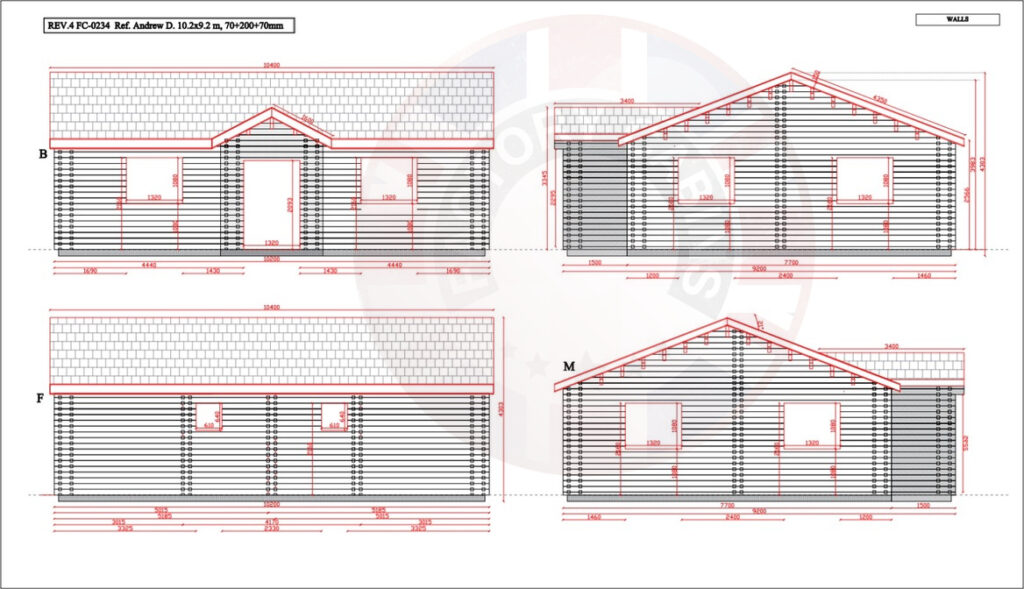
We built our first net-zero cabin in 2023 — a 10.2 x 9.2 m x 6m holiday home with:
Two en-suite bedrooms
-Kitchen
– Living/dining area
– Utility room
– Roof-mounted ground solar array
– ASHP + underfloor heating
Annual energy use: **2,100 kWh**
Solar generation: **2,450 kWh**
Net export: **+350 kWh/year**
It’s in stock — ready for delivery. Not a prototype. Not a demo. A *real* physical Twin Skin cabin.
Yet most companies still sell 44mm single-skin cabins with no insulation, calling them “energy efficient.” They’re not. They’re thermal sieves.
Part IV: The Dealer Crisis — Why We Terminated 97% of Our Partners
Let’s address the elephant in the room: **Dealerships**.
In our early years, we relied on dealers — local businesses who knew their communities, could provide installation support, and offered after-sales service.
By 2019 , we had 50/60 active dealers across the UK-Wales-Scotland-Holland-Europe
By 2020, we had **2**.
Why?
Reason #1: Systematic Overcharging and stealing !
We discovered dealers inflating prices by 50–100% — then blaming *us* for “high factory costs.” One dealer in Manchester charged £22,500 for a cabin we sold him for £9,200. When confronted, he said: *“Customers expect to pay that — they think it’s premium.”*
We terminated him.
We decided to sell direct. No more killing our brand and hard work with sadly thieves.
Reason 2: Theft & Fraud
Yes — theft. From *customers*.
Case study: A dealer in Yorkshire took deposits from 14 customers (£68.000 total) for cabins “in production.” The cabins never existed. He used the money to pay personal debts. When customers called us, we reported him to the police — he was later sentenced.
We also reported him to Trading Standards.
Another case: A dealer in Scotland substituted our 70mm twin-skin cabins with 44mm single-skin knockoffs — same packaging, same branding. Customers received cabins that leaked in rain and froze in winter. We sent engineers. Found the fraud. Terminated. Prosecuted.
These aren’t outliers. They’re symptoms of a broken system.
Which leads us to our core belief:
**If you want quality — buy direct from the factory.**
Why?
– No middleman markup
– Direct access to engineers and designers
– Full transparency on materials and processes
– Ability to customise *anything* — from roof pitch to amount of doors and windows,
– No risk of misrepresentation
And let’s be clear: **There are no significant log cabin factories in England.** None. Zero.
Why? Because England has no commercial forests suitable for structural timber. The UK imports 85% of its softwood — mostly from Scandinavia and the Baltics and sadly the Baltics is mainly Pine, too many knots, young trees, and small in diameter,. So when a company claims “Made in England,” they mean: *Assembled in England from imported parts.* Often with Chinese-made hardware and cheap timber.
We manufacture in Lithuania — But we manufacture only with Swedish Spruce.
Buying from a “UK factory” dealer? You’re paying for logistics, not quality.
Part V: The Consumer’s Survival Guide — How to Spot a Real Cabin
You’re overwhelmed. You’ve read 10 websites. Seen 50 videos. Still don’t know who to trust.
Here’s your actionable checklist — proven over 23 years:
Insist on Window/Door Specifications
Ask: *“Are windows joinery glulam or solid timber? Who manufactures the hardware? Please send photos of exactly what I am buying.
If they say “uPVC” or “premium composite” — run.
Request 4 Independent Customer References
Not testimonials on their site. *Real people.* Ask:
When did you receive your cabin?”
What issues have you had?”
Have you needed repairs? Who did them?”
Would you buy from them again?”
We give customers our direct line — no gatekeeping. If a company refuses, they have something to hide.
Check the Warranty Terms
A 20-year warranty that requires *only* basic maintenance (gutter cleaning, no standing water, re-treatment) is credible.
A 10-year warranty that excludes “natural settlement,” “weather damage,” or “improper installation” is worthless.
Visit the Factory (If Possible)
We welcome visitors — by appointment. See the timber stacks. Watch the CNC machines. Meet the joiners. Compare the finish on a freshly assembled cabin vs. one stored for 6 months.
If they won’t let you visit — why not?
Our Promise — And Why We’re Still Here After 24 Years
We could have taken the easy path. We could have switched to uPVC. We could have outsourced to the lowest bidder. We could have offered 10-year warranties and called it a day.
But we didn’t.
Because we believe:
– A log cabin is not a garden ornament. It’s a *building*.
– It deserves the same respect as a house — structurally, thermally, and aesthetically.
– The customer shouldn’t need a degree in timber engineering to avoid being ripped off.
Today, we manufacture over 7,000 unique cabin designs — from a 2m x 1.5m lawn mower cabin (yes, we make those — with lockable doors and ventilation) to a 20m x 18m luxury lodge with underfloor heating, smart lighting, and a rooftop terrace.
We’ve shipped to every county in the UK. To remote Scottish islands. To Welsh valleys. To urban London gardens (yes — even on 10m x 8m plots, with planning permission).
And we still do what we did in 2003:
– Hand-inspect every log
– Test every window under simulated settlement
– Refuse to compromise on hardware
– Fire dealers who betray trust
We’re not the biggest. We’re not the cheapest. But we are — and always have been — the most honest.
## Final Thoughts: The Future of Log Cabins — And Your Role in It
The UK log cabin industry stands at a crossroads.
On one side: Mass-produced, disposable structures — sold with flashy ads, fake reviews, and promises that crumble with the first frost.
On the other: A quiet movement of makers who believe that wood, when respected, can create beauty that endures.
We choose the latter.
But we cannot do it alone.
Every time you choose quality over hype — when you ask the hard questions, demand proof, and refuse to accept “good enough” — you strengthen the entire industry.
You protect future generations from inheriting cabins that rot, leak, and disappoint.
You honour the craft.
So, thank you — for reading this far. For caring enough to seek the truth.
If you have questions — about timber, insulation, net zero, or why your neighbour’s “premium” cabin is already peeling — email us. Call us. Visit us.
We’re here. As we’ve been since 2003.
Not to sell you a cabin.
But to help you build a legacy.**FactoryCabins.com**
Building Log Cabins That Last Longer Than Promises*
Please send us an email to sales@factorycabins.com
Hi all, another post, and this one has a long story attached to it. We first started working with our client (Jackie) 4 years ago; she had 1001 questions and her desire to have the best log cabin she could afford. And she was going to save up because she said we manufactured the best, and she wanted the best!
What she wanted was a place where she could clean her pets and also chill out, watch TV, drink a cup of tea, with no loud noises, in her garden; all she wanted was peace!
What was very important was that it would hold all that Mother Nature could throw at it, as she is in the top end of Scotland, where the weather is one minute sunny then pouring down with rain.
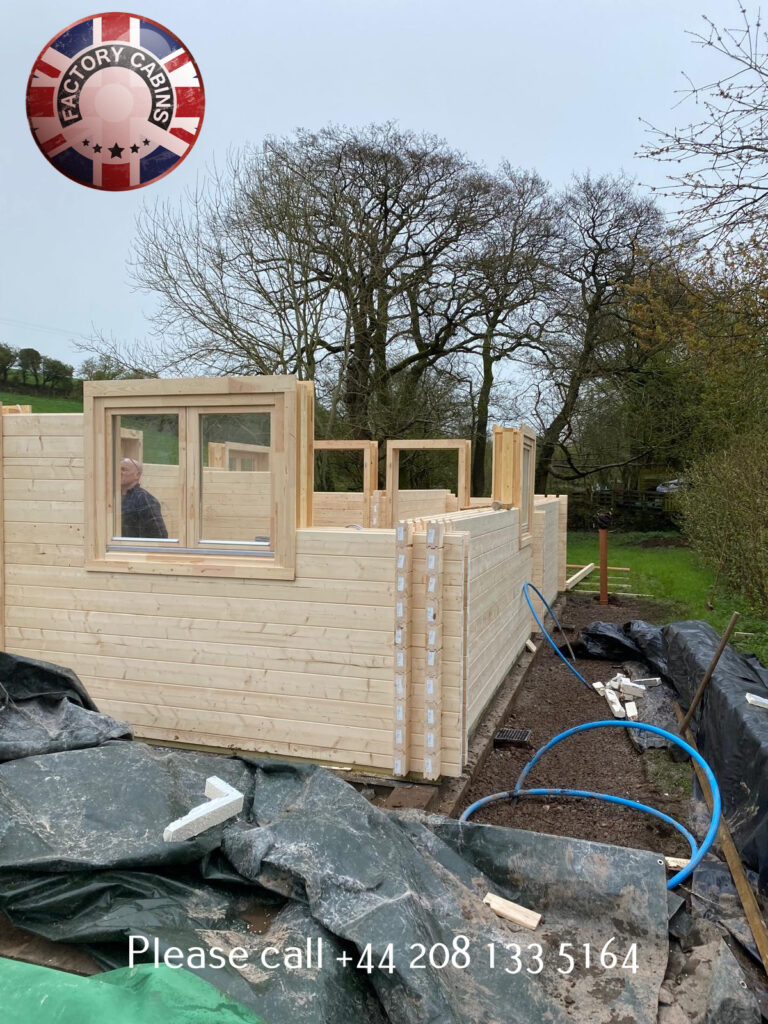
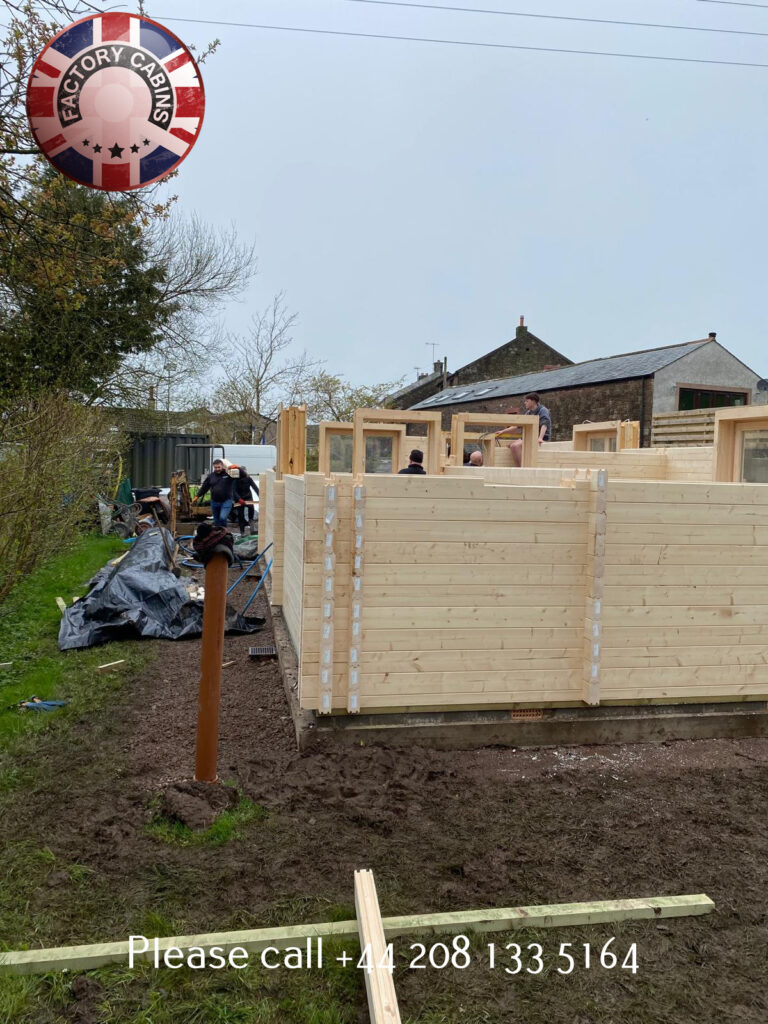
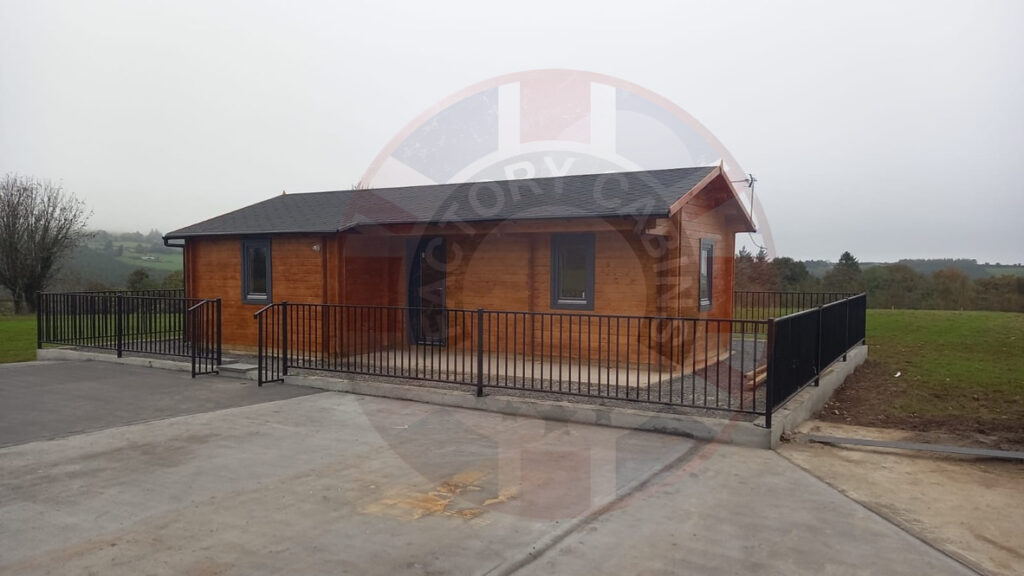
Bespoke 4m x 7m 44mm x 44mm Twin Skin Log Cabin
Jackie only wanted one from our cabins, as she was sure that we sold the best, plus we could easily bespoke it to her needs. Jackie had also spoken to a few of our other customers and had asked them about the quality, etc. Also, we said please look around and then, if they are happy, come back. Jackie and her husband, Gerry, decided to visit every dealer in Aberdeenshire and the surrounding areas and check what else was available and what the pricing was on offer. They were looking for quality, and Jackie had read quite a lot of my blog. So she knew what’s what.
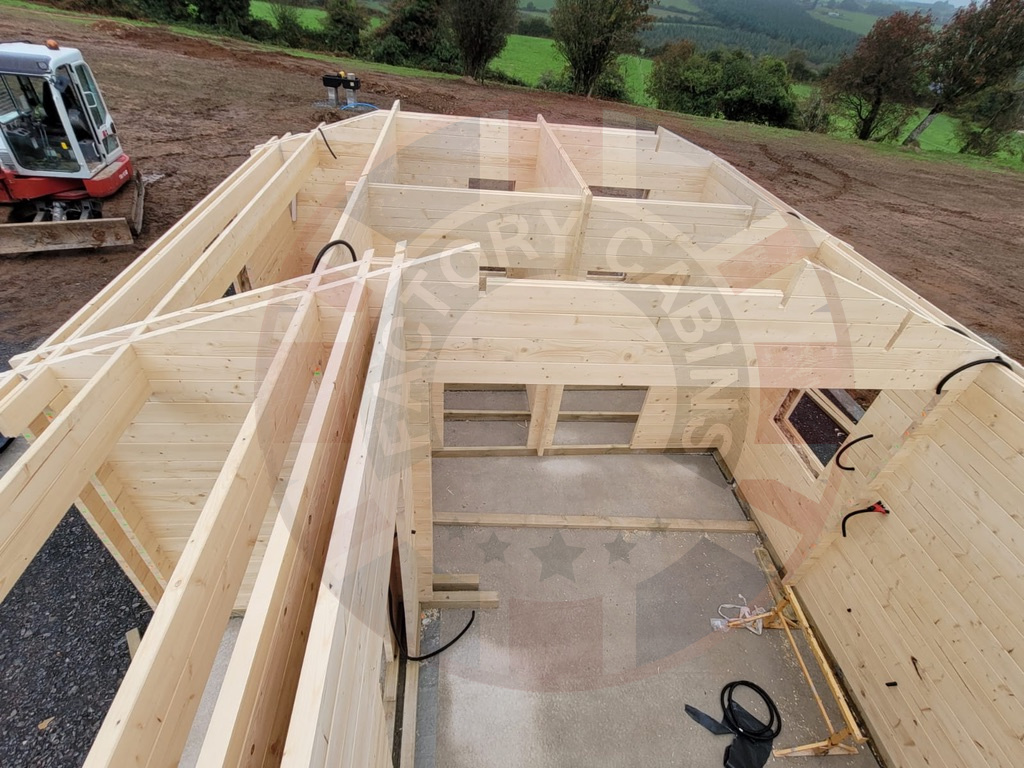
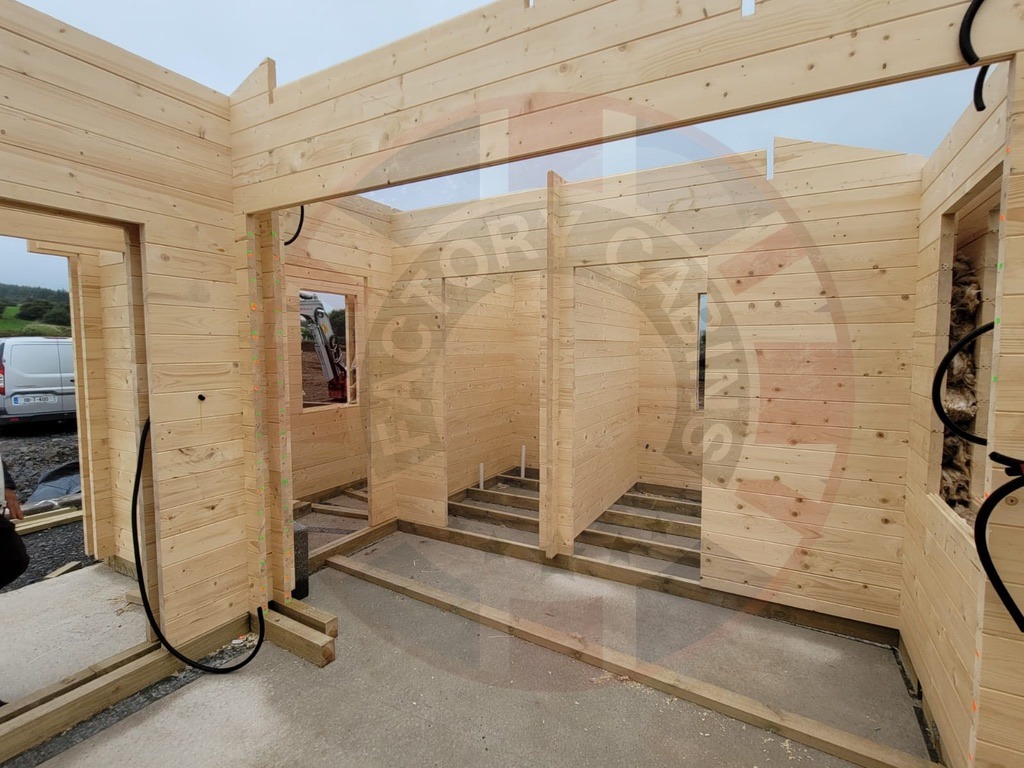
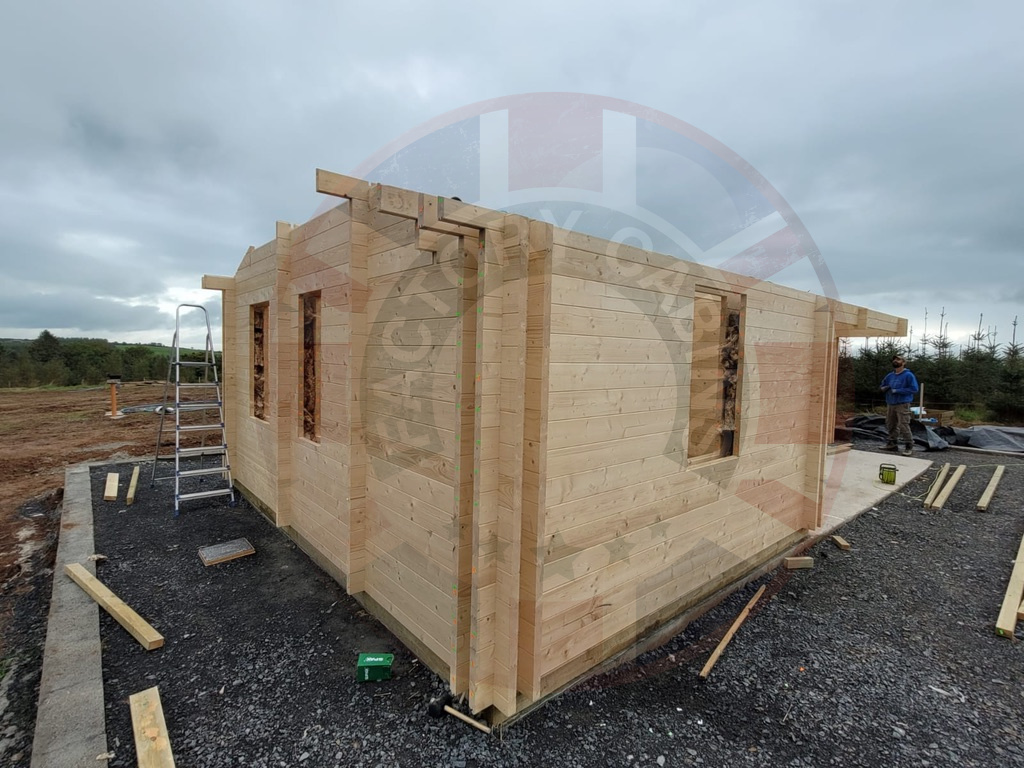
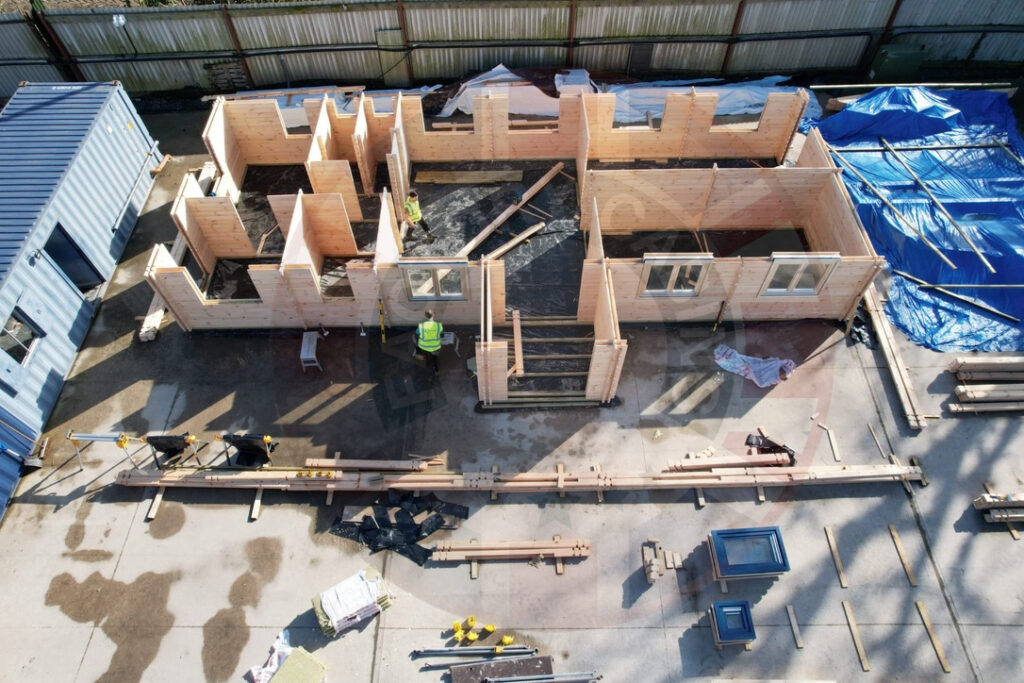
So here are some photos of their build. And the outcome.
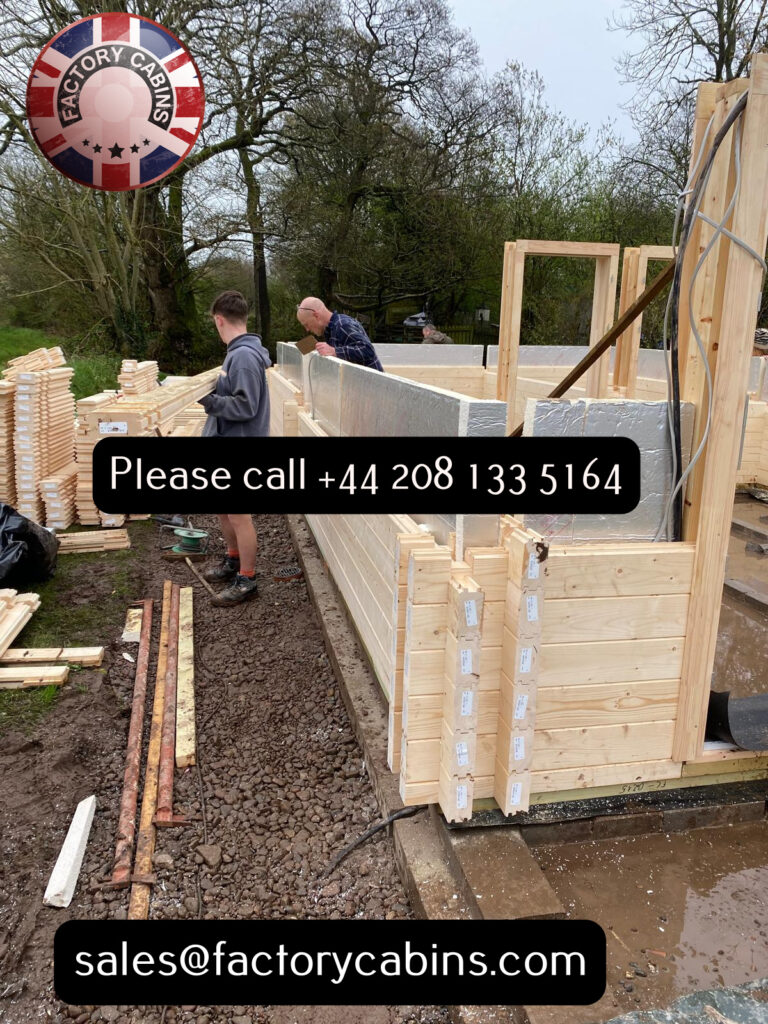
So the concrete base went down, and as you all know, bad base, bad build. All flooring was impregnated and dampproofed.
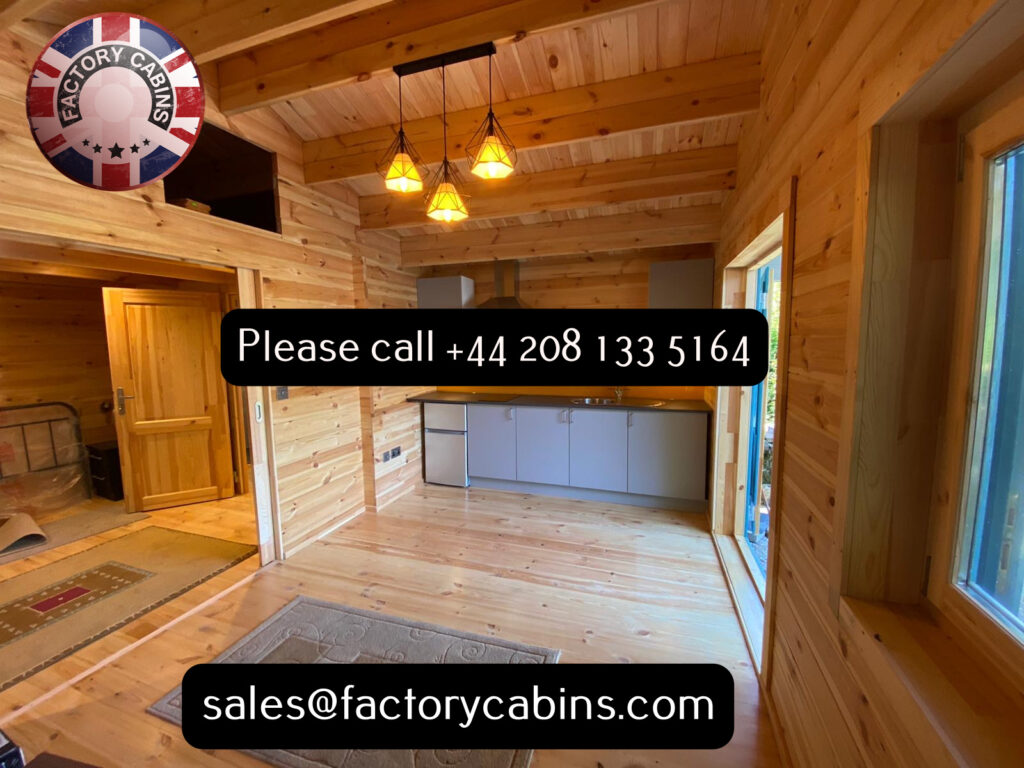
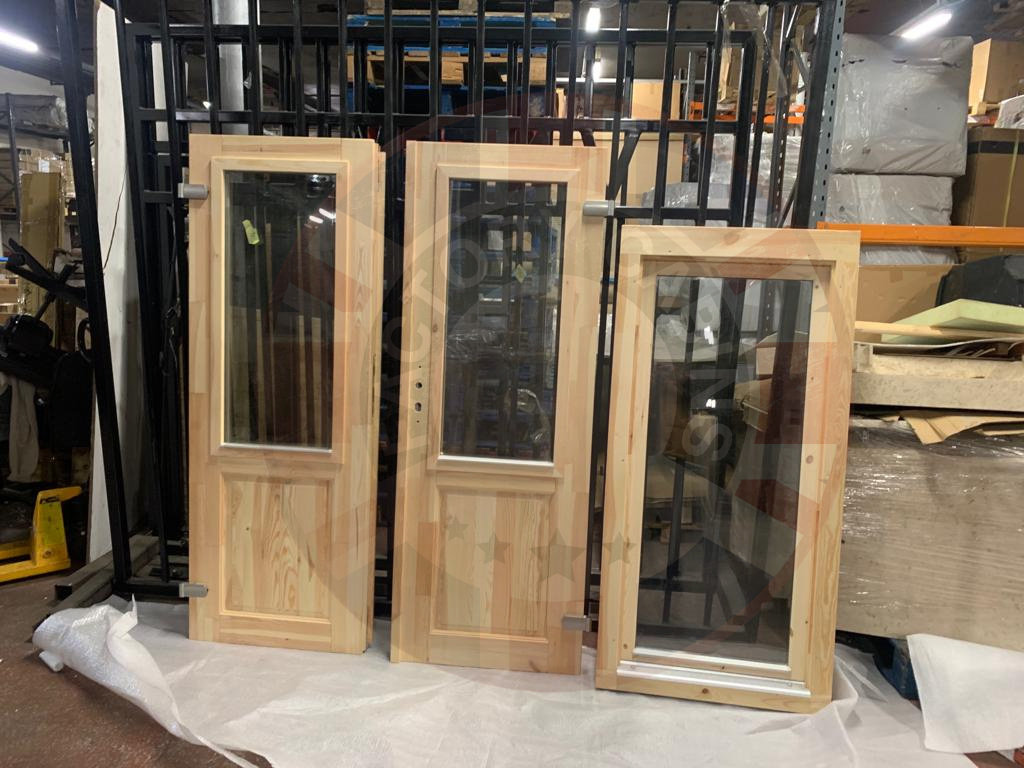
Our internal doors for all our log cabins are superb quality.
All windows and doors are treated before they are put into place. Our windows and doors are manufactured from Joinery Glulam; we are not very keen on putting plastic, cheap windows and doors into our cabins (which are sold as an expensive upgrade) as we are able to manufacture the best joinery wooden ones, double-glazed tilt, and turn on our new CNC window and door line.
Bespoke 4m x 7m 44mm x 44mm Twin Skin Log Cabin
A lot of the mass-manufactured cabins may have an upgrade offered on their websites from their cheap, awful windows and doors, and then they offer plastic. The reason for this is obvious: they cannot manufacture quality. This is the first sign that what you are thinking of purchasing is mass-manufactured rubbish! The price is tempting, but the quality is poor!
Twin skins are perfect for all seasons, and as the first to manufacture these and design this system, I think we know what we are talking about!
We do not have missing bits, and that one thing for you is a blessing.
We use Swedish timber, which is now the best on the planet to manufacture your log cabins from? The Swedish know how to cut and prepare logs.
Bespoke 4m x 7m 44mm x 44mm Twin Skin Log Cabin
It’s really important to know what you are buying, who you are buying from, and always remember that purchasing your cabin from the best means your cabin will last you the test of time; cheap means a few years; our means 30 years plus.As long as you stick to our terms and conditions.
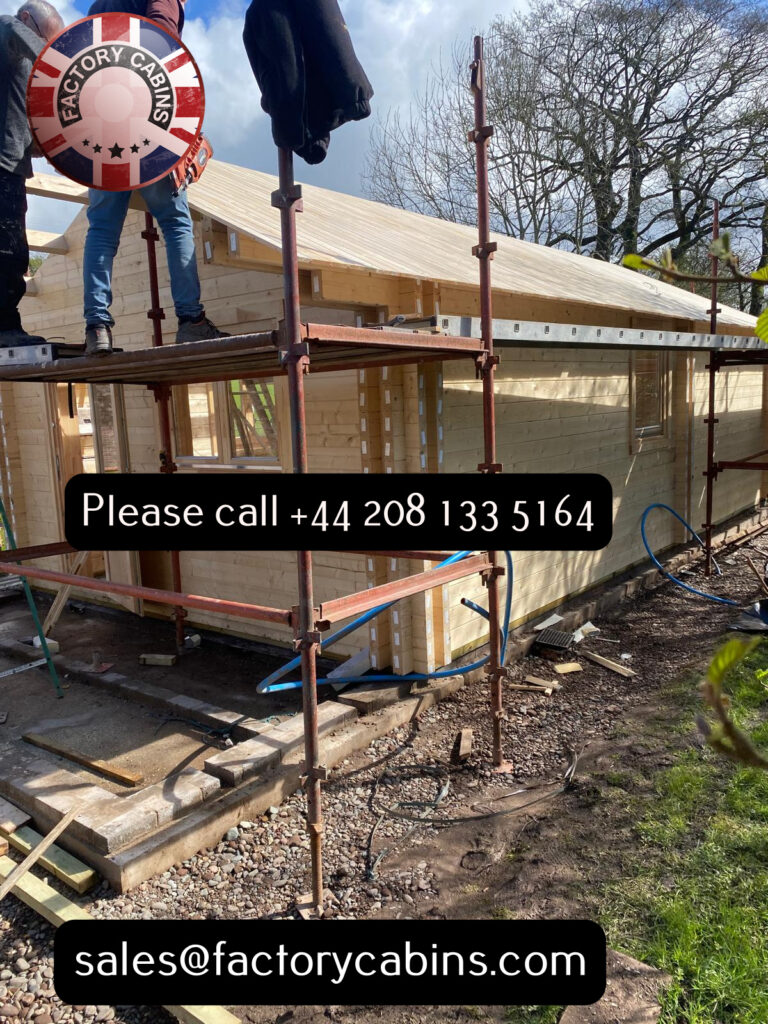
If it rains, you must always have a cover ready to put over the building; we do not want damage, you do not want damage, and if you listen to us if your doing a self-build, there are a few things you must have at hand. Jackie and Gerry listened to us, and that’s why their build was spot on in every sense. Plus Gerry did not screw the logs together, who in their right mind came up with this idea—madness, stupidity at the lowest level. The logs must settle, and if you screw them together, when they shrink, it leaves gaps—rather large gaps.
Bespoke 4m x 7m 44mm x 44mm Twin Skin Log Cabin
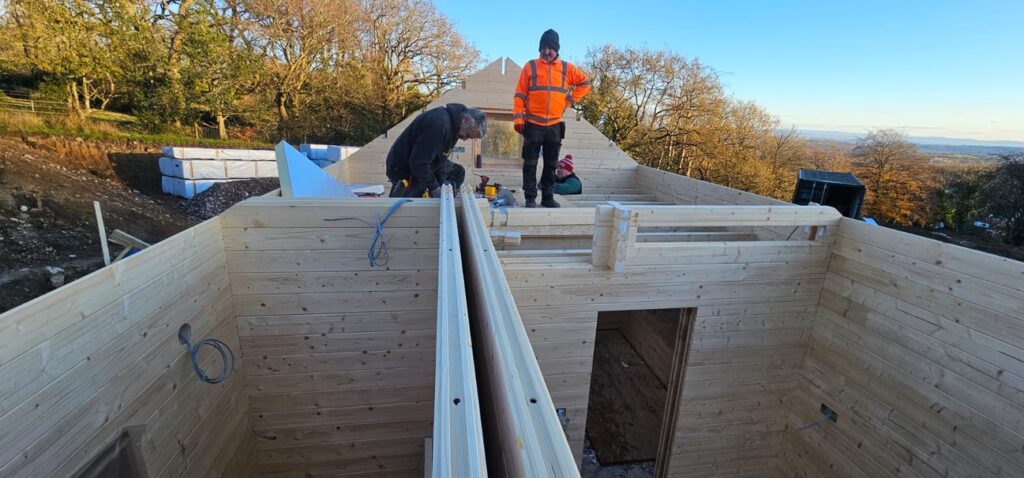
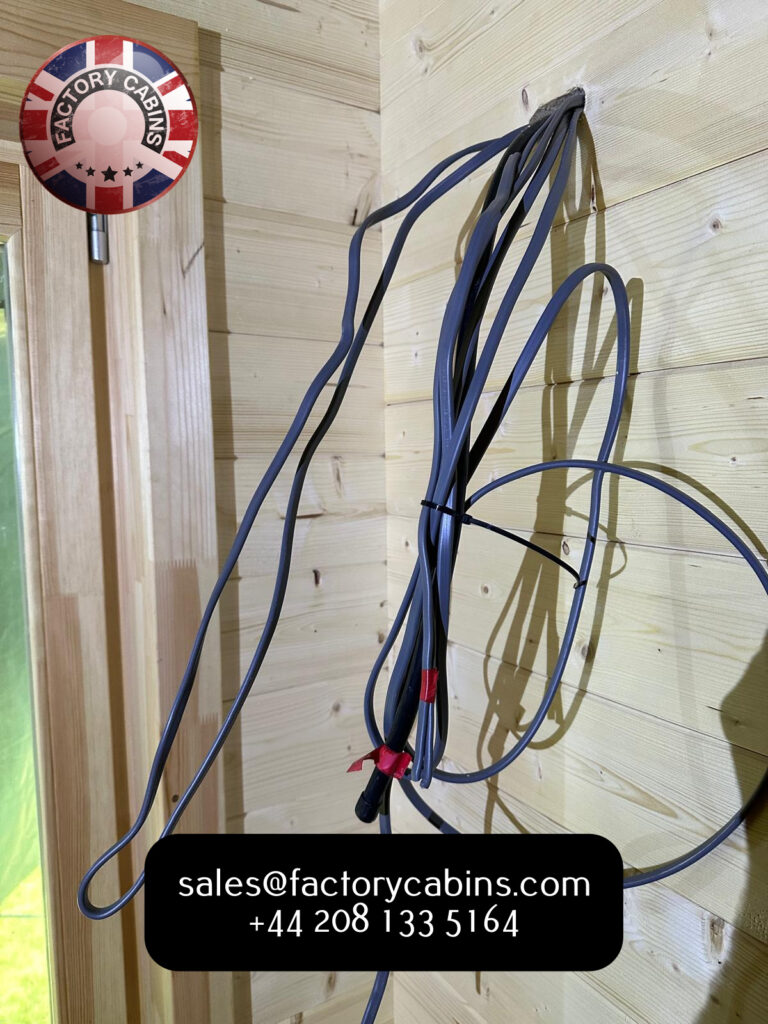
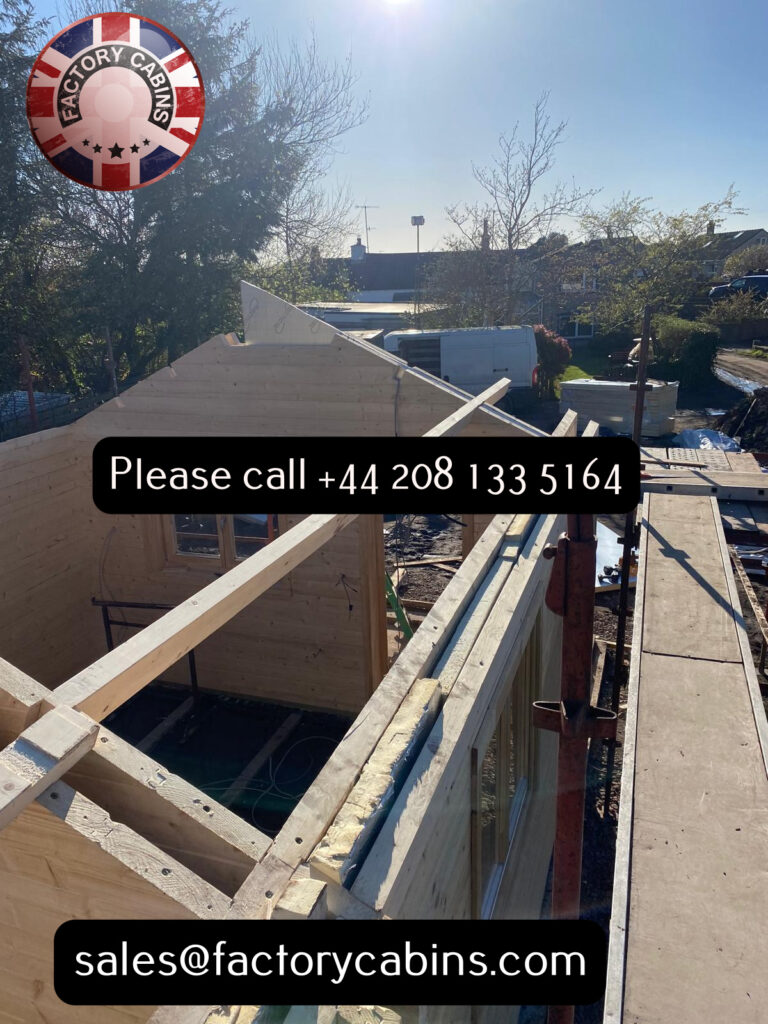
The great thing about twin skins is that you can hide all the wires in side the viod.
A small scaffolding tower is best to have at hand. Health and safety first…
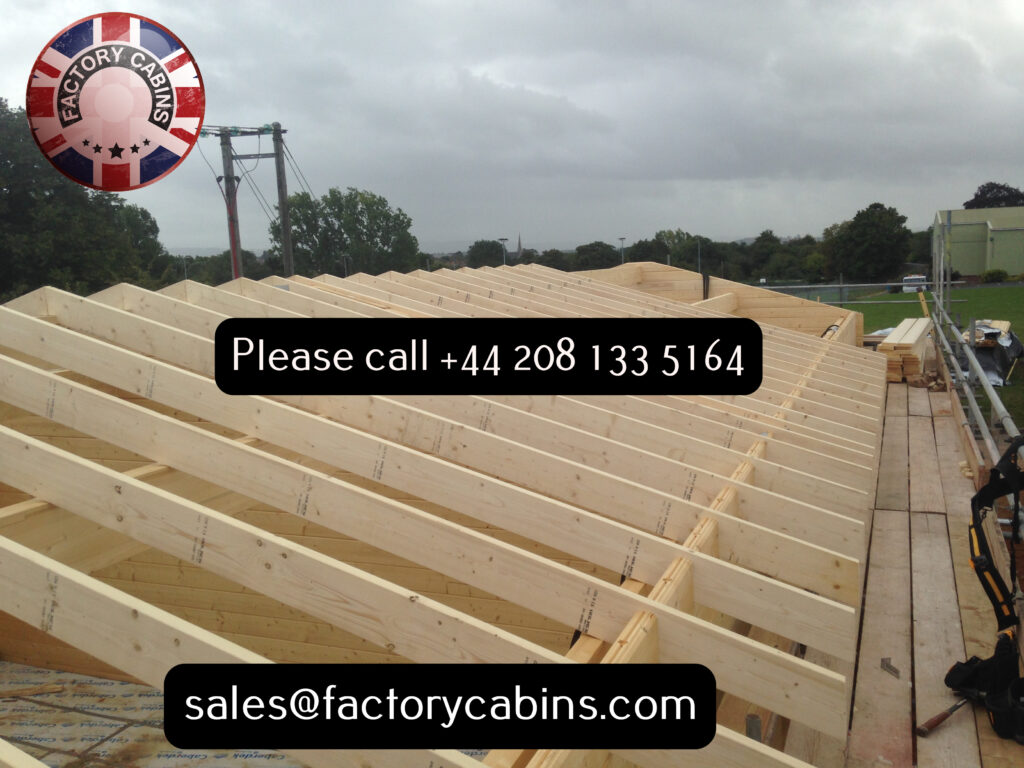
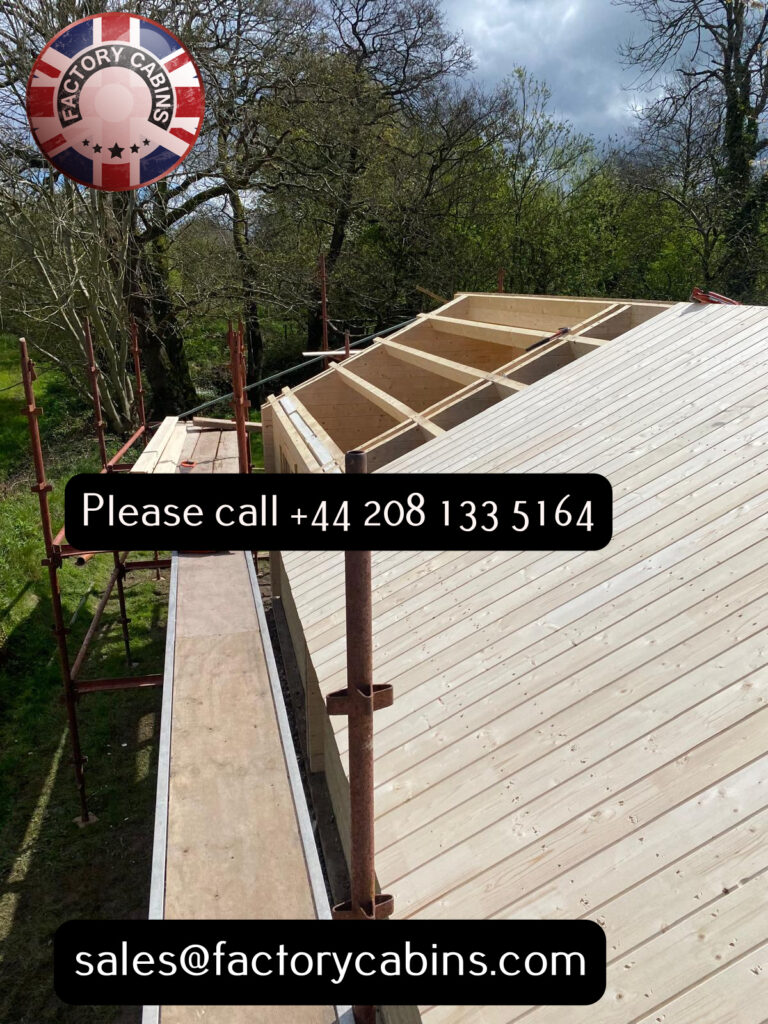
Add a protective layer of water proof paint on the roof boards a very clever idea.
You must let this dry before you move forward.
Then… battens, insulation, and OSB.
And on top of that, a felt roof. Wow, not finished yet.
Then shingles! Yep. An all-weather log cabin… only from factory cabins.
Looks solid!! This cabin can be slept in in minus 30 easy!
Bespoke 4m x 7m 44mm x 44mm Twin Skin Log Cabin
Now inside…….
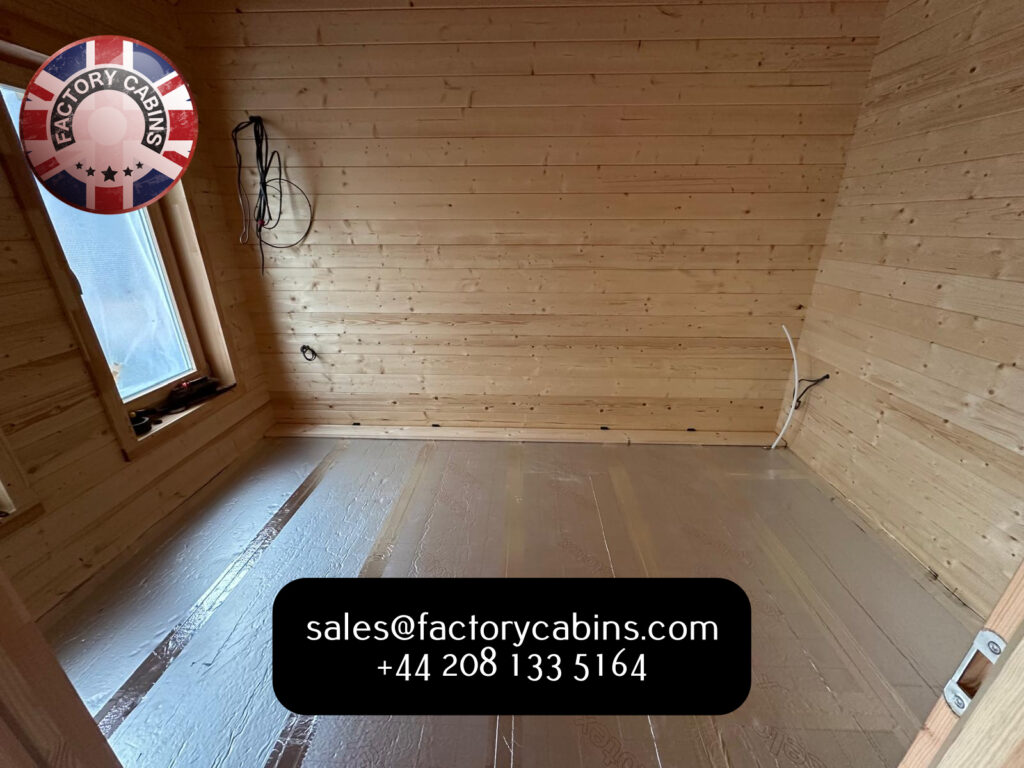
Doing the floor is a quality job, as its the last thing to do, and it’s actually the hardest, as you must make sure you have done all your calculations so they are correct. The floor must be spot on!
Massivley insulated floor, base, and well done.. Superb!
So if you are looking for a high-quality insulated twin-skin log cabin, please give us a call.
Let’s talk about “Twin Skin” log cabins, something we at Factory Cabins are absolute experts on! Why are we the experts, Because we designed the twinskin system.
We were the first to design, manufacture, and bring to market, all others are copies of ours! We went through the whole trial and error. Understanding how to manufacture a twin skin correctly is a task in itself. Everything must be calculated precisely.
These are not your basic log cabins. These are ( Incredible Quality Insulated Twin Skin Log Cabins)
Twinskin ones have become sought-after lately, all thanks to their unique design and plenty of benefits.
So, what makes them so special?
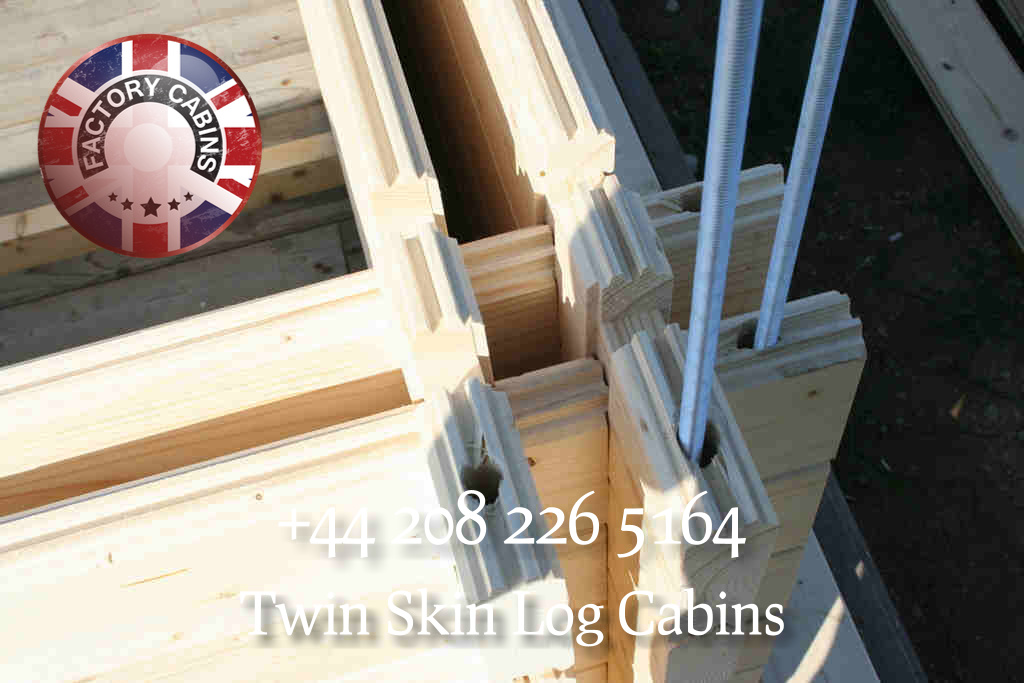
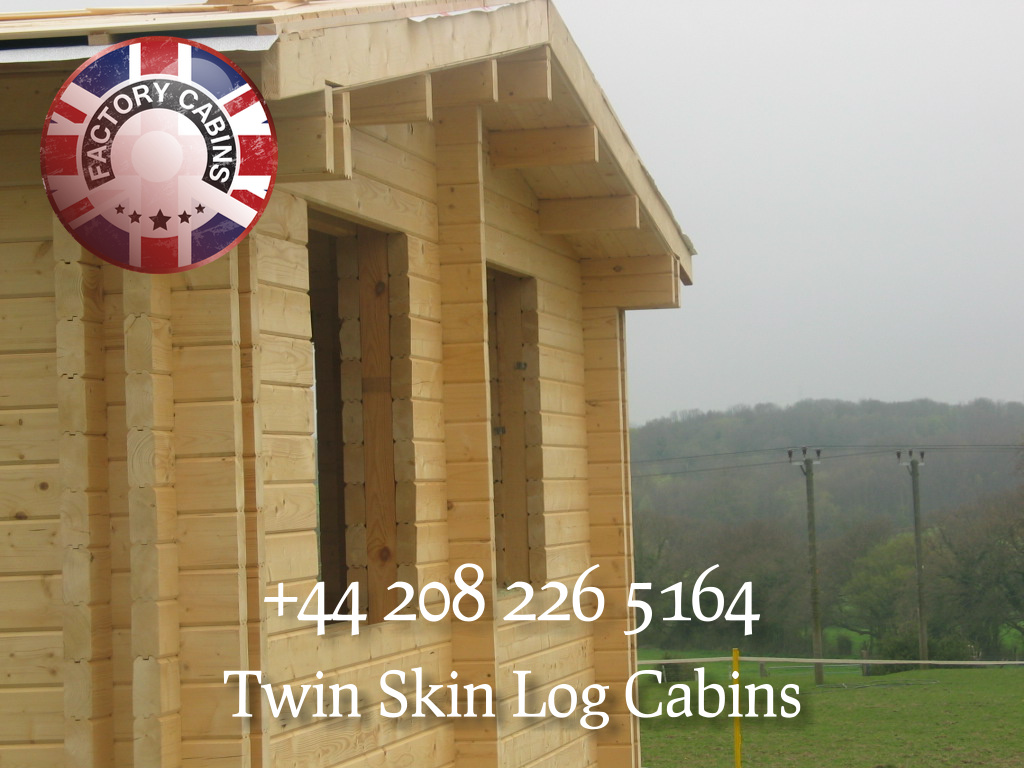
Twinskin log cabins, or, if you like, call them double-skin or twin-wall cabins, have an innovative construction with two separate walls.
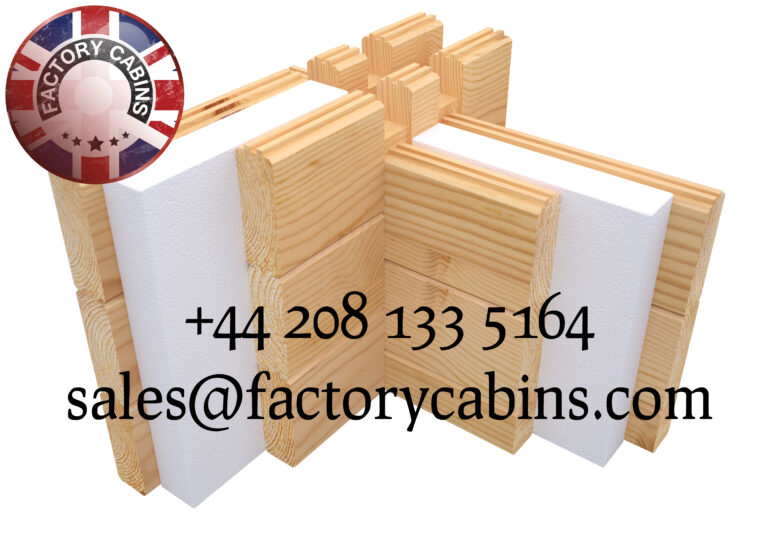
This is a big jump from the usual one-wall affair in traditional log cabins. Here’s the best part: there’s an air cavity right between these walls acting as insulation!
That means superior thermal performance, making your cabin energy efficient. Let’s dig a bit deeper into how they’re built. You start by assembling two different walls with top-notch Swedish spruce logs. Why? The sturdiness and thermal characteristics of these logs ensure you get a solid structure that keeps cosy very well indeed.
Now remember the air cavity I mentioned earlier. Some sort of insulating material (perhaps mineral wool or foam) fits right in there, optimising thermal efficiency.
It’s probably clear by now that the high level of insulation is a major feather in the cap for Twinskin log cabins!
That little cavity does great work as a barrier against heat transfer – so it’ll keep your cabin cool during the summer and warm in the colder months without needing extra heating or cooling units around, thus saving energy.
The double-wall structure isn’t just for show – it multiplies durability too! These two walls divide up weight equally and battle external strains from wind to snow loads, ensuring longevity for your space.
Now onto another plus point: customisable designs! With extra insulation to play with, twin skin log cabins give you more freedom to play around durably with larger windows and doors without cutting down on energy efficiency, Flexible interior design options further add creative flexibility to how you want things done inside!
Surely this awesome level of insulation means energy efficiency is taken care of.
Absolutely right! Lower utility costs, less heat loss during the winter, and limited heat gain in the summer seasons mean the living conditions inside remain comforting while trimming down on environmental impact.
It’s a massive economic and ecological win!
Why should you think about including a Twinskin Log Cabin on your land?
Well, it’s simple: they are comfortable, durable, and offer great energy efficiency, regardless of whether you’re aiming for a home away from home hideout or scouting out your new permanent residency. These log cabins tick all boxes that combine optimal functionality with gorgeous aesthetics.
So, to sum things up: twin skin log cabins redefine traditional log cabin construction, boost insulation abilities, strengthen durability, and increase energy effectiveness.
And at Factory Cabins, we’re all about giving you quality options that meet your exact needs or go beyond them. We’re ready to start whenever you are! Please do not hesitate to get in touch with us now so we can discuss fitting a fantastic Twinskin log cabin onto your property. ( Incredible Quality Insulated Twin Skin Log Cabins)
In the dynamic and ever-evolving landscape of contemporary society, we are consistently exploring avenues to elevate and refine our habitation environments.
As the veil of ignorance lifts, revealing the profound repercussions of our lifestyle on the delicate balance of our planet, the blazing urgency of sustainability and energy efficiency rises like a volcanic force, engulfing our collective consciousness with fervour—propelling us towards a future where responsibility reigns supreme.
An aspect that has experienced noteworthy progress in relation to both ecological responsibility and the utilisation of resources is the development of cabin infrastructure.
In a market filled with choices, twin skin log cabins rise above the rest; they are the ultimate selection for individuals in search of a snug, eco-conscious living environment. This blog will delve into the rationale behind the superior insulation properties of twin skin log cabins, asserting their status as the premier choice in the market, and ultimately elucidating how they embody a futuristic approach in the present time.
Above all else, the twin skin log cabins boast remarkable insulation capabilities. The cabins, aptly named for their construction with two layers of logs, boast a unique “twin skin” design; this design enhances insulation significantly.
These twin skin log cabins boast a distinctive design, setting them apart from all other cabin types—ideal for those in pursuit of an exceptionally energy-efficient habitat! The double stack of logs forms a cosy hideaway; it shields the cabin from extreme temperatures, ensuring snug winters and breezy summers.
The remarkable insulation prowess of twin skin log cabins allows for reduced energy consumption while maintaining optimal indoor temperatures, leading to substantial financial benefits for the homeowner.
In addition to this; the air pockets formed due to the twin skin construction act as organic sound barriers, thus decreasing the noise levels in the cabin. This attribute renders twin skin log cabins a superb option for individuals residing in bustling metropolitan environments, as well as for those seeking a serene and tranquil residential setting.
With its top-notch insulation, the cabin becomes a peaceful sanctuary where you can create without disturbing others; it’s an ideal spot for a home office or studio. The extraordinary resilience and lasting quality of twin skin log cabins—these are attributes that cannot be overlooked.
The dual strata of logs imbue these cabins with enhanced durability and stability compared to conventional single-layered log structures. Wrapped around the core like a shield, the outer layer of logs safeguards the inner layer, guaranteeing the cabin’s structural integrity for years to come.
Additionally, by incorporating a twin skin design, the risk of moisture and water damage is minimised; this not only fosters a healthier living space but also extends the longevity of the cabin.
Twin skin log cabins boast unparalleled versatility, making them a masterful choice with a myriad of possibilities. These cabins, ranging in sizes and designs as vast as the ocean, possess the magical ability to transform—moulded and shaped according to the unique desires and wishes of each soul they encounter.
In the quest for a charming and intimate weekend escape; or a roomy, welcoming abode for the family, twin-skin log cabins can be customised to suit all your needs. The multifaceted nature of these cabins renders them a superb choice for a myriad of purposes, encompassing a guest abode, a professional workspace, or even a holiday lodging.
Finally, embrace the innovative choice of twin skin log cabins, harmonising with modern ecological principles and presenting a sustainable living alternative. The majestic logs gracing these cabins were procured from sustainable sources—a gift from the forest to shelter weary travellers; their innate ability to keep temperatures stable ensures a harmonious equilibrium inside, reducing the demand for energy—a dance between nature and construction. This not only diminishes carbon emissions but also serves to minimise the aggregate energy consumption of the cabin.
In a world teetering on the brink of an environmental crisis, the advent of twin skin log cabins heralds a bold leap towards a future draped in lush, verdant hues—a symphony of sustainability echoing through the ages.
To sum up, it is evident that twin skin log cabins stand out as the most well-insulated cabins available, providing a plethora of benefits and advantages to property owners. The duality of the twin skin construction offers superlative thermal retention, robustness, adaptability, and ecological consciousness, rendering these lodgings a preferred option for individuals in search of a thoroughly insulated and environmentally sustainable habitat.
In our relentless journey towards a future brimming with sustainability where the echoes of progress harmonise with nature’s whispers, the emergence of twin skin log cabins stands as a beacon, illuminating our path forward.
The unlimited uses of a Twinskin Log Cabin from Factory Cabins start with a holiday park that is looking for rental or home passive incomes a granny annex, a highly insulated home office, the warm and inviting man’s cave, a reading room, a sound studio, a bar, this kind of structure where insulation is very important, and longevity—the twin skin design offers so many possibilities and costs only a fraction of that of a timber frame cabin.
The term “Twinskin Log Cabins” refers to the system that consists of separate layers of timber with an air space (void) between them. These kinds of buildings are becoming more and more famous within the UK, as they offer the appropriate aggregate of affordability, durability, and aesthetics.
At Factory Cabins, we are proud to provide a wide range of twin-skin buildings that are unbeatable in terms of amazing designs and affordable pricing. Our buildings are perfect for nearly everything, whether it is as a bedroom in the garden, a passive income, home office, or maybe you need a place for mum and dad to hang out and enjoy being close to their family.
One of the key bullet points of our highly insulated twin skin all year-round log cabins is the use of Scandinavian timber. This remarkable lumber is known for its robustness, durability, endurance, and resilience to extremely harsh weather, making it perfect for the UK climate. (if you would like the PFC certification number for our timber, we are always happy to oblige).
Because we manufacture with this type of superb timber, it sets us apart, You must note that most log cabin companies will not use this expensive type of timber, You ask why, Simple profit, it’s always about their profits, which is why you see them state that their timber is amazing and they will give a ten-year guarantee, This is a joke.
We have the very first twin skin log cabin ever made, and it is over 20 years old, It is still standing strong, no splits, cracks, or discoloration. Why??
We are not looking to have you as a repeat customer (unless you are looking for something larger), as we want your cabin to last you a lifetime, Most of our business comes from word of mouth. If you take our advice and stain your cabin in what we deem to be the best, and do exactly what we recommend, it will last over 20 years easily. Our customer reviews on their windows and doors are always overstated on their shock of the quality. In 23 years of manufacturing, we have never had a building returned.
In addition to the usage of first-rate Swedish lumber, our twin skin cabins are also equipped with superb windows and doors, that are fitted with toughened glass, and German hardware, Because we go the extra mile to use only joinery glulam timber in the production of our windows and doors, we feel, that if you are looking for a cabin that exceeds everything else on the market, also with low pricing, you are onto a winner. Most manufacturers will not show you up close their products, in fear that you will see their flaws immediately.
We provide a huge variety of sizes and configurations, from one and 3-bed room options with separate living areas, kitchens, and bathrooms. We love to bespoke our buildings, and help you get that dream highly insulated log cabin you have always wanted.
But it’s not just the realistic aspects that make our twin-skin log cabins stand out. We additionally placed a variety of emphasis on the design and aesthetic appeal of our buildings. Each of our twin- or single-skin cabins, 44mm, 70mm, 44mm x 44mm, and 70mm x 70mm, is carefully crafted to achieve the appropriate stability among functionality and style.
Whether you decide on a traditional or modern-day appearance, we can create a constructing to supplement your garden and enhance its look and give you a cabin that really will stand apart from your neighbours. Our goal is as it has been since we first introduced Log Cabins into the UK garden market, some 24 years ago, and which took us over 3 years for the Shed Boys, and Garden Centres to put the log cabins on display and offer a better building than the typical expensive, leaking shed.
At Factory Cabins, we understand that affordability is a critical element for our customers.
However this is difficult, as quality costs, so our cabins are at the high end of the pricing spectrum or so we thought, but we seem to be lower than the cheap and cheerful end most of the time, (one reason is because we don’t offer upgrades, as you get the best from us as standard) we offer 28mm flooring as standard, and 19mm for roof boards, we also offer exceptional joiner glulam windows and doors. This formula of quality is in our 3m x 3m 44mm or our 70mm x 70mm twin skin cabin. However, our Log Cabin Twins have an extra roofing layer for insulation included at no additional cost .
As the designer and first to manufacture and bring to market the twin skin cabin system, and considered the best of the best, Factory Cabins is your first choice.
We take a wonderful pride within the fact that our range of twin skin buildings is the biggest in the marketplace and very much the leading light, plus we are always the ones to push the market into offering better.
We have the abilities, knowledge, and revel in to create high-quality cabins with a view to exceed your expectations. Our crew of experienced joiners, machinists, works tirelessly to make sure that every detail of your log cabin is perfect.
So? if you are looking for an amazing twin skin log cabin in your garden, you are looking for quality, cost, and a long-lasting superior building, then please do not hesitate to give us a call.
Always pay with a credit or debit card, and never, ever buy a cabin from anyone who promises you a large discount if you pay in cash. This has led to too many people losing their entire deposit.
Twin skin log cabins, often referred to as double-wall or dual-wall log cabins, have gained significant popularity in recent years due to their enhanced durability, insulation properties, and customisable designs. These structures offer a unique blend of traditional charm and modern functionality, making them an attractive option for residential, commercial, and recreational purposes.
What are Twin Skin Log Cabins?
Twin skin log cabins consist of two separate walls, 44mm x 44mm with 100mm void between, or 70mm with an air gap between them, providing superior insulation compared to single-wall log cabins. Typically, the inner and outer walls are constructed using interlocking logs or timber panels, with insulation materials such as mineral wool or foam inserted between them. This design helps regulate indoor temperature and humidity levels, making twin skin log cabins suitable for year-round use in various climates.
Construction Process
The construction process of twin skin log cabins involves several stages, including site preparation, foundation installation, wall assembly, roof construction, and interior finishing. Skilled craftsmen carefully select and assemble high-quality logs or timber panels to ensure structural integrity and aesthetic appeal. Additionally, specialised insulation materials are installed between the walls to enhance thermal efficiency and acoustic performance.
Advantages of Twin Skin Log Cabins
Twin skin log cabins offer several advantages over traditional single-wall log cabins, making them an ideal choice for homeowners and businesses alike.
Durability
The dual-wall construction of twin skin log cabins provides added strength and stability, making them more resilient to environmental factors such as wind, rain, and snow. This durability ensures that the structure remains sturdy and secure for years to come, reducing the need for frequent repairs or maintenance.
Insulation Properties
One of the key benefits of twin skin log cabins is their excellent insulation properties, which help maintain comfortable indoor temperatures throughout the year. The air gap between the walls acts as a thermal barrier, preventing heat loss in the winter and heat gain in the summer. As a result, occupants can enjoy energy savings and reduced utility costs.
Customisation Options
Twin skin log cabins offer endless customisation options to suit individual preferences and requirements. From traditional rustic designs to modern contemporary styles, homeowners can choose from a variety of finishes, layouts, and amenities to create their dream cabin. Additionally, optional upgrades such as skylights, balconies, and porches allow for personalised touches that enhance functionality and aesthetics.
Applications of Twin Skin Log Cabins
Twin skin log cabins are versatile structures that can be used for a wide range of purposes, including:
Residential Use: Twin skin log cabins serve as cosy retreats, guest houses, or primary residences for homeowners seeking a peaceful and sustainable living environment.
Commercial Use: Businesses can utilise twin skin log cabins as offices, retail stores, restaurants, or accommodation facilities, providing a unique and inviting space for customers and employees.
Recreational Use: Twin skin log cabins are perfect for recreational activities such as camping, hunting, fishing, or hosting gatherings with family and friends in nature.
Choosing the Right Twin Skin Log Cabin
When selecting a twin skin log cabin, it’s essential to consider the following factors:
Budget Considerations: Determine your budget and explore different pricing options, including standard models and custom designs tailored to your specifications.
Size and Design Options: Assess your space requirements and preferences regarding cabin size, layout, and architectural style to ensure a perfect fit for your needs.
Location and Environmental Factors: Consider the climate, terrain, and local building regulations to determine the most suitable location and foundation type for your cabin.
Maintenance Tips for Twin Skin Log Cabins
To keep your twin skin log cabin in optimal condition, follow these maintenance tips:
Regular Inspections: Schedule routine inspections to check for signs of wear and tear, including cracks, leaks, and insect infestations.
Cleaning and Treatment: Clean the exterior surfaces regularly and apply protective coatings or treatments to prevent moisture damage, UV fading, and wood rot.
Repairs and Upkeep: Address any maintenance issues promptly to avoid further damage and prolong the lifespan of your cabin. Replace damaged logs, repair roof shingles, and seal gaps to maintain structural integrity and weatherproofing.
Comparison with Other Types of Log Cabins
While twin skin log cabins offer numerous benefits, it’s essential to compare them with other types of log cabins, such as single skin log cabins and insulated log cabins, to make an informed decision.
Single Skin Log Cabins
Single skin log cabins consist of a single wall without additional insulation, making them more affordable but less energy-efficient than twin skin log cabins. While suitable for seasonal use or mild climates, single skin log cabins may require additional heating and cooling systems to maintain comfort levels.
Insulated Log Cabins
Insulated log cabins feature a single wall with built-in insulation, offering improved thermal performance compared to single skin log cabins. However, they may not provide the same level of insulation as twin skin log cabins, particularly in extreme climates or high-traffic areas.
Case Studies and Examples
Numerous successful twin skin log cabin projects showcase the versatility and appeal of these structures in various settings. From cosy countryside retreats to modern urban dwellings, twin skin log cabins offer endless possibilities for homeowners and businesses alike. Customer testimonials and reviews highlight the quality craftsmanship, comfort, and sustainability of twin skin log cabins, making them a preferred choice for discerning buyers.
Future Trends and Innovations
As technology and sustainability practices continue to evolve, the future of twin skin log cabins looks promising. Advancements in construction materials, energy-efficient systems, and smart home technologies offer opportunities to enhance comfort, convenience, and environmental performance. Sustainable practices such as eco-friendly materials, passive solar design, and off-grid solutions contribute to reducing the carbon footprint of twin skin log cabins, making them a sustainable housing option for the future.
Environmental Impact of Twin Skin Log Cabins
Twin skin log cabins are inherently eco-friendly structures that promote sustainability and environmental responsibility. The use of renewable resources such as wood and timber reduces reliance on non-renewable materials and helps mitigate climate change. Additionally, the energy-efficient design and insulation properties of twin skin log cabins contribute to lower carbon emissions and energy consumption, resulting in a smaller environmental footprint compared to conventional construction methods.
Cost-Benefit Analysis
While the initial cost of twin skin log cabins may be higher than single skin log cabins or traditional construction methods, the long-term benefits outweigh the investment. Energy savings, reduced maintenance expenses, and increased property value contribute to the overall cost-effectiveness of twin skin log cabins. Furthermore, the durability and longevity of these structures ensure a high return on investment and years of enjoyment for homeowners and businesses.
Common Misconceptions About Twin Skin Log Cabins
Despite their numerous benefits, twin skin log cabins may be subject to common misconceptions, including:
Expense: While twin skin log cabins may have a higher upfront cost than other types of log cabins, they offer superior quality, durability, and insulation properties that justify the investment over time.
Maintenance Requirements: Some people believe that twin skin log cabins require excessive maintenance due to their complex construction. However, with proper care and upkeep, twin skin log cabins can remain in excellent condition for decades with minimal maintenance.
Expert Recommendations and Advice
Industry experts recommend considering the following factors when purchasing or building a twin-skin log cabin,
Industry Insights: Stay informed about the latest trends, regulations, and innovations in the log cabin industry to make informed decisions and maximise the value of your investment.
Professional Tips for Buyers: Consult with experienced architects, builders, and contractors to assess your needs, explore design options, and ensure a smooth construction process from start to finish.
So….
Twin skin log cabins offer a perfect blend of timeless charm and modern convenience, making them an attractive housing option for homeowners and businesses alike. With superior durability, insulation properties, and customisation options, twin skin log cabins provide a comfortable and sustainable living environment for people of all ages. Whether used as a primary residence, vacation retreat, or commercial space, twin skin log cabins offer endless possibilities for creativity, comfort, and enjoyment.
FAQs about Twin Skin Log Cabins
Are twin skin log cabins suitable for year-round living? Yes, twin skin log cabins are designed to provide comfortable indoor temperatures throughout the year, making them suitable for permanent residency in various climates.
How long do twin skin log cabins last? With proper maintenance and upkeep, twin skin log cabins can last for several decades or even centuries, depending on the quality of construction and materials used.
Can I customise the design of a twin skin log cabin? Absolutely! Twin skin log cabins offer endless customisation options, including size, layout, finishes, and amenities, to suit your preferences and requirements.
Do twin skin log cabins require a lot of maintenance? While twin skin log cabins may require occasional maintenance such as cleaning, sealing, and repairs, they generally require less upkeep compared to traditional homes or single skin log cabins.
Are twin-skin log cabins environmentally friendly? Yes, twin-skin log cabins are eco-friendly structures that promote sustainability and reduce carbon emissions through the use of renewable materials and energy-efficient design principles.
When it comes to searching for the perfect log cabin online, it can often be a daunting task to differentiate between the array of options available.
Many companies use similar images and marketing tactics, making it difficult for consumers to discern the quality and value of the cabins being offered. This can lead to disappointment when the actual product falls short of expectations based on the enticing visuals and promises made online.
One of the primary issues that consumers face when searching for a log cabin online is the lack of detailed and transparent information provided by many companies.
Often, companies will showcase beautiful images of their cabins without offering close-up views or detailed specifications that would allow potential buyers to assess the quality of the materials and craftsmanship.
This lack of transparency can make it challenging for consumers to make informed decisions about which cabin is the best fit for their needs and budget.
Furthermore, the prevalence of misleading online reviews and exaggerated marketing claims can further complicate the process of finding a high-quality log cabin.
Some companies may rely on fake reviews or exaggerated claims to attract customers, making it difficult for consumers to trust the information provided online.
This can result in buyers being misled by false promises and ultimately ending up with a subpar product that does not meet their expectations.
To navigate these challenges and ensure that you are investing in a log cabin that meets your standards, it is crucial to seek guidance from qualified cabin manufacturers. These professionals have the expertise and industry knowledge to help you see past the superficial aspects of online listings and identify the key factors that determine the quality and value of a log cabin.
By consulting with experienced cabin manufacturers, you can gain valuable insights into the materials used, construction techniques, and overall quality of the cabins you are considering.
They can provide you with detailed information about the durability, insulation, and maintenance requirements of different cabin models, helping you make an informed decision based on your specific needs and preferences.
In addition, working with reputable cabin manufacturers can help you avoid falling victim to deceptive marketing tactics and false promises.
These professionals are committed to providing honest and accurate information about their products, ensuring that you have a clear understanding of what to expect before making a purchase.
By building a relationship with a trusted cabin manufacturer, you can benefit from their expertise and guidance throughout the decision-making process, ultimately leading you to a log cabin that exceeds your expectations in terms of quality and value.
So, the process of finding the best log cabin at the best price online can be challenging due to the prevalence of misleading marketing tactics and a lack of transparency in the industry.
By seeking guidance from qualified cabin manufacturers and relying on their expertise to navigate the complexities of the market, you can make a well-informed decision that aligns with your needs and budget.
Trusting in the guidance of industry professionals will help you see past the attractive images and false online reviews, leading you to a log cabin that truly reflects the quality and craftsmanship you desire.
Imagine stepping into your backyard and being greeted by the tranquil charm of your very own log cabin. Imagine that cabin not just as a single-layered structure but as a twin-skin log cabin, offering double the insulation, durability, and comfort. In this article, we’ll explore the marvels of owning a twin-skin log cabin, from its construction to the myriad of benefits it brings into your life.
1. What are Twin Skin Log Cabins?
2. The Construction Process
3. Enhanced Insulation
4. Durability and Strength
5. Versatility in Design
6. Natural Aesthetic Appeal
7. Cost-Effectiveness
8. Environmental Sustainability
9. Easy Maintenance
10. Creating Personal Retreats
11. Embracing Nature
12. Twin Skin Log Cabins for All Seasons
13. Investment Value
14. Increasing Property Value
15. Verdict
What are Twin Skin Log Cabins?
Twin-skin log cabins are a type of log cabin structure characterised by having two layers or skins of logs with an air gap between them. This design enhances insulation, making the cabin more energy-efficient and comfortable throughout the year.
The Construction Process
Constructing a twin-skin log cabin involves carefully assembling two layers of logs, typically with insulation material placed between them. This process requires skilled craftsmanship to ensure structural integrity and proper insulation.
Enhanced Insulation
Twin-skin log cabins excel at providing superior insulation compared to traditional single-layered cabins. The air gap between the two layers of logs acts as a natural insulator, effectively regulating indoor temperatures and reducing energy consumption.
Durability and Strength
The dual-layered construction of twin-skin log cabins enhances their durability and strength. The additional layer of logs adds structural stability, making these cabins resilient against harsh weather conditions and ensuring longevity.
Versatility in Design
Despite their rustic charm, twin-skin log cabins offer versatility in design. Owners can customise various aspects, including the layout, size, and interior decor, to suit their preferences and needs.
Natural Aesthetic Appeal
One of the enduring charms of twin-skin log cabins is their natural aesthetic appeal. The rich textures and earthy tones of the logs add warmth and character to any outdoor space, creating a welcoming ambiance.
Cost-Effectiveness
While twin-skin log cabins may initially require a higher investment than traditional cabins, their long-term cost-effectiveness is undeniable. Reduced energy bills, minimal maintenance requirements, and an extended lifespan make them a wise financial choice in the long run.
Environmental Sustainability
Choosing a twin-skin log cabin is not just beneficial for you but also for the environment. The use of natural materials and improved energy efficiency contribute to a lower carbon footprint, promoting sustainability and eco-friendliness.
Easy Maintenance
Maintaining a twin-skin log cabin is relatively straightforward. Periodic inspections and minor repairs are usually sufficient to keep the cabin in top condition, allowing owners to spend more time enjoying their outdoor retreat.
Creating Personal Retreats
Whether used as a home office, studio, or simply a cosy retreat, twin-skin log cabins offer endless possibilities for creating personalised spaces. Their peaceful ambiance and connection to nature make them ideal for relaxation and creative endeavours.
Embracing Nature
Owning a twin-skin log cabin allows individuals to immerse themselves in nature without sacrificing comfort. Whether nestled in a forest clearing or overlooking a scenic vista, these cabins provide a serene sanctuary for connecting with the natural world.
Twin Skin Log Cabins for All Seasons
Thanks to their superior insulation and durability, twin-skin log cabins are suitable for year-round use. Whether it’s basking in the warmth of a fireplace during the winter or enjoying cool breezes in the summer, these cabins offer comfort in every season.
Investment Value
Investing in a twin-skin log cabin is not just about immediate gratification; it’s also about long-term value. As the demand for eco-friendly and sustainable housing continues to rise, these cabins are poised to appreciate in value over time.
Increasing Property Value
Adding a twin-skin log cabin to your property can significantly increase its market value. Potential buyers are drawn to the charm and functionality of these cabins, making them a valuable asset for property owners.
Verdict
The allure of twin-skin log cabins lies in their ability to combine rustic charm with modern comfort and sustainability. From their enhanced insulation and durability to their versatility in design, these cabins offer a host of benefits for homeowners seeking a unique outdoor retreat.
FAQs
Are twin-skin log cabins suitable for year-round living?
Yes, thanks to their superior insulation, twin-skin log cabins are well-suited for year-round living, providing comfort in all seasons.
How do twin-skin log cabins compare to traditional cabins in terms of energy efficiency?
Twin-skin log cabins surpass traditional cabins in energy efficiency due to their dual-layered construction, which provides enhanced insulation and reduces energy consumption.
Can I customise the design of a twin-skin log cabin to suit my preferences?
Absolutely! Twin-skin log cabins offer versatility in design, allowing you to customise various aspects such as layout, size, and interior decor according to your preferences and needs.
What maintenance is required for a twin-skin log cabin?
Regular inspections and minor repairs are typically all that’s needed to maintain a twin-skin log cabin in top condition, thanks to its durable construction and minimal maintenance requirements.
Are twin-skin log cabins environmentally friendly?
Yes, twin-skin log cabins are environmentally friendly, as they utilise natural materials and promote energy efficiency, thereby reducing carbon footprints and promoting sustainability.
If you are looking for a wooden log cabin to live in that meets permitted building regulations and is in the garden, then please have a look at our garden studio range of log cabins, With so many different configurations, we are sure you will find something that will suit your needs, and budget! If you are unsure of the dealer to go to please send us an email, and we will try our hardest to make the whole process as easy and pleasant as possible.
Buying a log cabin with credit/debit card: Convenience and benefits
Advantages of Purchasing a Log Cabin with Credit/Debit Card
Flexibility in payment options
Accumulation of rewards and points
Protection against fraud and disputes
Factors to Consider Before Making a Purchase
Understanding your financial standing
Checking the terms and conditions of the card
Confirming the cabin provider’s payment policies
Step-by-Step Guide to Buying a Log Cabin with a Credit/Debit Card
Researching log cabin options
Contacting the cabin provider for payment details
Making the purchase securely
Tips for a Smooth Transaction
Keeping track of expenses
Being cautious with personal information
Understanding refund and cancellation policies
Ensuring Security and Protection
Utilizing secure payment gateways
Verifying the credibility of the cabin provider
Keeping records of transactions for future reference
Conclusion
Recap of benefits
Encouragement for a secure and convenient purchase
Buying a Log Cabin with a Credit/Debit Card
Log cabins have long been cherished for their rustic charm, offering a retreat into nature and a break from the hustle and bustle of everyday life. As the popularity of these cosy getaways continues to rise, so does the ease of purchasing one. One convenient option that has gained traction is buying a log cabin with a credit or debit card. In this article, we’ll explore the advantages, considerations, and steps involved in this process, ensuring a smooth and secure transaction for your dream retreat.
Advantages of Purchasing a Log Cabin with Credit/Debit Card
Flexibility in Payment Options
One of the primary benefits of using a credit or debit card to purchase a log cabin is the flexibility it offers in payment options. Unlike traditional bank transfers or cash transactions, which may require immediate payment in full, using a card allows for the convenience of spreading payments over time, depending on the card’s terms and conditions.
Accumulation of Rewards and Points
Many credit and debit cards offer rewards programs or cashback incentives for purchases. By using your card to buy a log cabin, you can accumulate points or cashback rewards, which can be redeemed for future purchases or other benefits, enhancing the value of your investment.
Protection Against Fraud and Disputes
Credit and debit cards typically come with built-in protections against fraud and disputes. In the unlikely event of unauthorized charges or discrepancies with your purchase, you can easily dispute the transaction with your card issuer, providing an added layer of security and peace of mind.
Factors to Consider Before Making a Purchase
Before swiping your card for that dream log cabin, there are several factors to consider ensuring a smooth transaction and avoid any unexpected surprises.
Understanding Your Financial Standing
It’s essential to assess your financial situation and determine whether purchasing a log cabin with a credit or debit card aligns with your budget and long-term financial goals. Consider factors such as interest rates, payment deadlines, and any potential impact on your credit score.
Checking the Terms and Conditions of the Card
Each credit or debit card comes with its own set of terms and conditions regarding purchases, interest rates, and fees. Before making a significant investment like buying a log cabin, carefully review the terms and conditions of your card to understand any applicable fees or restrictions.
Confirming the Cabin Provider’s Payment Policies
Before proceeding with your purchase, it’s crucial to confirm the log cabin provider’s payment policies regarding credit or debit card transactions. Some providers may have specific requirements or restrictions, so be sure to communicate directly with the provider to avoid any misunderstandings or delays.
Step-by-Step Guide to Buying a Log Cabin with a Credit/Debit Card
Researching Log Cabin Options
Begin by researching various log cabin options to find the perfect fit for your needs and preferences. Consider factors such as size, location, amenities, and budget to narrow down your choices.
Contacting the Cabin Provider for Payment Details
Once you’ve identified a log cabin that meets your criteria, reach out to the cabin provider to inquire about their payment process for credit or debit card transactions. Provide any necessary information and clarify any questions or concerns you may have before proceeding.
Making the Purchase Securely
Once you’ve confirmed the payment details with the cabin provider, proceed with making the purchase securely using your credit or debit card. Ensure that you’re using a secure payment gateway and double-check all transaction details before finalizing the purchase.
Tips for a Smooth Transaction
Keeping Track of Expenses
To avoid overspending or exceeding your budget, it’s essential to keep track of all expenses related to purchasing your log cabin. Monitor your card statements regularly and be mindful of any additional fees or charges that may arise.
Being Cautious with Personal Information
When making a purchase online or over the phone, always exercise caution when providing personal and financial information. Ensure that you’re communicating with a reputable and secure vendor to protect yourself against potential fraud or identity theft.
Understanding Refund and Cancellation Policies
Before finalizing your purchase, familiarize yourself with the log cabin provider’s refund and cancellation policies in case of any unforeseen circumstances. Knowing your rights and options in advance can help alleviate stress and uncertainty down the road.
Ensuring Security and Protection
Utilizing Secure Payment Gateways
When making a payment with your credit or debit card, always ensure that you’re using a secure payment gateway to protect your sensitive information. Look for indicators such as HTTPS encryption and trusted payment processors to safeguard your transaction.
Verifying the Credibility of the Cabin Provider
Before making a purchase, take the time to research the credibility and reputation of the log cabin provider. Look for customer reviews, testimonials, and accreditations to ensure that you’re dealing with a trustworthy and reliable vendor.
Keeping Records of Transactions for Future Reference
After completing your purchase, be sure to keep thorough records of all transaction details, including receipts, confirmation emails, and payment confirmations. These records will serve as valuable documentation for future reference or in the event of any disputes or inquiries.
Buying a log cabin with a credit or debit card offers a convenient and flexible option for fulfilling your rustic retreat dreams. With the right precautions and considerations in place, you can enjoy the benefits of secure transactions, rewards, and peace of mind throughout the purchasing process.