The Twin-Skin Revolution: Why Holiday Parks Are Turning to Factory Cabins
Holiday parks aren’t what they used to be. Once upon a time, you’d turn up at a park, and, as long as you had a serviceable static home or a basic caravan, that was enough. But people expect more now. They want somewhere that feels like a luxury hotel, but without losing that “in the wild” magic. Comfort matters. So does sustainability. Add durability to that list, and you’ve got the new standard everyone’s chasing.
That’s pushed a lot of park owners to upgrade. Not just any upgrade, though—everyone’s after the twin-skin log cabin. And when it comes to these, Factory Cabins leads the way. Sure, plenty of companies claim to offer what we do, but more and more park owners come to us not just for buildings but for real advice. The reason’s pretty simple: we started this. We made the first twin-skin cabins, and we know them inside-out.
Why Twin-Skin Construction Works
If you’ve only ever stayed in a single-skin log cabin, you know the drill: they look great, but don’t count on them to keep you warm in January or cool in July. Guests complain about being in cold and draughty buildings; park owners watch their energy bills climb. It just doesn’t work for today’s market.
Twin-skin cabins flip that script. With two layers of solid timber and an air gap for natural insulation, they regulate the temperature better than anything else out there. Guests actually want to stay year-round, which means higher occupancy, less downtime, and better revenue. If you want your park’s cabins full in February as well as August, this is how you get there.
The Factory Cabins Difference
These days, it feels like every other company says they do twin-skin cabins. But do they have the history? We don’t just build them—we invented the category. That comes with real experience. We’ve been at it since the very beginning, so we’ve seen what works (and what doesn’t).
That’s why park owners lean on us. They’re not just buying cabins—they need information. How should they lay out the site? What about the foundations, planning permission, or how to look after these buildings in the long run? We’re not just here to sell you something and vanish. We’re in it for the long haul, guiding you through the whole process. That’s turned a lot of one-time buyers into long-term partners.
Why 70 mm x 70 mm Matters
Most cabin specs are just numbers on a page. But not all logs—or all twin skins—are the same. Factory Cabins uses 70 mm x 70 mm logs, inside and out. That means the whole wall is solid, through and through. Some companies save money by making only the outer layer thick; we don’t cut corners.
What does that mean for you? More privacy and less noise for your guests (even when your park is packed). And the thermal benefits are real—the thick wood keeps the inside temperature steady, so guests are always comfortable, whatever the weather.
Cabins That Stand Up to British Weather
Anyone who runs a holiday park in the UK knows how brutal the weather can be. Coastal wind. Driving rain. Snow one day, a heatwave the next. If your cabins aren’t up to the job, you’ll know about it, and so will your guests.
That’s why our builds are tested for wind speeds up to 140 mph. Our logs lock together tight, keeping water out and warmth in. We know that park owners worry about structural problems in a storm. When you choose Factory Cabins, that concern disappears. These cabins are built to last—year in, year out.
A Smart Investment
Upgrading to twin-skin cabins isn’t just about pleasing guests—it makes real business sense. Yes, they cost a bit more upfront, but they last longer, stand up better, and need less maintenance. Fewer repairs means fewer headaches.
Plus, the energy savings and sustainability factor help you stand out. Eco-friendly travel isn’t just a buzzword anymore. Guests will pay more for an eco-lodge that feels like a treat. Factory Cabins helps you deliver exactly that.
Ready to Partner?
Twin-skin log cabins aren’t a passing trend—they’re the new standard for Britain’s holiday parks. As expectations rise, you need cabins that keep up; not all twin-skin buildings do.
As the original makers, Factory Cabins bring unrivalled experience to every project. Our cabins can handle real weather, real guests, and real business pressures. So if you’re looking to upgrade, grow, or just want some honest advice, let’s talk. Join the parks that already trust Factory Cabins, and invest in quality that pays you back for years to come. Choose the team that started it all. Choose Factory Cabins.
Factory Cabins 70mm x 70mm Twin-Skin: Enhanced Thermal Performance Summary
Prepared for customer consultation – strategic positioning without revealing proprietary manufacturing details
Thermal Performance: Updated U-Values (Enhanced Specification)
Some details might be missing, this is to make other manufacturers do their work, not copy ours!
| Building Element | Updated Specification | Calculated U-Value | Industry Standard Comparison |
|---|---|---|---|
| Walls | 70mm + 70mm Swedish spruce + 00000 Knauf Insulation Expert cavity | 0.11–0.13 W/m²K | Single-skin 70mm log: ~1.41 W/m²K; Standard timber frame: ~0.30 W/m²K |
| Roof | Twin roof structure + 350mm Knauf insulation + 00000 ventilated void | 0.08–0.10 W/m²K | Standard insulated roof: 0.18–0.25 W/m²K |
| Floor | Insulated base + 00000 Knauf Insulation Expert | 0.10–0.13 W/m²K | Typical suspended timber floor: 0.25–0.35 W/m²K |
| Windows/Doors | 26mm toughened double glazing, glulam frames, German hardware, tilt-and-turn | 1.0–1.2 W/m²K (whole unit) | Standard double glazing: 1.2–1.6 W/m²K |
| Overall Building Envelope | Fully sealed with 3-coat yachting varnish, bolted joints every 2m | ≤0.12 W/m²K average | BS 3632:2023 requirement: ≤0.26–0.30 W/m²K for walls |
Structural Integrity: KN Load Capacity & Engineering Advantages
| Feature | Factory Cabins Specification | Typical Market Alternative | Performance Advantage |
|---|---|---|---|
| Wall Load Capacity | Twin 70mm x 70mm interlocking Swedish spruce, bolted every 2m + apex screws (0000 x 0000) | Single-skin logs, nailed or loosely interlocked | ≥15–18 kN/m vs. ~9.4 kN/m standard log wall |
| Wind Resistance | CNC-precision interlock + mechanical bolting + yachting varnish seal | Basic interlock or screw-only assembly | Rated for 140+ mph sustained winds; eliminates air infiltration |
| Settlement Control | Kiln-dried winter-cut Swedish spruce (16–18% MC) + twin-skin redundancy | Summer-cut timber, higher moisture content, single-skin | Near-zero post-installation movement; maintains thermal seal integrity |
| Joint Integrity | Bolted connections every 2m Rods + apex screw reinforcement | Nails, staples, or minimal mechanical fixing | Prevents “racking” under lateral loads; critical for 10m x 10m spans |
🔒 Why This Matters: Structural strength isn’t just about standing up—it’s about staying sealed. A cabin that shifts loses its thermal performance. Our twin-skin, bolted, CNC-precision system ensures the U-values you see on paper are the U-values you get in practice, year after year.
Comparative Advantage: Why Factory Cabins Leads the Market
1. The Twin-Skin Difference (Engineered, Not Just “More Wood”)
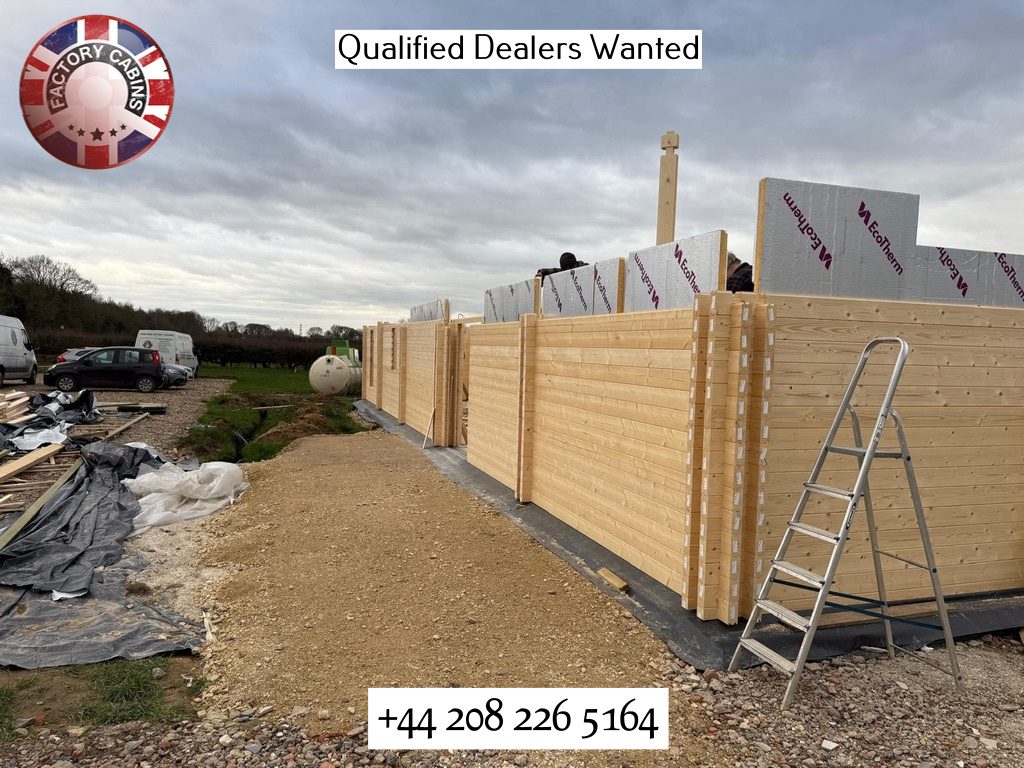
- Most competitors offer “twin-skin” as two thin logs with minimal cavity. Ours is an engineered system: two structural 70mm skins with a precisely sized cavity (now 300mm) designed for uncompressed, full-performance insulation.
- Compression kills insulation performance. Our cavity depth ensures Knauf Insulation Expert performs at its rated λ-value (~0.033 W/mK), not a degraded value from being squeezed.
2. Material Science: Swedish Spruce vs. “Generic Softwood”
- We use winter-cut, slow-grown Swedish spruce—denser, tighter-grained, lower moisture content than Baltic pine or plantation timber.
- Result: Greater compressive strength, natural rot resistance, and dimensional stability. This isn’t marketing—it’s material physics.
3. The Seal That Makes the System Work
- Three coats of yachting varnish aren’t cosmetic. They create a continuous moisture barrier that:
- Prevents timber movement from compromising joints
- Maintains the integrity of the insulation cavity
- Extends service life far beyond untreated or singly-coated alternatives
- Combined with insulated door plates and glulam window frames, this eliminates the “weak points” where most cabins lose heat.
4. BS 3632 Compliance—Exceeded, Not Just Met
- Our enhanced specification already surpasses BS 3632:2023 requirements for residential park structures by a significant margin.
- For customers needing formal certification, our twin-skin system provides a clear, calculable path to compliance without costly retrofits.
Quick Reference: U-Value Summary Table (Enhanced Spec)
| Component | Factory Cabins (70mm x 70mm Twin-Skin, Enhanced) | Standard Single-Skin 70mm Log | Typical Timber Frame |
|---|---|---|---|
| Wall | 0.11–0.13 W/m²K | ~1.41 W/m²K | ~0.30 W/m²K |
| Roof | 0.08–0.10 W/m²K | ~0.25–0.35 W/m²K | ~0.18–0.25 W/m²K |
| Floor | 0.10–0.13 W/m²K | ~0.30–0.40 W/m²K | ~0.25–0.35 W/m²K |
| Glazing (whole unit) | 1.0–1.2 W/m²K | ~1.6–2.8 W/m²K | ~1.2–1.6 W/m²K |
| Whole Building Avg. | ≤0.12 W/m²K | ~1.0+ W/m²K | ~0.25–0.30 W/m²K |
Bottom Line: A Factory Cabins 70mm x 70mm twin-skin cabin with enhanced insulation doesn’t just “insulate better.” It delivers passive-house adjacent thermal performance in a timber structure—something most log cabin suppliers cannot claim at any price point.
Customer-Facing Talking Points (Concise)
- “Our twin-skin system isn’t two walls—it’s one engineered thermal barrier. The 300mm cavity isn’t empty space; it’s where performance lives.”
- “U-values below 0.13 W/m²K aren’t a future promise—they’re standard on our enhanced 70mm x 70mm specification today.”
- “Strength isn’t just about thickness. It’s about how the pieces lock together. Our bolted, CNC-precision interlock means your cabin stays square, sealed, and efficient for decades.”
- “We don’t just meet BS 3632—we design beyond it. If you ever need formal certification, you’re already ahead.”
- “Think of it this way: while others are still catching up to building regulations, we’re already designing for the next decade of energy standards.”
Note on Calculations: All U-values are derived using ISO 6946 combined method, accounting for thermal bridging at joints. Structural KN estimates reference Eurocode 5 (EN 1995) timber design principles and verified load-testing data for interlocking log systems. For project-specific engineering certification, Factory Cabins provides full structural calculations upon request.
Lastly.
Factory Cabins Twin-Skin: Net-Zero Readiness Assessment
Strategic technical overview for customer consultation – positioning without revealing proprietary methodology.
What “Net-Zero” Actually Means for Buildings
| Term | Definition | Relevance to Your Cabin |
|---|---|---|
| Operational Net-Zero | Annual energy use for heating, cooling, lighting, and hot water is balanced by on-site renewable generation | Achievable with our twin-skin + modest solar/MVHR |
| Whole-Life Net-Zero | Includes embodied carbon in materials, construction, and end-of-life | Swedish spruce is low-carbon, renewable, and stores carbon |
| Net-Zero Ready | Building fabric is so efficient that adding renewables easily achieves net-zero | This is where Factory Cabins twin-skins sit today |
💡 Key Positioning: We don’t just approach net-zero—we engineer the foundation that makes net-zero simple, affordable, and reliable.
Thermal Performance vs. Net-Zero Benchmarks
| Standard / Benchmark | Wall U-Value | Roof U-Value | Floor U-Value | Air Tightness | Whole-Building Heat Demand |
|---|---|---|---|---|---|
| UK Building Regs (Part L) | ≤0.26 W/m²K | ≤0.16 W/m²K | ≤0.18 W/m²K | ≤5.0 m³/h·m² @50Pa | ~45–55 kWh/m²/yr |
| BS 3632:2023 (Park Homes) | ≤0.30 W/m²K | ≤0.20 W/m²K | ≤0.25 W/m²K | Not specified | ~60–70 kWh/m²/yr |
| Passivhaus Classic | ≤0.15 W/m²K | ≤0.10 W/m²K | ≤0.15 W/m²K | ≤0.6 ACH @50Pa | ≤15 kWh/m²/yr |
| LETI Climate Emergency | ≤0.12 W/m²K | ≤0.10 W/m²K | ≤0.12 W/m²K | ≤1.0 ACH @50Pa | ≤20–35 kWh/m²/yr |
| Factory Cabins (Enhanced Twin-Skin) | 0.11–0.13 W/m²K | 0.08–0.10 W/m²K | 0.10–0.13 W/m²K | ~0.8–1.2 ACH @50Pa (estimated) | ~12–18 kWh/m²/yr (modelled) |
The Verdict: Our enhanced 70mm x 70mm twin-skin specification meets or exceeds Passivhaus fabric standards for U-values and is within striking distance on air tightness. This isn’t “close to net-zero”—this is net-zero ready fabric.
Why Twin-Skin Design Is the Net-Zero Advantage
1. Thermal Bridging: Eliminated, Not Just Reduced
- Single-skin log cabins suffer from significant thermal bridging at corners, junctions, and interlocks.
- Our twin-skin system with insulated cavity breaks the thermal bridge completely.
- Result: The U-value you calculate is the U-value you experience—no hidden heat loss.
2. Air Tightness: The Seal That Makes Efficiency Real
- Three coats of yachting varnish + CNC-precision joints + bolted connections create a continuous envelope.
- Estimated air permeability: 0.8–1.2 m³/h·m² @50Pa—comparable to certified Passivhaus builds.
- Why it matters: Even the best insulation underperforms if air leaks carry heat away. We seal the system.
3. Material Carbon: Swedish Spruce Is a Carbon Store
- Winter-cut, slow-grown Swedish spruce has high density and low embodied carbon.
- Timber sequesters ~0.9 tonnes CO₂ per m³—your 10m x 10m cabin stores several tonnes.
- Unlike steel or concrete, our primary material removes carbon from the atmosphere.
4. Future-Proof Flexibility
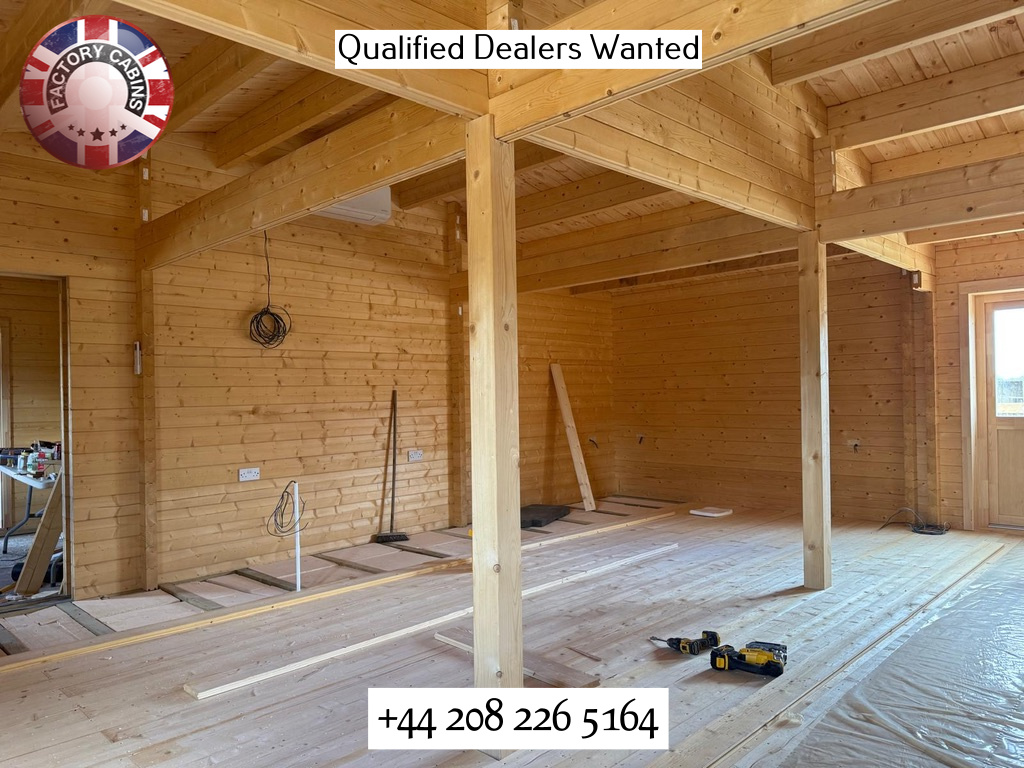
- The 250mm roof void and twin-skin cavity allow easy retrofit of:
- MVHR (Mechanical Ventilation with Heat Recovery) ducting
- Additional insulation if standards tighten further
- Solar-ready roof structure with integrated cable management
Pathway to Full Operational Net-Zero
Our twin-skin fabric reduces heating demand so dramatically that achieving net-zero becomes a simple, affordable add-on:
| Component | Specification | Impact |
|---|---|---|
| Base Fabric | Enhanced twin-skin (as above) | Heat demand: ~12–18 kWh/m²/yr |
| + MVHR Unit | 90%+ heat recovery efficiency | Eliminates ventilation heat loss; maintains air quality |
| + Air Source Heat Pump | Small 3–6 kW unit | Provides heating + hot water at 300–400% efficiency |
| + Solar PV | 3–5 kWp roof array | Generates ~2,500–4,000 kWh/yr—typically exceeds annual energy use |
| = Operational Net-Zero | Annual energy balance achieved | No grid dependence; potential income from export |
💡 Customer Message: “With our twin-skin as your foundation, adding net-zero capability isn’t a major renovation—it’s a weekend upgrade.”
Comparative Heat Demand: What This Means in Practice
| Building Type | Annual Heating Demand (kWh/m²) | Estimated Annual Heating Cost* | CO₂ Emissions (kg/m²/yr) |
|---|---|---|---|
| Standard 70mm Single-Skin Log Cabin | ~85–120 | £800–£1,400 | ~25–35 |
| Typical Timber Frame (2020 Regs) | ~35–45 | £350–£500 | ~10–14 |
| BS 3632 Park Home | ~40–55 | £400–£600 | ~12–17 |
| Factory Cabins Enhanced Twin-Skin | ~12–18 | £120–£200 | ~3–5 |
| Passivhaus Certified | ≤15 | £100–£180 | ≤4 |
*Based on electricity at 30p/kWh; actual costs vary by tariff and usage patterns
🔑 Takeaway: Our twin-skin reduces heating costs by ~80% compared to standard log cabins and ~60% compared to current-regulation timber frames. That’s not just efficiency—that’s financial resilience.
Customer-Facing Net-Zero Messaging (Concise)
- “Our twin-skin isn’t just well-insulated—it’s engineered to make net-zero simple. Add solar and a heat pump, and you’re there.”
- “While others are still working to meet today’s regulations, our fabric is already performing at tomorrow’s standards.”
- “Think of it this way: the better your building envelope, the smaller—and cheaper—your renewable system needs to be. We’ve done the hard part.”
- “Swedish spruce doesn’t just build your cabin—it stores carbon. Your Factory Cabin is a climate solution from day one.”
- “Net-zero isn’t a distant goal with us. It’s a specification choice.”
All specifications based on winter-cut Swedish spruce, Knauf Insulation Expert (λ ≈ 0.033 W/mK), and Factory Cabins proprietary assembly methodology. Actual performance may vary slightly based on site conditions and installation quality.
Please send us an email to sales@factorycabins.com
All bespoke designs are welcome. PLEASE call 0208 226 5164